
The following response was received from the Minister for Fire and Emergency Management, Local Government, Mark Shelton
We have had advice from TFS which is unchanged to what has previously been provided. The advice is there is an abundant supply of water sources in the area and that the loss of the Waratah Reservoir would have no impact on TFS aerial firefighting capability. Noting that the Waratah Reservoir is only accessible by aerial appliances, a tanker would not be able to access this water source.
This information has been provided to Minister Ferguson as the Minister responsible for TasWater.
I responded as follows, after considerable dialogue within the Waratah community:-
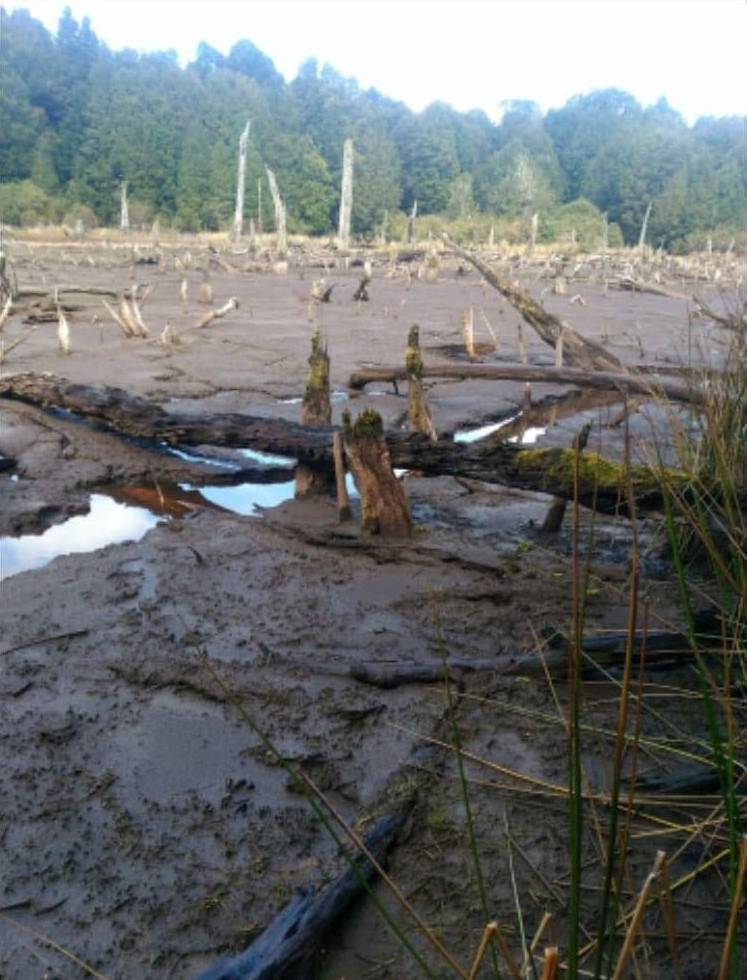
The drained Waratah Dam, 2017.
Minister, thank you for your email outlining the TFS response to my Tasmanian Times article Dam(n) Waratah.
With all due respect the response does not actually meet reality, nor does it describe the dramatic impact on the reservoir, or the community of Waratah, that TasWater has had since it acquired its role in 2013.
A far from complete description is as follows:-
In 2017, without community consultation or advice, TasWater both reduced the level of and widened the spillway of the reservoir (which it DOES NOT OWN).
Up until that time there was an ability for TFS appliances to draw water from the reservoir. However, it is now not accessible since the water level was dropped in 2017.
Clearly the reservoir is needed for firefighting by appliances in summer, not winter and it needs to be reinstated to prior 2017 level.
This ensures that appliances are not travelling all the way into Waratah to lift water up from bottom lake located in the centre of town, which is full of tourists in summer, with vehicles parked everywhere. A completely unsafe practice with tankers driving in and around the town centre and further distances to travel to refill.
It must also be noted that the Waratah River/ spring stops flowing at height of hot dry summer; water in the Bischoff Reservoir drops very low in hot dry summer as the creek that supplies also dries up. The wall is weight restricted and operators have stated unsuitable for choppers to lift water and with too many logs.
Waratah Reservoir is ideal for water storage for boosting town dam in summer as well as being best safest easily accessible place for fire appliances to lift water.
The TasWater pumps have already failed when they sucked air due to water level dropping. No water into lake, water coming out of lake, equals water levels dropping, which means no reliability of mains water.
While aerial views of the lakes in the Waratah region suggest an abundance of water is available for aerial tankers, the reality, ignored by your TFS advice, is that they are shallow and full of silt. Nothing in and water out equals lowered water levels. We are right at top of the catchment, so while called Waratah River it is only spring-fed from couple kilometres upstream.
During the fires of summer 2018/19, I am told choppers had to lift from a water source past Parrawee, some 15kms distant, because the prospect of four helicopters working in centre of Waratah would have been untenable; they would have been working dangerously right beside homes, tourists and campers. But a chopper has lifted from town because there was no other choice but as a Minister, I am sure you would decry this!
TasWater MUST remediate the dam it does not own, but still destroyed and thereby allow future tourists to view, fish, watch unique animals and the environment.
Just imagine the $$$$ increments to flow to the community, as a result of that – ask (Tourism Industry Council of Tasmania) Luke Martin!