On 15 August 2020, the Acting General Manager Corporate and Community Relations Ruth Dowty issued a media statement indicating TasWater would proceed with decommissioning the Waratah Reservoir.
“Decommissioning the Waratah Dam
Following an extensive search to find a new owner for the Waratah Dam, including two Expression of Interest processes, TasWater will now move to decommissioning the dam.
Acting General Manager Corporate and Community Relations Ruth Dowty said the preferred position for TasWater, Waratah Wynyard Council and State Government was to find a new owner for the dam.
“We all worked closely together throughout this process as we know the dam is highly valued by the community. We’ve done everything we can to find a new owner,” Ms Dowty said.
The dam has not been used as a water supply for years and is no longer operationally required. It is also not compliant with modern dam safety standards or essential for firefighting.
“To keep the dam, it would be mandatory to undertake a multi-million-dollar investment to bring it up to current standards and we are responsible for spending our customer’s money wisely, especially in the current environment.”
The picturesque Waratah Waterfall in the town will not be affected when the dam is decommissioned.
We will continue to keep the community informed as we work through the decommissioning process.”
There are a number of incorrect or misleading points in this statements as follows:-
1 – Not needed for drinking water supply
Even as a recent resident I know it is, and the reservoir is a reserve for the town lakes. I understand that a previous TasWater answer to a question about supply concerns during dry times was they would provide residents with bottled water.
2 – Not needed for firefighting
As well documented, the treatment plant cannot cope with large demand and shut down when water was attempted to be drawn from the mains. During a potential major fire on the edge of town residents had no water supply. This was a real experience and not based on modelling. The reservoir has the only ramp access for a fire truck to get to the dam edge to draw water efficiently to fill their tank. See commentary below from Waratah TFS.
An Infrastructure Tasmania Report which is from around 2017 documents ‘accelerated’ programs for TasWater to deliver projects.
In this, the spend for Waratah is listed to be achieved by 2022 and is budgeted at $1.35 million. There is also a budget for ‘non network other’ for the entire state of around $7 million plus minimum per year which I gather is a contingency fund for unexpected expenditure.
It appears Waratah residents are the affected end users of an arbitrary decision on a 10-year plan; they have plenty of our money.
Perhaps the most relevant commentary is the following from the Waratah Volunteer TFS:
“The TFS points out, that the Waratah Reservoir. during a dry summer, when the level is where it was post 2017, it is impossible to draw water from, for fire appliances.
The spillway totally drying up is not uncommon during hot dry summer in Waratah area, which at the same time is at the greatest risk from vegetation fires.
Fire appliances cannot use Bischoff Reservoir, as the stone dam wall has weight limit and has been damaged from heavy water tankers tramping over it from past Mt Bischoff mining activities. Also, the level drops dramatically during summer.
Dams in Waratah. Water bombing choppers use lower dam to lift from. Fire appliances and all people and vehicles need to keep well clear of choppers working around and over the lower dam. Choice for appliances to fill is either water mains, or direct from top lake, Waratah Dam, water held back by the timber weir, and where TasWater also draws water from for town water supply.
During hot dry summer weather when Waratah River stops flowing, as happened January-February 2019, more water is taken by the treatment plant than is replaced naturally and the treatment plant pump draws air, causing the pump to shut down.
Air in the lines supplying the town causes water hammer thus blowing out hydrants, pipes etc. Lengthy repairs are then required and the town is without water.
Water released as needed from a fully functioning Waratah Reservoir storage upstream will solve these problems.
Into the future, the Tasmania Fire Service plan is bringing in and utilising more and more water bombing choppers for bushfire fighting. These need a water source close by that is also safe and suitable for choppers to fill from, during summer when water levels are notoriously low.
Distance to be travelled for choppers increases time between water bombing and increases refueling intervals. Time and water availability are directly related to control or loss of control of bushfires.
We are surrounded by huge areas of Eucalyptus nitens plantations and these are highly volatile during hot dry weather. Firefighting by water bombing choppers will be required to deal with bushfires in and threatening these plantations.
The stuff of nightmares for TFS volunteers”.
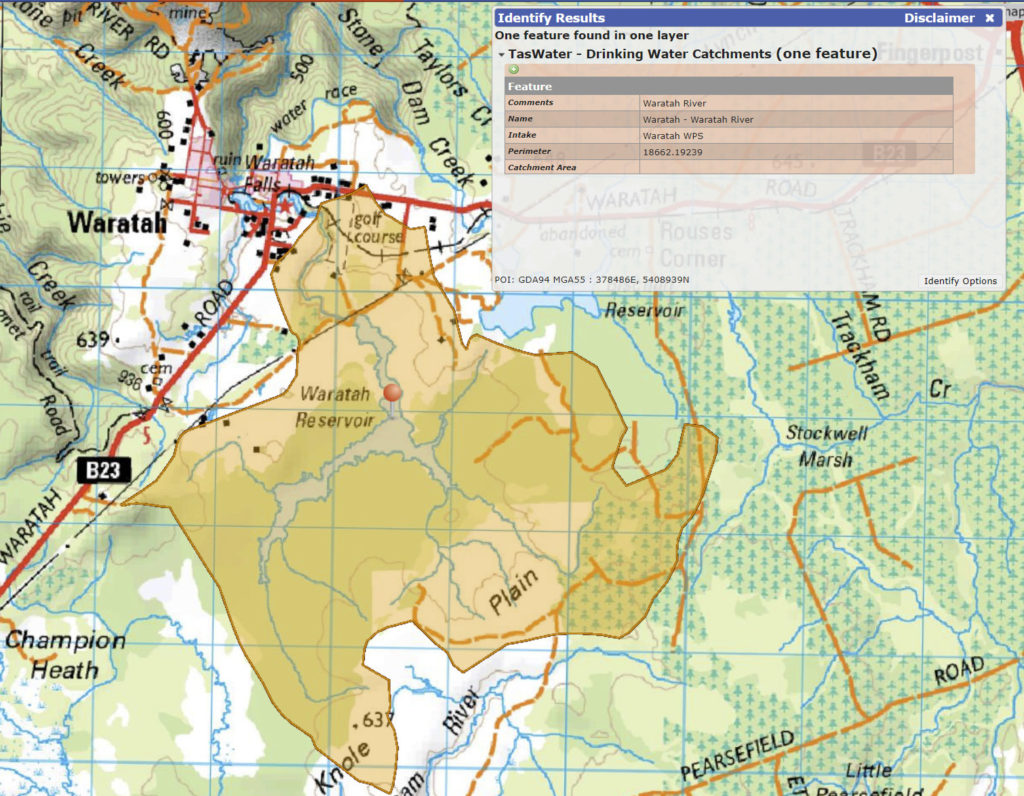
And to finalise the concern I attach a copy of a LIST map (see below) which shows the Waratah River catchment as ‘TasWater Drinking water catchment’.
And by the way despite the best efforts by TasWater, I am reliably told the Dam’s tenure is still Crown Land (Public Reserve) with the Administrative Authority listed as administered by the Department of Primary Industries.
Thank you, Mike Brewster, PhD OH&S.
DUH!