Opinion piece – Independent Member for Clark, Helen Burnett MP
The latest Annual Electricity Report from the Tasmanian Economic Regulator and the recently released report of Professor Bruce Mountain, Director of the Victorian Energy Policy Centre should prompt a serious rethink of some of the assumptions underpinning Tasmania’s energy future, and who pays.
For years, Tasmanians have been told that Marinus Link will unlock enormous opportunities by allowing us to export clean renewable energy to the mainland at significant profit while supporting new industries at home. Yet the regulators latest figures paint a very different picture of Tasmania’s current energy position.
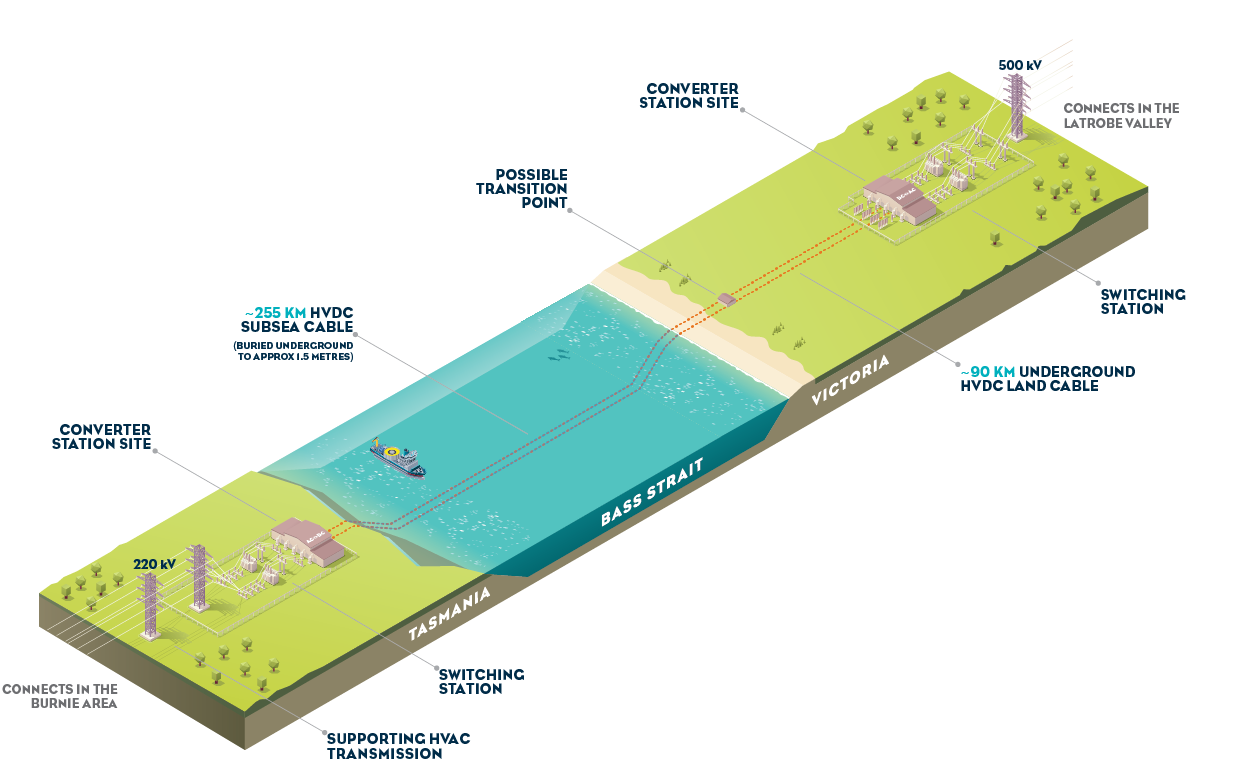
At a projected cost of 5 to 6 billion dollars, including associated transmission developments in the Northwest, Marinus Link is one of the largest infrastructure investments in Tasmania’s history. The question is: will there be enough surplus electricity to justify it?
The Governments own Whole-of-State Business Case acknowledges that major industrial customers face substantial increases in transmission charges because of Marinus Link.
Treasury modelling suggests additional network costs of up to $20 million per year under Stage 1, with further increases if Stage 2 proceeds. TasNetworks is expected to run at a loss for decades, copping hundreds of millions of dollars in debt.
These costs are no longer theoretical. This year’s State Budget includes millions of taxpayer dollars shielding major industrial customers from increased electricity costs associated with Marinus Link, and a $170 million dollar equity injection for TasNetworks. While support is being offered to major industrials and TasNetworks, no similar protection has been promised to households and small businesses, despite the likelihood that they too will face higher network costs as the project proceeds.
Similarly, this week the Tasmanian Economic Regulator has said that our power bills will be going up by more than 4% – an extra $100 per month – when most power bills around the country are going down. The increase is in part due to the $160m in early works for the North West Transmission Development that TasNetworks will recover through an increase in the network costs in your power bills over the next 3 years.
But wait there is more. By 2029, TasNetworks want to recover over $900m for Marinus Link and related infrastructure from your power bills, which will drive up average power bills by another $50 per year, but very likely more. This is money you will have to pay, just so we can import more power for the data centres the Government is wanting to attract to the State.
The latest electricity report raises even more fundamental concerns. On-island generation fell by 10.1%, and gas-fired generation increased by more than 30%. Hydro production fell by 15% because of low flows in Hydro Tasmania’s catchments. To compensate, a record 1,967 gigawatt hours of generation was imported via Basslink. In fact, Tasmania has been a net importer of electricity for most of the past five years, exporting more than it imported only once, in 2021-22. Over the same period, hydro generation has steadily declined while gas consumption has increased dramatically.
These are not the figures of a state overflowing with renewable energy. At stake is Tasmania’s clean energy reputation which rests heavily on hydro-electricity.
If Hydro is already managing generation conservatively to maintain energy security, where will the additional electricity come from to support large-scale exports through Marinus Link?
What about future industry demand on-island? The State Government is actively pursuing new energy-intensive industries like AI data centres which require vast amounts of reliable, dispatchable power operating around the clock. This will further reduce the amount of hydro- electricity available to export to the mainland.
Before Tasmania commits billions of dollars to a second interconnector designed largely around exports, there needs to be a frank discussion about whether we will actually have enough electricity to meet our own future needs.
There are positive signs. Rooftop solar generation increased by almost 13 per cent during the year, supported by thousands of new installations. Over the past four years, the number of customers with solar systems connected to the grid has increased by around 30 per cent.
Much of this electricity is consumed behind the meter, reducing demand on the network and helping households to slash their own power bills.
That points towards an alternative pathway worthy of greater attention. Expanding rooftop solar, community batteries, local storage and energy efficiency measures could improve energy security, reduce reliance on gas and lower demand on the grid without requiring a multi-billion-dollar interconnector.
And yet the State Government has abandoned its interest free loans for households and small businesses wanting to install rooftop solar, while the NSW Government has announced an interest free loan for energy efficiency upgrades that even renters and landlords are eligible for. It would seemingly prefer to underwrite major industrials and GBEs than to help lower Tasmanians’ power bills.
Supporters of Marinus Link argue increased interconnection will allow Tasmania to import cheaper mainland electricity when prices are low. But that benefit must be weighed against the enormous cost of the project, the risk of higher power bills to pay for it, and the growing evidence that Tasmania may not have the renewable energy surplus that has long been assumed. The recently released report of Professor Bruce Mountain, Director of the Victorian Energy Policy Centre, concludes “Marinus Link will impose very large needless costs on electricity consumers and taxpayers.” While Saul Eslake rightly suggests Marinus Link is in the national interest, Tasmania’s energy policy should begin with a simple question: how do we provide reliable, affordable and low-emissions electricity for Tasmanians first?
The latest Regulators report does not describe a state awash with excess renewable energy. It describes a system increasingly dependent on imports, increasingly reliant on gas generation and facing growing uncertainty about future supply. That’s why I’ll be asking for transparency from the government about its energy plan, before it’s too late to turn back.