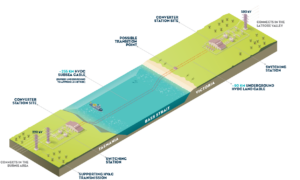
Around 35,000 years ago, Aboriginal people occupied Flinders Island, which at the time wasn’t an island at all – it formed part of a land bridge connecting Tasmania and mainland Australia. Rising sea levels eventually flooded the land bridge, separating Tasmania and Flinders Island from the mainland. Aboriginal people did not remain on Flinders Island, possibly due to environmental changes and a lack of fresh water.
In 1773, British navigator Tobias Furneaux sighted Flinders Island while accompanying James Cook on his second voyage of discovery, though he did not actually set foot on the island. The Furneaux Islands were later named after him.
Twenty-four years later, in 1797, the merchant ship Sydney Cove was wrecked off nearby Preservation Island. This led to the development of sealing in the Furneaux Islands, as well as a seal-skin export trade.
British naval officer Matthew Flinders charted the islands between 1798 and 1799, discovering Bass Strait in the process. At the time, European settlers believed Tasmania was connected to the mainland. Flinders Island was later named after him.
During the early 1800s, European sealers set up camps on Flinders Island and the other Furneaux Islands. Many of them formed families with Aboriginal women, creating a mixed-heritage community often called ‘the Straitsmen’.
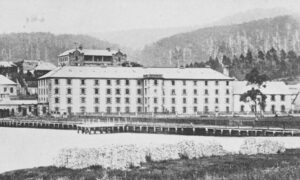
Following the Black War, the colonial authorities in Van Diemen’s Land began relocating surviving Aboriginal Tasmanians to the Furneaux Islands. In 1833, they established the Aboriginal settlement of Wybalenna and exiled around 200 Aboriginal people there under the supervision of George Augustus Robinson. Unfortunately, the mortality rate at Wybalenna was high due to disease, poor living conditions and cultural suppression. The settlement closed in 1847, and the remaining population was moved to the Oyster Cove area near Hobart.
After this, European settlers began establishing farms on Flinders Island, with sheep grazing and small-scale agriculture becoming the main industries. The towns of Whitemark and Lady Barron also sprang up as local service centres and ports.
In the 1910s and 1920s, the Tasmanian Government encouraged the expansion of farming on Flinders Island. After World War II, the Soldier Settlement Scheme provided land on the island to army veterans.
In 1999, the government returned the Wybalenna settlement site and some of the land surrounding it the Tasmanian Aboriginal community. This followed decades of growing recognition of the historical importance of Wybalenna and Aboriginal heritage on the island.
Today, Flinders Island has a population of around 800 people, with one of the highest proportions of Aboriginal residents in Tasmania. Tourism and agriculture are key parts of its economy.
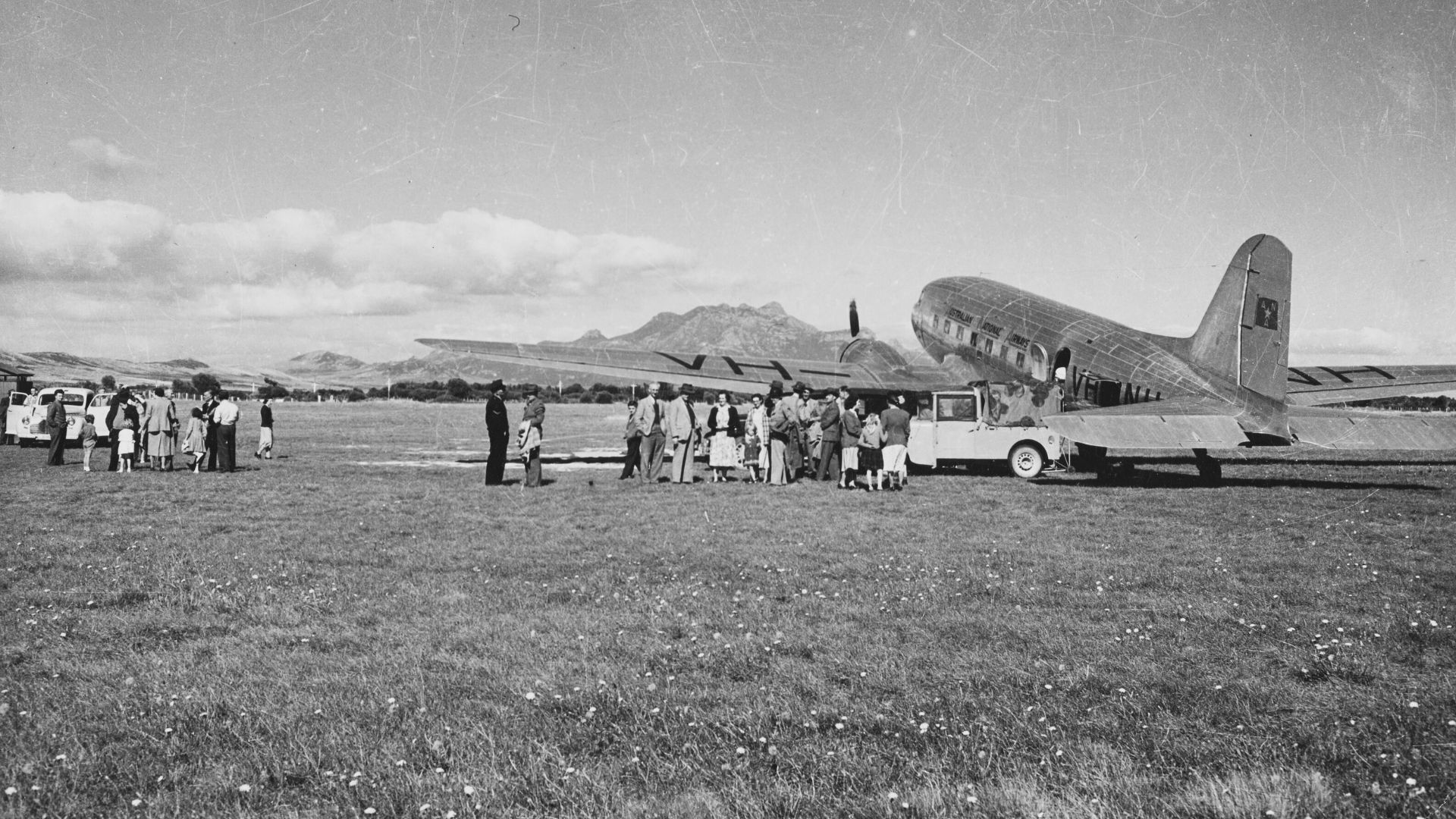
A plane on Flinders Island (1949).
References & Bibliography
- Furneaux History (Flinders Council)
- See Australia’s wild beauty – and dark history – on its newest Great Walk (National Geographic Society)
- Historic Aboriginal mission grounds damaged in act of vandalism (Herald Sun)
- ‘Time to move on’: Flinders Island councillor pushes to scrap Welcome to Country (news.com.au)
- History of Flinders Island
- Flora and Fauna of Flinders Island
- Soldier Land Settlement Scheme (State Library and Tasmanian Archives Blog)
- Furneaux Group (Companion to Tasmanian History)
Tas That Was is a column that includes:
- anecdotes of life in Tasmania in the past;
- historical photographs of locations in Tasmania; and/or
- documentaries about locations in Tasmania.
If you have an anecdote or photograph you’d like to share with us, please send it to [email protected].
Callum J. Jones is passionate about telling stories. He studied English, History, and Journalism at the University of Tasmania and lived in Western Sydney from 2022 to 2024 while working as a journalist for Professional Planner, a leading online publication for financial planners. Callum has written for Tasmanian Times since 2018 and has also been published in a range of other outlets, including Quadrant and the BAD Western Sydney anthologies.