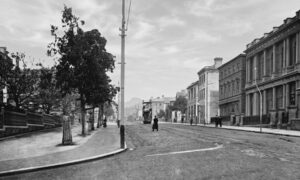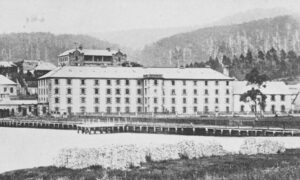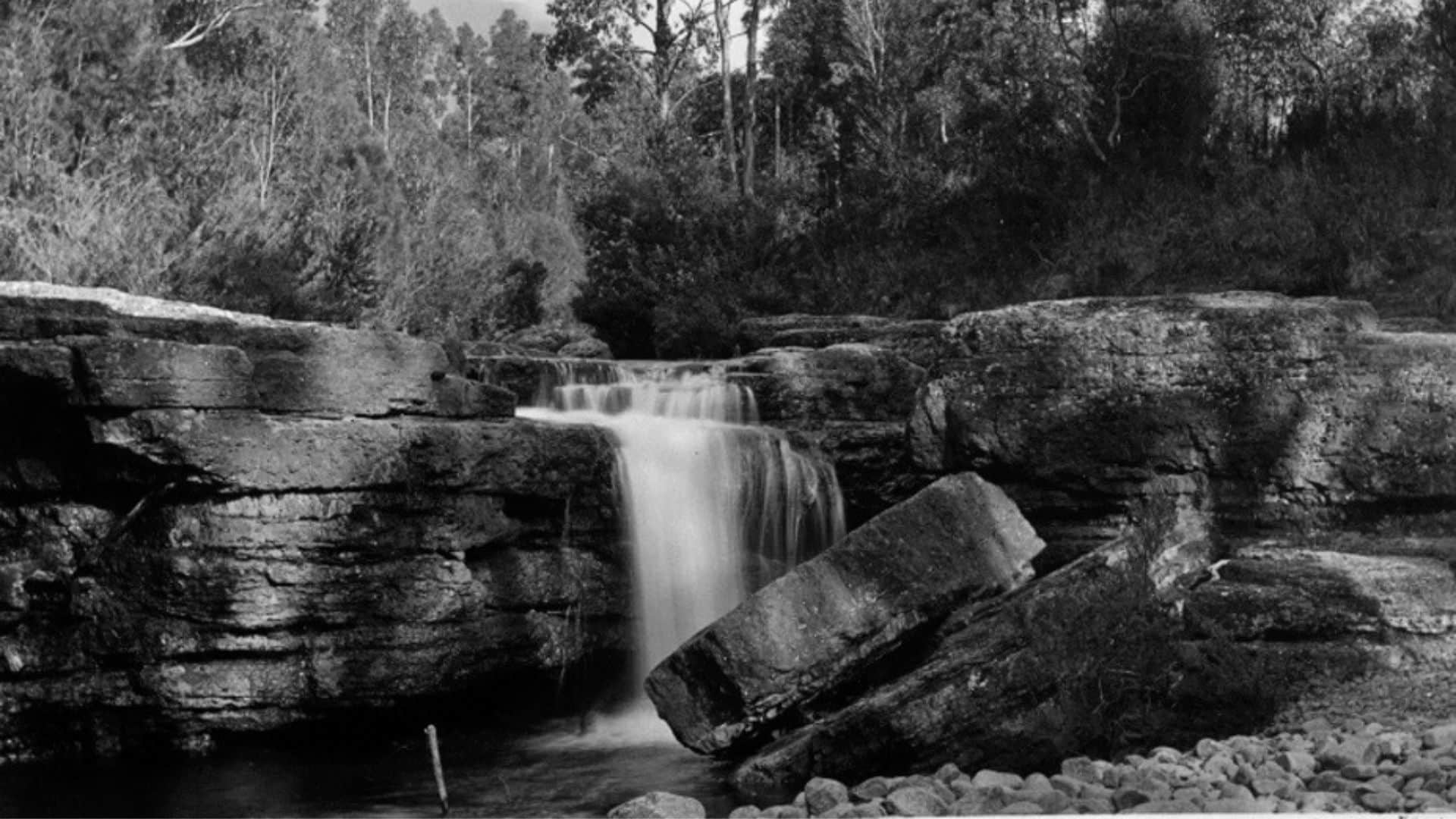
Humphreys Rivulet is less well known than the Hobart Rivulet, but it has played an important role in the history and development of Glenorchy.
For thousands of years prior to British colonisation of Tasmania in 1803, the rivulet formed flowed through the traditional country of the Mouheneener people. It provided them with fresh water and formed part of a broader cultural landscape.
During the early European surveys of the Derwent estuary between 1798 and 1803, the waterways descending from kunanyi / Mount Wellington, including Humphrey’s Rivulet, were mapped and named. The rivulet was originally Duke’s Rivulet, after the Duke of Clarence, the vessel commanded by explorer and surveyor John Hayes.
Following the establishment of Hobart at Sullivans Cove in 1804, land to the north of the new settlement was gradually occupied by settlers, including ex-convicts and people who had relocated from Norfolk Island. They established farms around Humphreys Rivulet and other nearby waterways because these areas provided reliable fresh water, fertile soils, and easily accessible routes through otherwise heavily wooded terrain.
When the municipality of Glenorchy was created in 1864, Humphreys Rivulet had already become one of the area’s most defining geographical features, influencing property boundaries, roads, and industrial sites. Flowing from the slopes of kunanyi / Mount Wellington and Mount Buller, it passed through Glenorchy and Montrose before entering the River Derwent near Elwick Bay.
By the late 19th century, sections of the rivulet had become popular recreational spots, complete with picnic areas and walking tracks.
The most dramatic event in the rivulet’s history occurred in June 1872, when a large debris flow thundered down the slopes of kunanyi / Mount Wellington and swept through Glenorchy at an estimated speed of 55 kilometres per hour. Homes and properties were destroyed, parts of Glenorchy were buried underneath debris, and one person was killed. Modern geologists have come to use the 1872 debris flow as a reference point for understanding debris flow hazards in the Hobart region.
As Glenorchy evolved from an agricultural district into an urban suburb of Hobart, bridges, roads, drainage works, and surrounding development altered sections of Humphreys Rivulet. Despite these changes, much of its upper catchment remained relatively undisturbed.
Following World War II, residential subdivisions expanded around the rivulet, reducing vegetation in some parts of it. Increased stormwater runoff, erosion, and the spread of invasive weeds became ongoing environmental challenges.
In 2013, the Glenorchy City Council commissioned a detailed concept study for a shared-use pathway along the rivulet. The proposal aimed to transform the waterway into a major recreational and active transport corridor connecting Tolosa Park, mountain bike trails, and the Glenorchy CBD. The project remains under development.
Four years later, in 2017, local residents reported the presence of platypuses in the rivulet, drawing attention its ecological value as well as its declining condition. Community volunteers subsequently organised clean-ups that removed rubbish, tyres, scrap metal, and other waste from the stream corridor.
Restoration, revegetation, and public access projects along Humphreys Rivulet continue to this day.
References & bibliography
- ‘To Investigate Riculet’, The Mercury, Thursday 19 November 1953, page 29
- Humphreys Rivulet Path (Glenorchy City Council)
- Humphreys Rivulet path answer to Tolosa St troubles (Bicycle Network)
- Wild about waterways: Nature triumphs in $2 million rivulet rewilding (City of Hobart)
- Community cleaning up a Glenorchy rivulet to protect shy resident platypus (ABC News)
- Bushland and foreshore reserves (Glenorchy City Council)
- History of Glenorchy (Glenorchy Community)
- The Glenorchy landslide of 1872 was a ‘very serious disaster’ and is still used to model future risk (ABC News)
- Hobart’s Rivulets (Our Tasmania)
Tas That Was is a column that includes:
- anecdotes of life in Tasmania in the past;
- historical photographs of locations in Tasmania; and/or
- documentaries about locations in Tasmania.
If you have an anecdote or photograph you’d like to share with us, please send it to [email protected].
Callum J. Jones is passionate about telling stories. He studied English, History, and Journalism at the University of Tasmania and lived in Western Sydney from 2022 to 2024 while working as a journalist for Professional Planner, a leading online publication for financial planners. Callum has written for Tasmanian Times since 2018 and has also been published in a range of other outlets, including Quadrant and the BAD Western Sydney anthologies.
If you’re interested in this article, please join our mailing list. It’s all free … and we won’t share your information with anyone!
If you have any comments you’d like to add to this article, please contribute via this form. We’re trialling this while we work through replacing our comments section.
Truly independent media is a cornerstone of democracy.
Remember: once they gain power the first action of every despot in modern history is to take control of the media, so please consider supporting us.
Your kids will thank you and so will your Granny, but the aspiring despots won’t…