Bruny Island was originally occupied by Tasmanian Aboriginals, specifically the Nueonne tribe. They lived with a strong connection to the land and the sea, and used natural resources for food and culture. Little else is known about their time on Bruny Island because they did not keep written records.
The first European to see Bruny Island was Dutch explorer Abel Tasman in 1642. He charted some of it before heading on his way. In 1772, British Royal Navy officer Tobias Furneaux – who accompanied James Cook on his second voyage of discovery – became the first British person to actually set foot on the island. James Cook himself anchored his ship in Adventure Bay for a couple of days.
People believed Bruny Island was connected to the Tasmanian mainland at first, but when French explorer Bruni D’Entrecasteaux sailed along Tasmania’s east coast in 1792, he discovered that it was actually an island. Both Bruny Island and the channel separating it from mainland Tasmania were later named after him.
Bruny Island was opened up for whaling, grazing, agriculture, and timber harvesting after the British settled Tasmania in 1803. Agriculture and timber harvesting went on to become its primary industries in the twentieth century, with tourism also becoming ‘a thing’.
Today, Bruny Island is well-known for its ‘eco-tourism’ and food products. It is accessible via a ferry service from Kettering.
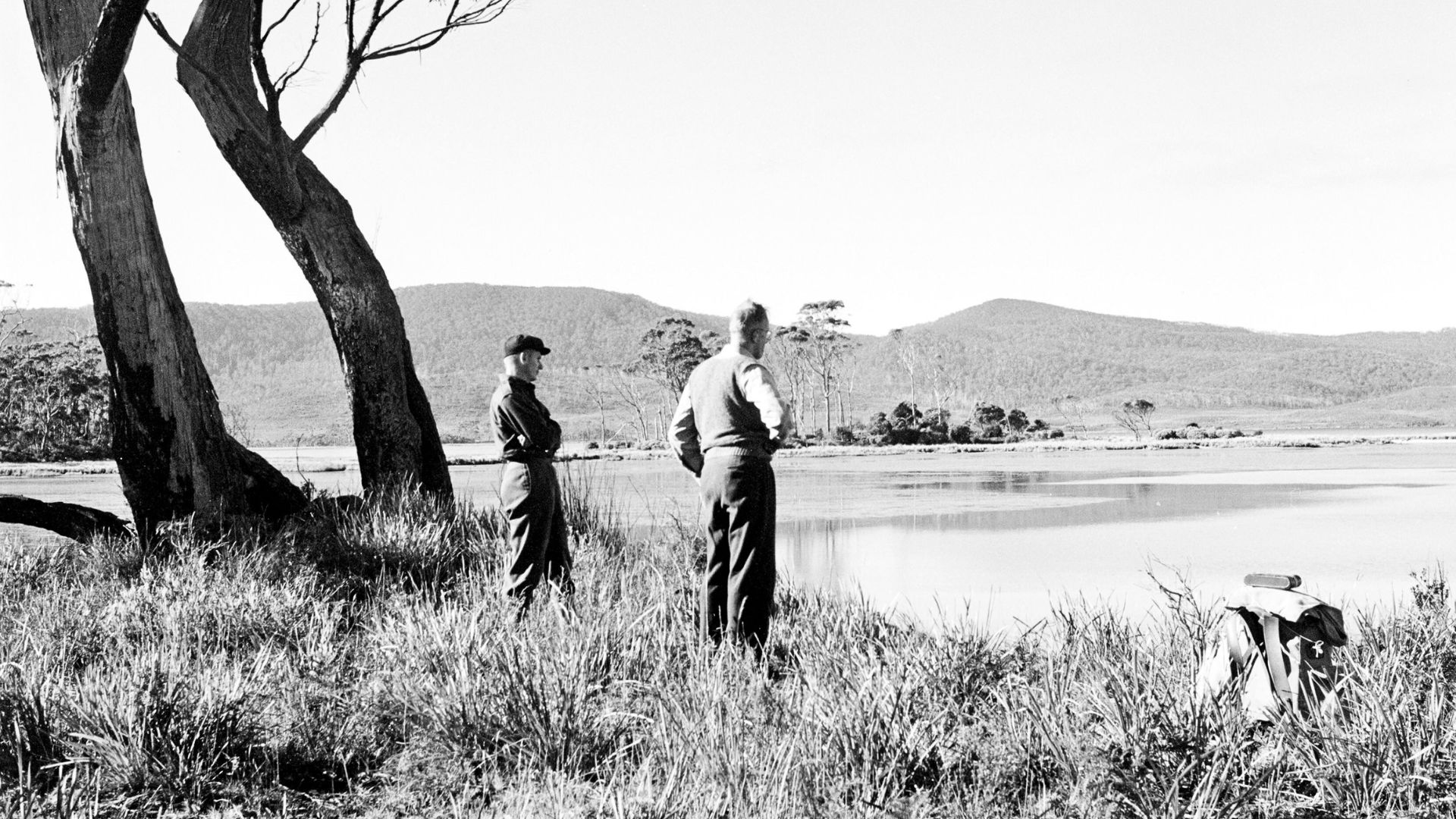
Two men on Bruny Island (1949).
Tas That Was is a column that includes:
- anecdotes of life in Tasmania in the past;
- historical photographs of locations in Tasmania; and/or
- documentaries about locations in Tasmania.
If you have an anecdote or photograph you’d like to share with us, please send it to [email protected].
Callum J. Jones is passionate about telling stories. He studied English, History, and Journalism at the University of Tasmania and lived in Western Sydney from 2022 to 2024 while working as a journalist for Professional Planner, a leading online publication for financial planners. Callum has written for Tasmanian Times since 2018 and has also been published in a range of other outlets, including Quadrant and the BAD Western Sydney anthologies.