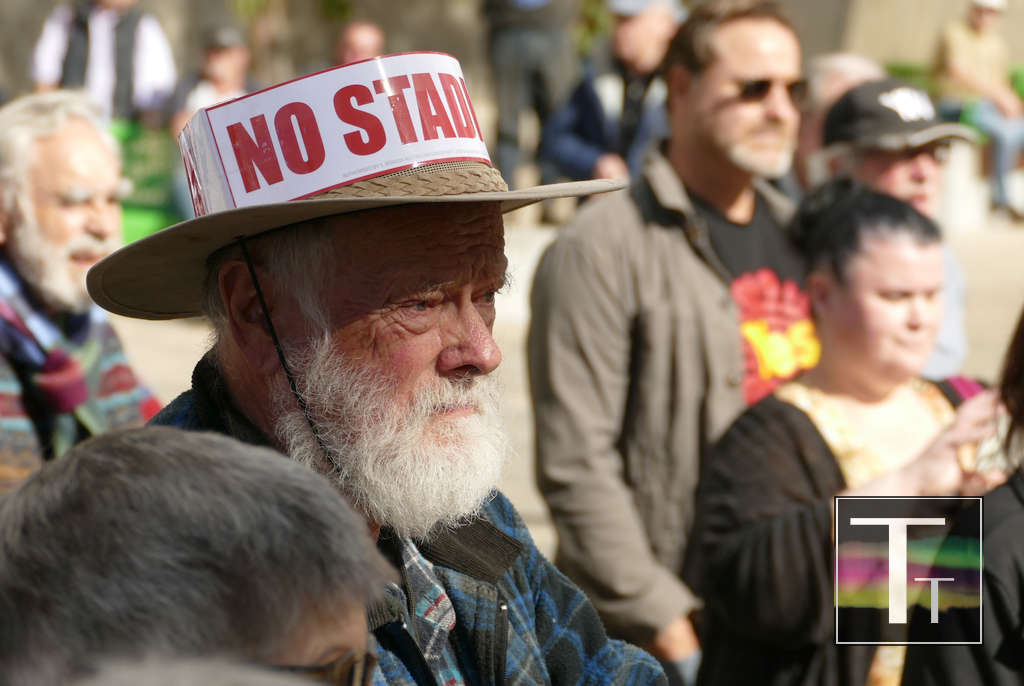
Community advocate Christine Bayley argues the Tasmanian stadium project is fiscally reckless, lacks public support and ignores the original AFL Taskforce’s calls for financial restraint and “proof of concept” before committing billions in taxpayer funds.
Bayley contends that the commitment made by Premier Rockliff poses a long-term financial risk, noting that independent analysis, like that by the Tasmanian Planning Commission, suggests the project’s costs “far outweigh its benefits,” potentially driving up state debt and reducing economic welfare. She calls for an end to the project, urging politicians to prioritise essential services.
I spend considerable time trying to understand government decisions and to help others make sense of them.
The debate over a new stadium continues to dominate public discussion. The Premier accepted terms that most Tasmanians do not support, leaving everyday workers to shoulder the risk of a multibillion-dollar project at a time that Tasmania can least afford risky investment decisions.
Tasmanians still do not understand, or even if they do, do not accept how and why this commitment was made.
Supporters often point to the AFL Taskforce, yet the irony is that the Taskforce demonstrated more financial restraint than many since. Claims that the Taskforce mandated a stadium are simply false. Their recommendations were conditional and aspirational—not binding:
“Upon ‘proof of concept’, a longer-term aspiration should be a roofed, CBD-based ‘Adelaide Oval’ multi-purpose facility.”
In other words, the stadium should only be considered after evidence proves it is viable and needed. Proof of concept for a project of this scale requires 3–5 years of evidence – commercial viability, fan support, sponsorship, broadcast appeal and infrastructure needs—before committing billions of taxpayer dollars.
A membership drive based on $10 “foundation” stickers does not demonstrate genuine community backing.
The Taskforce’s views, that Tasmania’s current facilities were adequate for the early years of a Tasmanian AFL Team, were later endorsed by Former AFL Chief Executive, Andrew Demetriou during the Legislative Council Select Committee Inquiry into AFL in Tasmania.
“What you really want as part of the journey and making sure you are successful is having those stadiums sold out.
A good result would be six games at Launceston getting 21,000, with people not being able to get in and Blundstone for five games having 19,000 sell out and not being able to get in and then membership packages sold at capacity. The club would do very well out of that – the signage, the corporate boxes, dining – it would do well. That might be the catalyst and the demand then compels you to go to a much greater capacity; the next stage is like Geelong, it could go to 25,000; and there might be a second stage and go to 30,000. You don’t have to do it at the beginning. It would be terrible to have a 22,500-seat $500 million investment and be getting 13,000 people there.”
There is also concern about existing stadia. The new Stadiums Tasmania Act 2022 centralises all major venues under a new authority. Yet, the Stadiums Tasmania submission to the Tasmanian Planning Commission was little more than a letter of recommendation, offering no substantive data on current stadia or usage.
How can informed decisions be made without transparency – The Taskforce recommended a statewide stadia review to test demand and value regardless of whether a new stadium is built. Has that been completed?
Public opinion is clear – survey after survey shows a majority of Tasmanians do not support this project.
The July 2025 survey commissioned by the Devils themselves only shows 44% support in Hobart and surrounds, which includes Kingborough, the proposed “home” of the Devils.
A project that cannot secure majority support in the very city where it is being built lacks a social licence.
To date, the AFL Tasmanian Licence Taskforce has been the only financially responsible stakeholder to argue for restraint, proof, review and value. By contrast, in May 2023 the Premier signed a binding contract committing $1–2 billion of taxpayer funding for a 12-year licence—without Cabinet approval, Treasurer consultation, or full legal advice. This “captain’s call” is unacceptable to most Tasmanians.
Premier Rockliff once expressed concern. In August 2022, in response to a letter from Gillon McLachlan, former AFL Chief Executive, the Premier wrote back:
The AFL’s new requirements: “compromise community expectations, sound economic governance and ultimately the sustainability of the club.”
Yet within a year, the Premier abandoned those principles and set Tasmania on a course that poses long-term financial risks for the state.
Proponents claim the stadium will bring major economic benefits—creating jobs, boosting tourism, hosting events and supporting new industries. The government points to an expected lift to Gross State Product and contributions to grassroots sport.
Independent analysis tells a different story. The Tasmanian Planning Commission (TPC) found the stadium’s costs far outweigh its benefits. Its benefit-cost ratio is below 0.5, meaning each dollar invested returns less than fifty cents. The TPC warns the project could drive $1.8 billion in state debt within ten years, forcing tax increases or spending cuts and significantly reducing Tasmania’s overall economic welfare.
While there are some positives, these are tiny compared with the enormous public cost and long-term debt.
The Taskforce advised caution; yet the club and its most vocal backers are prepared to proceed at any cost. And what of the Devils? After receiving millions in establishment funding, there has been little recognition of the burden now placed on taxpayers. All we see is marketing hype.
To the stadium itself – the design itself compounds the financial risk. The proposed partly translucent fixed roof—a concept never before attempted on a stadium of this scale—creates enormous technical uncertainty. It combines the disadvantages of both open and closed venues – higher energy costs, complex turf management and expensive maintenance due to condensation, UV degradation and acoustic control.
Tasmania would become the global test case for an unproven engineering prototype, in one of the smallest markets in professional sport.
A fixed-roof, 23,000-seat “Tier 1” stadium in a state of just over half a million people magnifies every known failure of stadium economics—too expensive, too underused, too risky, and too fiscally damaging. It is a project that delivers global-city costs for regional-market returns. In simple terms, this is economic self-harm.
As political editor David Killick observed:
“Tasmania has a budget crisis with or without the stadium. When you’re struggling to make your mortgage payments, you don’t go out and buy a JetSki.”
If the AFL Taskforce never mandated a stadium, and Tasmanians themselves do not want it, when will the Opposition begin to represent its constituents? There have been some Labor members recently raise concerns —Dean Winter, Shane Broad, Jenna Butler and Ella Haddad. Others remain silent.
Deputy Leader Janie Finlay, back in 2022, condemned the proposed stadium. She warned against being dazzled by “shiny objects” and empty notions of “aspiration” which did not put community first. I agree, too many are distracted by the “big shiny thing”.
Please listen to your community. Every survey shows Tasmanians prioritise essential services over a billion-dollar roof. The choice is clear – continue down a path of costly distraction—or invest in what Tasmanians truly need.
It is time to end the stadium project and restore fiscal responsibility.
Christine Bayley, Community Advocate, Montagu Bay
Tasmanian Times (TT) is a community-based news and current affairs service covering the island state of Tasmania. It exists to provide a diverse presentation of Tasmanian issues. TT creates and supports independent media content utilising the best of modern technologies and tried-and-true practices of public-interest journalism.
Support us in expanding our coverage and developing new content by and for Tasmanians.
New initiatives on the way include … what our contributors and readers suggest! Please get in touch with your suggestions.