
If you are still feeling bewildered by how such an appalling project as a stadium at Mac Point could be approved by our parliament after such a resounding rejection by the TPC and other experts, and despite 60% of the community opposed it, and you have noted that some Tasmanian politicians have come to be held in such low esteem, consider the quality of the discourse surrounding this issue. A master of this discourse has been appointed as holder of the purse strings and minister in charge of the stadium, so understanding the strategies he employs will go some way towards addressing this bewilderment and preparing us for future onslaughts.
Tasmania’s current Treasurer is a Master of Deflection. He rarely gives a straight answer, preferring, “with respect”, to redirect the debate away from ‘uncomfortable’ issues, and heaven knows, we have a plethora of those in Tasmania at the moment. He uses a variety of logical fallacies to achieve this misdirection, sometimes in combination and often with success. Pulling random factoids from the ether and peppering his responses with them, leaves the listen er flummoxed, with insufficient time to check the relevance of what they’re hearing in order to respond in a timely fashion.
In Parliament, he dissembles and distracts until “the member’s time has expired” even when specifically directed by the Speaker to address the topic. In interviews, he works his way through a few of his strategies for deflection, until the interviewer, having asked the same question several times, gives up and moves on to another topic. His self-congratulatory tone and condescension can be galling for those of us who can see through his transparent attempts to pull the wool over our eyes.
In many ways, this approach is reminiscent of a high school debating team entering a competition against another school. They will be required to hold a position on a topic regardless of their personal morality, and to prosecute their case by dismantling their opponents’ arguments to ‘score points’. Minister Abetz’s arguments often strike an equally hollow note despite the outcomes being of far greater significance than who wins the pennant.
These are the strategies and how they work:
- Deflection/distraction, “look over there!” – he picks a semi related or tangential issue and takes the discussion off-course, away from the point under debate. He’ll focus on one word in the question and build his case against it, as if it’s the essence of the argument.
- Cherry Picking – he chooses only the most beneficial terms, opportunities, statistic etc. from the available data as evidence for his claims and ignores the disbenefits. He rarely uses the term ‘net’ because he knows his ‘benefits’ are mostly outweighed by the costs of achieving them. Where his benefits are intangible, or conveniently ‘unquantifiable’, no mrention is made of the equally intangible disbenefits.
- Whataboutism – he responds to a difficult question or accusation by making a counter-accusation or raising an analogous issue, regardless of its validity, accuracy or relevance.
- Strawman/ putting words in their mouths/rephrasing the debate – he creates a distorted, weaker version of an argument (the “strawman”) and then attacks that rather than the actual, stronger one.
- Ad hominem – he attacks a person’s character or credibility, making the argument about their motives or background to discredit the argument itself; this is a common logical fallacy in a debate, used to invalidate a claim without actually addressing its truth.
- Shooting the messenger – he uses what are often broad, emotional reactions to bad news, to punish the bearer of information (the messenger) rather than dealing with the news or its source. Like ad hominem it involves shifting the focus from the message to a person, thereby avoiding the issue entirely. Avoidance leads to denialism, one significant interpretation of which is that it is irrational, which means it is behaviour resulting from underlying unconscious drives or processes. Eric A deliberately plays on these unconscious drives.
- Generalisations – he draws a broad conclusion about an entire group or phenomenon based on a small, insufficient, or unrepresentative sample of evidence. The unrepresentative group is presented as if it is representative, and then it is criticised to produce general propositions that are claimed to apply to the entire group
- Anecdote vs statistical significance – he pretends that his personal experience with one or two examples outweighs all his opponents’ years of research and analysis – the “pub test” or the “kitchen table test”. In the social sciences, for example, this is called, mockingly, ‘n=1’. In other words, the sample size is so small that the analysis lacks any credibility.
- Slippery slope/catastrophising/domino effect – he predicts that one initial action will inevitably trigger a chain reaction of increasingly negative or extreme consequences, with no evidence that each step will happen, and then asserts that the final, worst outcome is unavoidable. He presents an exaggerated hypothetical sequence of events as fact, ignores possibilities for intervention, and assumes an inevitable conclusion. The catastrophic effect is generated by the (hidden) assumption that there are causal relations between the events in the chain. These causal relations are never demonstrated, of course, because they don’t exist.
- False dilemma/false dichotomy – he pretends that only two opposing options or outcomes are possible when, in reality, there are often multiple alternatives worthy of consideration.
- Authority vs Expertise – he adheres to the opinion of someone in authority simply because of their status, as evidence for a claim, even when that individual is not an expert in the relevant field, or when their opinion goes against the general consensus of experts in that field.
- Bandwagon Fallacy (Appeal to Popularity) – he argues that a claim must be true or good simply because many people believe it or are doing it.
- False Cause Post Hoc Ergo Propter Hoc/coincidence = causation – he implies that because one event happened after another, the first event must have caused the second. The simplistic association of ideas is still a feature of our unexamined thinking. We tend to associate ideas that are similar in kind, that occur close together in time, and/or that generate strong affect (feelings). These are played upon in modern politics and social media (eg. autism caused by fluoridated water).
- Red Herring – he introduces an irrelevant topic into the discussion as a distraction to divert attention away from the original, often difficult, issue (similar to whataboutism)
- Emotive language/emotional appeal – he evokes an emotional response such as pity, fear, suspicion, or anger to win the argument, rather than using sound logic and evidence. When our emotions are heightened or even altered, the brain will deliver conclusions more quickly. Eliciting an emotional response drives us towards existing cognitive biases and stereotypes, and reduces reasoning – it takes time and effort to use reason.
Some of these strategies can overlap or be used in conjunction with others. The main aim, though, is deflection, and when you notice them being employed, ask yourself why? Does the Minister not know the answer? Or does he know it but can’t afford for you to find out?
Now, Let’s Play EricA Bingo
When next you hear the Minister being interviewed on radio, or when he next avoids answering a direct question in Parliament Analyse the Minister’s strategy:
ERIC A BINGO
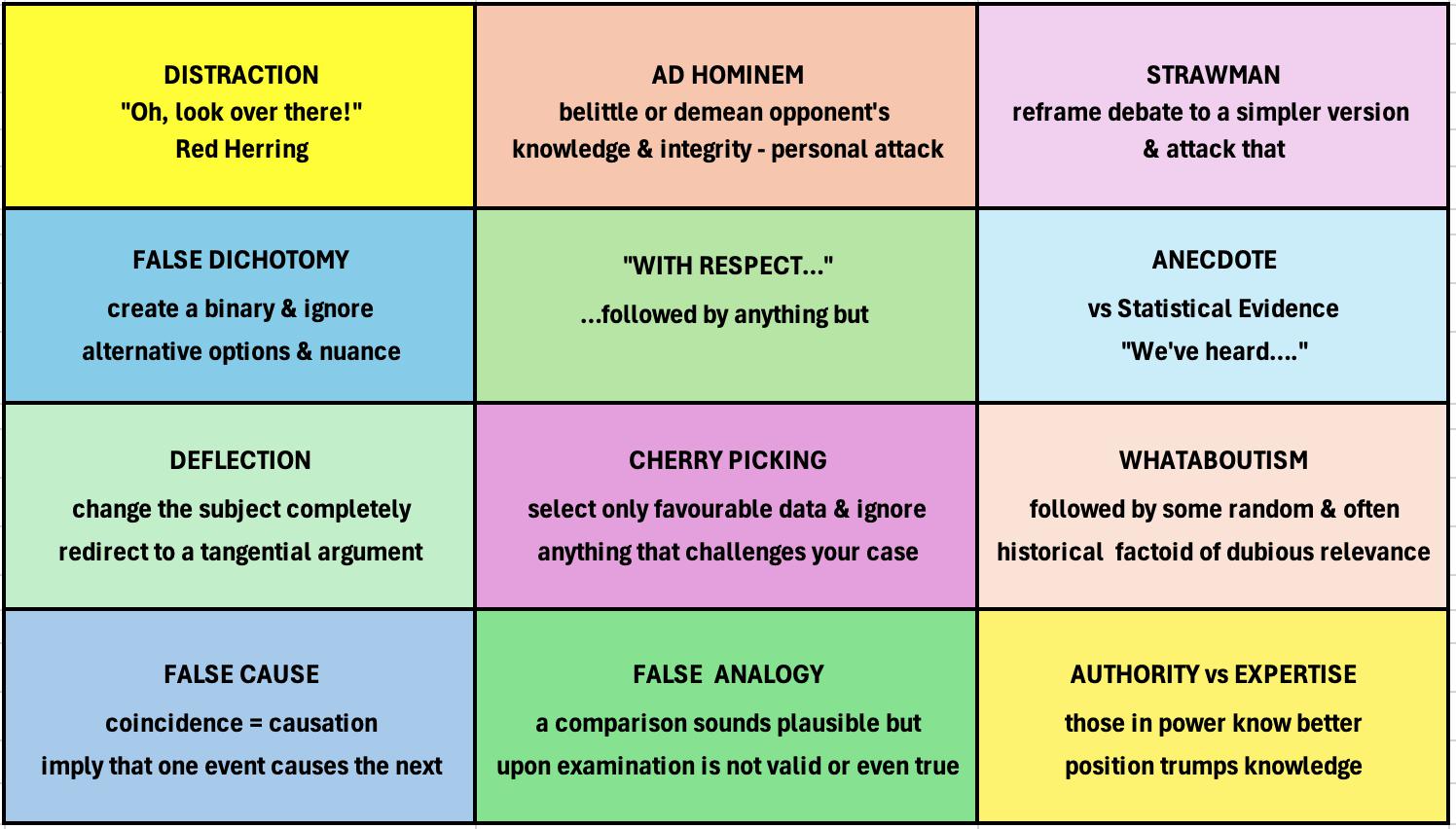
Note: The Minister will often combine several logical fallacies in the one sentence, or in consecutive sentences
in what sounds like it’s the one response. Remember his ultimate aim is deflection and avoidance.
Our Place is a community group with an alternative vision for Macquarie Point.