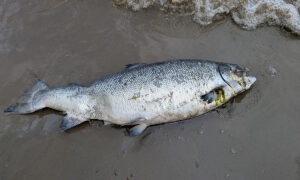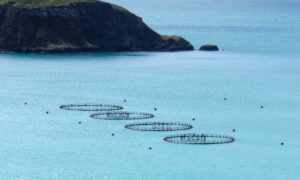
The salmon industry’s use of antibiotics in Tasmanian waters has forced the closure of the important commercial southern rock lobster industry in areas around diseased salmon pens being treated with a new drug, florfenicol, in south-eastern waterways.
Meanwhile, Tasmania’s largest organisation representing recreational fishers, TARFish, has backed the multinational industry, downplaying the impact of antibiotics in waters used by recreational fishers and accusing independent Franklin MP Peter George of “disinformation” in warning wild fishers to stay away from diseased salmon pens.
Pig Antibiotic Deployed, Christmas Fishing Season Under Threat
Editors note: It was the Department of Public Health who issued the warning, which we acknowledged in an earlier article.
The statement from Mark Veitch is now missing from the Department of Public Health website.

Media release – Peter George MHA, independent for Franklin, 15 November 2025 – Update 20:00
Rock Lobster fishery closed by salmon antibiotics – Minister confirms
Primary Industries Minister, Gavin Pearce, has confirmed to me that the rock lobster fishery near diseased salmon pens south of D’Entrecasteaux Channel has been closed due to fears for Tasmania’s export markets.
Mr Pearce says the decision was made in collaboration with the CEO of the Tasmanian Seafood Industry Council, Julian Harrington.
The export market is worth a potential $90 million annually, but customer countries insist there is no antibiotic residue in the flesh.
Mr Pearce told me he was concerned that there should be no chance of customers like Japan and China finding reasons to ban the import of Tasmanian southern rock lobster.
I pointed out to him that sufficient thought had not been given to the impact of introducing the new antibiotic, Florfenicol, to Tasmanian waters or its impact on commercial fishers, communities and the marine environment.
Other areas are likely to be impacted as rapidly warming waters have already led to early outbreaks of P.Rickettsia and a summer of antibiotics is expected in coming months.
Media release – Peter George MHA, independent for Franklin, 15 November 2025
SALMON INDUSTRY ANTIBIOTICS REPORTEDLY RISK ROCK LOBSTER EXPORTS
The salmon industry’s use of antibiotics in Tasmanian waters has reportedly forced the closure of the important commercial southern rock lobster industry in areas around diseased salmon pens being treated with a new drug, Florfenicol, in southeastern waterways.
Meanwhile, Tasmania’s largest organisation representing recreational fishers has backed-in the multinational industry, downplaying the impact of antibiotics in waters used by recreational fishers.
In doing so, TARfish has accused Independent Franklin MP, Peter George, of “disinformation” in warning wild fishers to stay away from diseased salmon pens.
“It’s now clear that the multinational salmon industry’s interests and profits in Tasmania have become the dominant force in the life of our island’s waterways at the expense of other industries, communities and our marine heritage.
“Tasmania’s commercial crayfishers have been completely blindsided by the rush to introduce a new antibiotic into diseased salmon pens with its flow-on impact on the $90-million southern rock lobster (crayfish) industry.
“At the same time, Tasmania’s largest recreational fishers’ organisation, TARfish, has chosen to side with the salmon industry over the interests of the state’s tens of thousands of recreational fishers,” said Peter George, independent MP for Franklin:
In the latest developments:
It’s reported that the area south of the D’Entrecasteaux Channel has been closed to commercial fishers until further notice because of the threat to exports arising from potential antibiotic residues found in our world-famous crays.
This is yet another complete stuff-up by government, regulator and salmon industry.
The rushed emergency use of antibiotics in overcrowded salmon pens, now routinely diseased with P. Rickettsia may already be damaging the state’s $90-million crayfish industry that employs more than 400 people.
The threat can only grow with rapidly warming waters over the coming summer.
Both Huon Aquaculture and Tassal – owned by multinational corporations – are now lacing their salmon feed pellets with a new antibiotic, Florfenicol in leases in the southern part of the Channel and the Huon River estuary.
TARfish backs salmon industry of rec fishers.
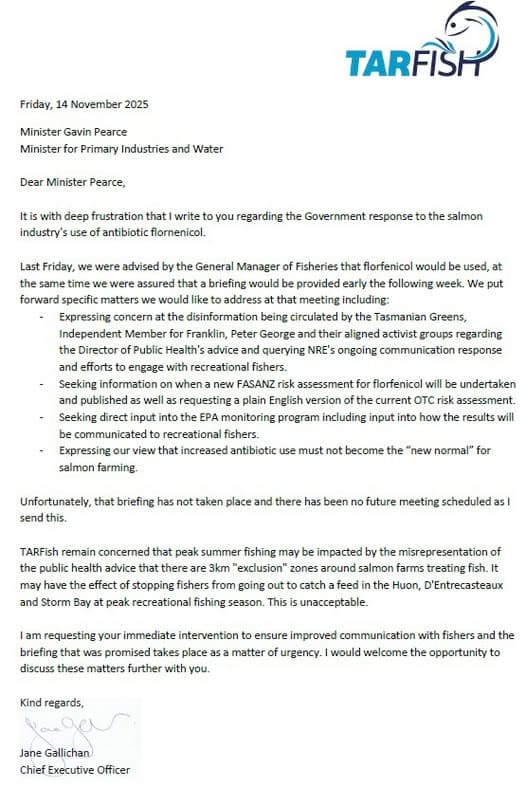
As for TARfish and its claims that I am spreading disinformation when warning wild fishers about staying 3 kilometres away from diseased fish pens using antibiotics, this is a patent falsehood.
Once again, TARfish reveals its conflicted interests between backing the multinational salmon industry and its duty to represent Tasmania’s thousands of recreational fishers.
TARfish CEO Jane Gallichan is a former corporate affairs manager for salmon producer, Huon Aquaculture, which undermines her position on the salmon industry and its impacts.
“In a letter to the Primary Industries minister, Gavin Pearce, Gallichan completely ignores Health Department advice against fishing within 3-kilometres of a diseased pen as a precaution against catching and consuming wild fish with antibiotic residues in their bodies.
“The idea that I have been spreading “disinformation” along with my supposedly aligned “activist groups” is laughable when all we have been doing is the government’s job of alerting the public and recreational fishers of the concerns of the Tasmanian Health Department. If the communities that I speak for are “activists” rather than simply concerned citizens, then I’ll proudly bear the accolade, ” said George.
I call on Ms Gallichan and incoming Chair John Edwards to live up to their primary duty of speaking for and on behalf of their members instead of running interference for the salmon industry.
TARfish should be concerned for the health of recreational fishers instead of encouraging them to fish anywhere near diseased salmon pens where the risk of catching antibiotic-laced wildfish is very real – especially since wild fish with high levels of antibiotics have been found more than 7 kilometres from diseased pens.
Image Fishing Tasmania.
Tasmanian Times (TT) is a community-based news and current affairs service covering the island state of Tasmania. It exists to provide a diverse presentation of Tasmanian issues. TT creates and supports independent media content utilising the best of modern technologies and tried-and-true practices of public-interest journalism.
Support us in expanding our coverage and developing new content by and for Tasmanians.
New initiatives on the way include … what our contributors and readers suggest! Please get in touch with your suggestions.