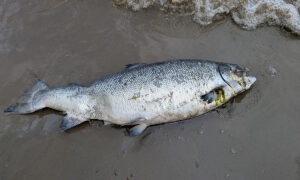
According to the Department of Natural Resources and Environment, florfenicol is an antibiotic used for veterinary medicine, agriculture, and aquaculture, including salmon farming.
Excerpt from Hansard transcript of Senate Estimates session, 10 February 2026
Senator WHISH-WILSON: There was some reporting in the last few days around oxytetracycline. That was approved by APVMA sometime ago for use in aquaculture. Is it your understanding that florfenicol was designed to replace that as a product that the salmon industry would use?
Mr Hansen: Yes. My understanding is that florfenicol is what the salmon industry is wanting. In the first instance, an application for an emergency permit was put in to try to deal with the immediate issue, but we’ve been told that their long-term ambition is registration of the product and that they’d be collecting data as part of these permits to be able to support that application. We keep saying ‘the industry’; it’s actually Abbey Laboratories Pty Ltd who’s the applicant for the permit and also who’s expressed an interest in registration [note: on behalf of the salmon industry].
Senator WHISH-WILSON: What would getting long-term registration mean in reality? Effectively, what does that mean?
Mr Hansen: That means running through the full gamut, as a permit needs to do, with regard to meeting all the safety criteria and efficacy and trade criteria. We’ve flagged that, because this permit is a one-use expiry in September – that’s the beauty of permits; we can actually use both temporal and spatial controls to help mitigate some of the risks – we’ve said that they would need, for a broader ongoing registration, a lot more information about any antimicrobial resistance. So there are additional burdens that we would put on them in terms of coming back if they sought registration. Our capacity and our legislation allow us to move quite swiftly if we need to cancel, we need to change or we need to vary a permit. Once a product is registered, the process for removing that registration is quite cumbersome, as you’d know, on some of our –
Senator WHISH-WILSON: But the current permit expires in September.
Mr Hansen: That’s right.
Senator WHISH-WILSON: And, if they don’t get a long-term registration, then they can apply for another one-off application?
Mr Hansen: They can apply for another one, and that would be judged on the merits of the information they provide.
Senator WHISH-WILSON: Thank you.
The full Hansard transcript can be viewed here.
Media Release – From Neighbours of Fish Farming (NOFF), 19 February 2026
State Government Must Prohibit All Use of Florfenicol in Tasmania’s Waterways Immediately
Latest NRE results show antibiotics found in multiple native species – up to 10kms from salmon pens
Local residents’ group Neighbours Of Fish Farming is demanding that the state government and multinational salmon industry come out of hiding and immediately act on the impending decimation of Tasmania’s local fisheries.
The Department of Natural Resources and Environment’s latest report of florfenicol detection in five of Tasmania’s native species up to 10kms from industrial salmon pens, is shocking.
Traces of florfenicol were found in several marine species, including economically important species abalone and lobster, which have a zero-residue limit to go to market.
Everyone, not least of all local fishers, should be very worried about the future of Tasmania’s export economy. The fact one industry can have such a consequential effect on so many other industries, the waterways and our communities is unacceptable.
“This is a strong cue to cease the use of florfenicol in salmon farms, but what has the government done instead? The NRE have closed Tasmania’s wild fisheries so that salmon farming can continue,” NOFF Campaigner Lilly Henley said.
If florfenicol is here to stay, there is no way wild fisheries or recreational fishing can continue. “The disregard for Tasmania’s wild fisheries, and the many Tasmanians working for these industries is appalling. How much more will the government bend over for these overseas corporations before they start listening to Tasmanians, as they are elected to do!
“The NRE and EPA needs to conduct full environmental testing, as they should have prior to the use of this antibiotic, on sediment microbial communities and antimicrobial resistance (AMR) genes in the environment, not just presence of the antibiotic.”
NOFF vice president Lisa Litjens said: “How can a foreign-owned, multinational industry come before the livelihoods of small operators, and the health of Tasmanians – including its tourism industry which supports thousands more jobs?”
“The state government must order an immediate halt to the use of florfenicol in salmon farms. Tasmanians are sick of being pushed to the side by their representatives. Clean and green was once a proud claim but it’s now a lie.”
Media Release – Rosalie Woodruff MP, Greens Leader, 19 February 2026
Florfenicol in Wild Fish Requires Rockliff’s Response
Florfenicol has been found in wild caught fish, including abalone and lobsters, up to ten kilometres away from salmon farms, according to a statement published by NRE Tas. The Liberal Government needs to protect our local fisheries’ export markets and require salmon farms to destock diseased pens rather than continue dumping antibiotics into marine waters.
It’s very concerning florfenicol has been identified in wild fish with export markets that have zero tolerance for florfenicol residues in products. Areas of the rock lobster fishery have already been closed because of the risk to their market caused by the antibiotic use of salmon companies.
The Liberals rushed to support the federal florfenicol registration process without thinking about the impacts on local fisheries. They are continuing to prioritise the interests of international salmon farming companies over local abalone and rock lobster fishers.
In Chile, the salmon industry’s antibiotic use has smashed their wild fisheries. The Liberal Government is walking Tasmania – our local fisheries and the marine environment – down the same fateful path.
Premier Rockliff needs to take control and regulate the salmon industry to destock diseased salmon from pens. Allowing the continuing dumping of tonnes of florfenicol into public waterways is a terrible outcome for Tasmanians.
Media Release – Bob Brown Foundation, 19 February 2026
Widespread Impacts of Antibiotic Dumping by Factory Fish Farms Spread Further into the Ecosystem
Information released by the Tasmanian government today showing that Florfenicol is now being detected in wild fish, including Abalone and Rock Lobster as far as 10kms away from the nearest factory fish farm.
This is the scandalous yet predicted outcome by environmental groups and scientists due to the Tasmanian Governments rushed support of the desire of huge corporations to dump these antibiotics in public waters.
The marine environment and the livelihoods of other commercial fisherman have been sacrificed on the altar of the big salmon corporations.
Bob Brown Foundation is calling for the immediate halt of antibiotics in Tasmania’s marine environment and for fish farms to be removed.
“The fact that fish farm antibiotics are being found in abalone 10kms away from a factory fish farm shows just how contaminated Tasmania’s waters are becoming, and it is an environmental disaster, with the toxic salmon companies being directly responsible for this damage,” said Alistair Allan, Antarctic and Marine Campaigner at the Bob Brown Foundtaion.
“Despite all the evidence of damage done in Chile by the same antibiotic, the Tasmanian government chose to condemn our own ecosystems at the behest of the big salmon corporations, and the damaging impacts are now becoming real. These factory fish farms are an environmental catastrophe, from our rivers to the seas, and they have to be removed now.”
Media Release – Rosalie Woodruff MP, Greens Leader, 20 February 2026
APVMA Florfenicol Suspension Welcomed
The Greens welcome the proposal from the APVMA to suspend the Tasmanian salmon industry’s permit for florfenicol.
This decision is an indictment on the Liberal Government, who never should’ve supported the rushed approval of the antibiotic in Tasmanian waterways.
They’ve consistently dismissed concerns of the community and local fishing industry, even yesterday as the antibiotic was recorded in wild fish more than ten kilometres away from salmon pens.
Premier Rockliff now has no other option. He must stop supporting the salmon industry’s use of the florfenicol in Tasmanian waters and require diseased pens be destocked immediately.
Statement by Peter George, Independent MP for Franklin, 20 February 2026
APVMA Will Suspend Florfenicol
The federal veterinary regulator, APVMA, will suspended the use of a new antibiotic, florfenicol, in tasmanian waters from 2 March, after traces were found in wild fish 10.6 kilometres away from diseased salmon pens.
The APVMA’s decision is a win for Tasmanian waters, Tasmanian marine wildlife and for Tasmanians who care about the health of our waterways.
At last, after two decades, the salmon industry’s dominance in decisions that impact and damage the health of our waterways and marine life has been challenged.
It’s the only decision that could be made when scientific research has shown traces of the antibiotic, florfenicol, in southeastern Tasmanian waters as much as 10.6 kilometers away.
The salmon industry’s use of the antibiotic threatens the livelihood of rock lobster and abalone fishers who rely on export markets with zero tolerance for antibiotic residue.
It also threatens the health of all our marine life as well as human health, contributing to the dangerous growth of antibiotic resistance that already takes the lives of more Australians than the annual road toll.
The decision will take effect from March 2, unless the salmon industry and its supplier can provide evidence that international trade in rock lobster and abalone is not threatened.
I welcome the move as a first step to ensuring that the multinational salmon industry can no longer dictate what happens in our waterways by using its political and financial muscle to intimidate government and regulators.
Media Release – Bob Brown Foundation, 20 February 2026
Suspension of Salmon Farm Antibiotic Use Welcomed
Bob Brown Foundation welcomes the proposed suspension by APVMA of the antibiotic florfenicol in Tasmania’s factory fish farms.
The announcement comes off the back of recent reporting that the antibiotic had contaminated wild fish such as abalone and rock lobster as far as 10 km from the nearest industrial fish pen.
Bob Brown Foundation is calling for a complete ban on the dumping of antibiotics en masse by the fish farm corporations and for the factory fish farms to be required to fallow and destock fish farms in times of disease outbreak.
“Despite the Tasmanian government knowing the impacts florfenicol has had in other parts of the world, such as Chile where florfenicol contaminated marine animals as far as 30 km from the nearest fish pen, they have allowed the mass dumping of antibiotics into the Tasmanian ecosystem,” said Alistair Allan, Antarctic and Marine Campaigner at Bob Brown Foundation.
“This suspension of antibiotic dumping should not be temporary, it should be a permanent. These huge companies should not be allowed to contaminate public waters ways and fragile marine ecosystems to protect their profits. This is yet another indictment in a list a mile long of how irresponsible these companies are. It’s time for Premier Rockliff to remove fish farms from Tasmania’s waters entirely,” said Alistair Allan.
Media Release – Rosalie Woodruff MP, Greens Leader, 21 February 2026
Rockliff Government Must Withdraw Support for Florfenicol Use
With the APVMA moving to suspend their permit to allow florfenicol use by the salmon industry, the Rockliff Government must act and withdraw their support for the use of this antibiotic in Tasmania’s waterways.
With rock lobster industry shutdowns already occurring, florfenicol detected in wild rock lobster and found abalone over 10 kilometres from the nearest salmon farm, and the federal regulator moving to suspend registration, there is nowhere for the Liberals to hide.
The Rockliff Government last year supported the salmon industry to access florfenicol for months before a permit application was made.
The government supported the permit application without any consultation and without consideration of other industries, the community, or the environment.
For months they’ve continued to support the use of the antibiotic, even as risks to trade impacts for wild catch became realities.
The fact the federal regulator has moved to suspend the use of florfenicol, yet the Rockliff government continues to fully back the industry using the product, is shocking. Not only that, yesterday two national experts in trade called out the risk of florfenicol to major export markets.
The government must change course.
Rather than continuing to prioritise the profits of the multinational corporations that run Tasmania’s salmon farms, the Liberals need to put our waterways, communities and critical wild catch export industries first. They should immediately withdraw their support for the use of florfenicol and require the destocking of diseased salmon pens instead.
Media Release – Rosalie Woodruff MP, Greens Leader, 23 February 2025
Liberals Must Stop Mass Florfenicol Dumping
The Liberal Government are refusing to withdraw support for the salmon industry’s use of florfenicol, despite the APVMA’s move to suspend the permit for use in Tasmania. It’s reckless of the Liberals to continue supporting salmon companies’ use of large amounts of florfenicol, while that threatens our wild abalone and rock lobster export markets.
The Rockliff Government supported the salmon industry’s intention to use florfenicol months before an emergency application was made to the APVMA, and despite the stated concerns of local communities and wild fish industries. The government ultimately supported the application, but did no formal consultation about impacts on other industries and the marine environment.
When it became clear the salmon industry’s use of florfenicol would require shutting down parts of the rock lobster industry to protect export markets, the Liberals did nothing. And when florfenicol was recently detected in wild abalone and rock lobsters more than ten kilometres from salmon treatment sites, the Liberals took no action.
The Rockliff Government is continuing to back the salmon industry, even as the APVMA is moving to suspend the salmon industry’s permit to use florfenicol. It’s a statement that shows they prioritise the interests of multinational salmon corporations over wild caught fishing industries.
With just one week before the permit to use florfenicol in Tasmania could be suspended, salmon companies are rushing to dose diseased fish. Yesterday, Tassal started treatments at five leases on the same day, which is unprecedented.
Jeremy Rockliff needs to act and put Tasmanian waterways and wild catch fishing industries first. It sends a terrible signal to our export markets that they continue to allow the mass dumping of florfenicol in Tasmanian waters. The sensible response is to require salmon companies to destock fish from pens where there is disease.
Media Release – Environment Tasmania, 23 February 2026
Five More Farms Treated with Antibiotics as ‘Don’t Speak’ Order Raises Transparency Concerns
Environment Tasmania calls out the ongoing use of antibiotic Florfenicol by the salmon industry at a large scale and the news that five more farms will be treated today ahead of the suspension on the industry’s license.
Today’s ‘don’t speak’ order across Tasmania’s seafood sector revealed by ABC’s Leon Compton on his Mornings show, speaks to the hearts of transparency issues rife within this industry and its governance.
“Contamination of wild fishery stocks up to 10km from farms is simply unacceptable and creates a massive reputational risk to both Tasmania and Australia’s brand to global markets,” says Environment Tasmania marine campaigner Rebecca Howarth.
“Other businesses, industries, our recreational fisheries and our wild marine life are impacted and it is absolutely irresponsible for the government to be prioritising this polluting industry over them.”
While the bacteria affecting the salmon has been listed as endemic to Tasmania, eradication is still possible by taking measures to destock salmon farms. Environment Tasmania is calling for a halt on all expansions while this disease remains an issue.
Media Release – Clare Glade-Wright, Independent Candidate for Huon, 23 February 2026
Clare Glade-Wright Calls for a Whole-of-Estuary Health Program for the Channel and Huon
Clare Glade-Wright, independent candidate for the Huon Legislative Council election this May, has raised serious concerns about the continued use of the antibiotic florfenicol in salmon farming operations in the D’Entrecasteaux Channel and Huon Estuary.
Ms Glade-Wright is calling on the Tasmanian Government to implement a comprehensive estuary health program, modelled on the Derwent Estuary Program, to safeguard the long-term health of these vital waterways.
“The D’Entrecasteaux Channel and Huon Estuary are globally significant marine environments,” Ms Glade-Wright said.
“They support diverse marine life, recreational activities, tourism, and local fisheries, while also hosting expanding industrial aquaculture operations.”
“While disease management is a legitimate operational issue for the aquaculture industry, the use of broad-spectrum antibiotics such as florfenicol in open-water marine systems raises serious environmental and public health questions.”
Ms Glade-Wright said key concerns include:
- “The potential development of antimicrobial resistance in marine bacteria.”
- “Impacts on sediment microbiota and benthic ecosystems.”
- “Flow-on effects to wild fish populations and broader marine food webs.”
- “Cumulative impacts when combined with nutrient loading, climate change, and other stressors.”
She said communities living along the Channel and Huon deserve transparent, independent reporting on the ecological condition of their waterways, similar to the publicly accessible “State of the Derwent” report cards produced under the Derwent Estuary Program model.
“For more than two decades, the Derwent program has shown how collaborative governance, bringing together state and local government, industry, scientists and community can monitor ecosystem health through rigorous scientific indicators, track pollution sources and industrial impacts, and report transparently to the public,” Ms Glade-Wright said.
“There is currently no equivalent, integrated estuary-wide reporting and management framework for the D’Entrecasteaux Channel and Huon system that matches this level of transparency and independence.”
Clare Glade-Wright will be holding an event at Trial Bay in April, and has invited local swimming groups to be involved by signing the open letter to the Premier.
“The Channel and Huon are facing increasing pressure from industrial expansion, warming waters, and land use runoff,” Ms Glade-Wright said.
“A fragmented regulatory approach is no longer sufficient. Tasmanians expect, and deserve, world-class environmental stewardship.”
“Establishing a coordinated estuary health program would provide clarity for industry, confidence for the community, and protection for one of our most important natural assets.”
Statement by Peter George, Independent MP for Franklin, 23 February 2026
Tasmanian Regulators and Mnisters Duck for Cover as Tassal Expands Controversial Antibiotic Treatments
As the salmon industry starts antibiotic treatments in 5 more diseased pens, regulatory authorities, ministers and health authorities go silent.
Tasmanian authorities have shockingly washed their hands of their responsibilities to act as the crisis mounts over the multinational salmon industry dumping tonnes of antibiotics in southeast Tasmanian waters.
Their silence as antibiotic residue spreads into wild marine life, and the resulting threat to rock lobster and abalone exports, is shameful.
Meanwhile, the multinational salmon industry is dumping even more of the antibiotic, florfenicol, into five diseased pens as a potential ban on its use is considered by the Federal veterinary authority, APVMA.
But instead of acting to reassure Tasmanians that action is being taken to protect commercial fisheries and the health of waterways, Federal and State Ministers; regulators have gone to ground.
I call on the responsible State ministers, Gavin Pearce and Madeleine Ogilvie, to speak up for our commercial fishers, our marine life and the health of our waterways.
I call on Federal Franklin MP and Fisheries Minister, Julie Collins, to end her silence and promise Tasmanians she’ll ensure the review process is fair, transparent and without political interference as the APVMA, does its due diligence.
I call on the EPA and the Department of Natural Resources and Environment (NRE), to reveal their role in the emerging crisis and why it’s taken so long to report the information to the APVMA.
I call on the Health Department to end its silence on the dangerous spread of antibiotic residue in the food chain.
I call on the Labor opposition to end its silence – it’s past time Labor chose Tasmania over its cringing loyalty to the salmon multinationals.
Even the state’s peak commercial fishing body, Seafood Industry Australia (SIT) has gone silent and directed its members not to speak about their concerns.
Media Release – Vica Bayley MP, Greens Environment spokesperson, 27 February 2026
RTI Shows Departments Questioned Florfenicol Use
Documents extracted from the government using Right to Information laws validate the questions and concerns the Greens and environmentalists have been raising for months about the use of florfenicol. They reinforce why Primary Industries Minister Gavin Pearce must tell the APVMA that the Rockliff Government no longer supports the use of this antibiotic in Tasmanian waters.
These documents show that the widespread use of florfenicol in Tasmanian waterways was supported by the Rockliff Government and approved by the federal regulator despite there being no relevant evidence for the industry’s claims about its benefits, nor about its impacts in Tasmania.
What we can now see in black and white is that even in the early days of florfenicol use in Tasmania, multiple government agencies were concerned about the idea of the antibiotic being allowed in new areas. Yet those concerns were kept from the public, who were instead told there’s nothing to worry about. They’ve only come to light following an RTI by the Greens.
While the industry was spruiking the early environmental testing results for florfenicol, government departments were questioning whether the monitoring program was adequate. Of course, we know now that expanded testing found the antibiotic in abalone more than 10 kilometres from the nearest salmon farm.
It’s astounding that while the Environment Department, the EPA, and the Health Department were raising concerns with the APVMA about the use of florfenicol on the East Coast, at the same time hundreds of kilograms of florfenicol were being dumped in south-eastern waters. All with the full support of the Rockliff Government.
With multiple agencies raising concerns about the lack of evidence on environmental and human health impacts, along with concerns over the consequences for wild caught fisheries, the Rockliff Government should have rethought their position on the widespread use of this antibiotic. But the Liberals were happy to put the profits of multinational companies first instead. It’s disgraceful.
The Primary Industries Minister needs to come out of hiding and address this issue. And crucially he needs to make it clear to the federal regulator that the Tasmanian Government has seen the error of its ways and no longer wants florfenicol used in our state’s waterways.
Media Release – Rosalie Woodruff MP, Greens Leader, 5 March 2026
Greens Welcome Florfenicol Suspension
The Greens welcome the decision by the APVMA to cancel the Tasmanian salmon industry’s permit to use florfenicol. It’s shocking that even despite this, with the stated reason being risks to our wild fish exports, the Premier is still backing the use of florfenicol by the salmon industry.
The APVMA have listened to the science and recognised the impacts for local wild-caught fisheries from florfenicol and suspended the salmon industry’s permit. This is a vindication of concerns raised from the outset by local communities, and recreational and commercial fishers. These concerns, and the risks raised by their own agencies, were dismissed by the Liberal Government.
Even now, after the APVMA has suspended the salmon industry’s permit for florfenicol, the Rockliff Government is refusing to regulate and prevent the industry’s continuing use of the antibiotic. Under a Greens’ question in Parliament, the Premier confirmed companies would be applying for another permit.
The Liberals have consistently prioritised multinational salmon companies ahead of the marine environment, communities and abalone and crayfish exports.
Premier Rockliff promised to put the industry on notice. His government needs to regulate to require salmon companies to properly manage P. salmonis outbreaks by destocking diseased pens, and ensure off-label use of florfenicol by the industry is prohibited.
Media Release – NOFF Tasmania, 5 March 2026
Overdue Florfenicol Ban Enacted Following Pressure From Neighbours of Fish Farming — But Salmon Industry Reform Still Urgently Needed
NOFF and the communities it supports are greatly relieved the permit for Florfenicol has been revoked. A decision that was well overdue.
The APVMA’s decision confirms what community members, fishers and scientists have been warning for months: antibiotics used in open net-pen salmon farming does not stay contained.
While the revocation is a critical step forward for Tasmania’s waterways, it should never have reached this point. The regulatory shortfalls meant florfenicol could be used without stringent baseline studies under an ‘emergency permit’ in our waterways: an untenable situation for our local fisheries and marine environment.
Lilly Henley from NOFF said the outcome raises serious concerns about how the permit was granted in the first place.
“The suspension of this emergency permit shows that not enough care was taken in its approval. There were no baseline studies, no risk analysis, and no proper consideration for Tasmanians working in wild fisheries, or for those who fish, swim and dive in what should, and could be clean, healthy waterways.”
Despite the ban, other antibiotics, including oxytetracycline, remain available for use and pose similar environmental and antimicrobial-resistance risks.
“Overturning the florfenicol permit is an important win for public and environmental health, but there is still a long way to go.
We are calling on the EPA to mandate de-stocking as the industry’s primary disease response, particularly during warmer months when keeping stressed and diseased salmon in overcrowded pens creates unacceptable welfare, biosecurity and environmental risks.”
Media Release – Helen Burnet MP, Independent Member for Clark, 5 March 2026
No Answers on Antibiotic Risk to Rivers
Minister unable to answer questions about potential antibiotic contamination in our rivers raises serious public health concerns
Today in Parliament I raised concerns with the Minister for Primary Industries, Gavin Pearce, about yet another government failure to properly regulate the salmon industry.
Although the salmon biosecurity program introduced in 2023 requires salmon hatcheries to “ensure that levels of antibiotics or chemical residues present within or outside a freshwater facility do not exceed any levels specified in the producer’s fish farming licence,” until last month the government had not imposed any licence conditions setting acceptable antibiotic levels. Nor was there any regulatory requirement for hatcheries to notify the EPA or the Department of Health of antibiotic use in our freshwater environment.
I asked the Minister: If salmon hatcheries were not required to report antibiotic use or test for antibiotic residues in their outflows until last month, how can we be confident that antibiotic residues have not been entering our rivers for years?
The Minister failed to answer this question, instead deferring to the Minister for the Environment, who took the matter on notice.
Later, the Minister for Environment informed the Parliament that testing is now occurring at Huon Aquaculture’s Meadowbank hatchery on the Derwent River and that new reporting and monitoring requirements will soon be imposed on all hatcheries. Yet her response still avoided the central question. That silence speaks volumes.
It raises the very real possibility that salmon hatcheries may have been releasing effluent containing antibiotics or antibiotic residues into our rivers – including drinking water catchments for months or years – without public knowledge.
Even trace amounts of antibiotics can contribute to emergence and spread of dangerous antibiotic-resistant bacteria in our drinking water and freshwater environment. The government’s inability to rule out this possibility today highlights yet another regulatory failure in its oversight of the salmon industry – one that may have placed public health at risk.
Media Release – Environment Protection Authority (EPA), 6 March 2026
Update on Florfenicol Environmental Monitoring in Southern Tasmania
The Environment Protection Authority (EPA) has continued to review environmental monitoring data following the release of its Preliminary analysis of environmental samples for florfenicol in southern Tasmania in December 2025.
EPA Director, Catherine Murdoch, said that environmental monitoring for the first four marine farming leases being treated with florfenicol commenced on 5 November 2025 and continued into February, reflecting multiple treatment events at some sites.
The environmental monitoring has been undertaken in accordance with required Antibiotic Residue Monitoring Schedules for the Meads Creek, Stringers Cove, Zuidpool and Soldiers Point leases, in the D’Entrecasteaux Channel and Huon River Marine Farming Development Plan Area. These monitoring programs have generated more than 3,000 individual analytical results from water, sediment and wild fish samples collected under the different monitoring schedules.
“A significant body of scientific work is represented in these results and the EPA’s ongoing review of the extensive data collected for the treatments at these leases continues to support the initial findings released by the EPA, and indicates the majority of the antibiotic administered is being taken up by salmon, with measured concentrations in the environment remaining very low and consistent with those previously reported,” said Ms Murdoch.
Ongoing analysis of the results indicate that florfenicol and florfenicol-amine residues were found in 15 out of 1,274 sediment sample results. These samples contained trace levels of florfenicol and florfenicol-amine (ie, in parts per billion).
Similarly, florfenicol and florfenicol-amine residues were found in water samples in very low concentrations (within the parts per billion and parts per trillion range). More than 1,300 water sample results have been reported to the EPA, 12.5% of water sample results analysed outside of the lease boundary contained trace levels of florfenicol or florfenicol-amine. Florfenicol and florfenicol-amine residues were highest in surface and mid waters samples and decreased with distance from the lease. Florfenicol and florfenicol-amine were not reported in water samples 7 days after treatment.
Florfenicol-amine residues have been found in 13 of the 639 wild fish samples analysed. The latest results indicate that florfenicol and florfenicol-amine residues are not accumulating in the water or sediment components of the marine ecosystem.
The results of this monitoring will enable the EPA to complete an environmental risk assessment for the use of florfenicol in Tasmanian marine waterways. Components of the risk assessment are currently being peer reviewed, and the EPA anticipates that the finalised environmental risk assessment will be released in April 2026.
Monitoring will continue over the coming months in response to treatments at five additional marine farming leases in the D’Entrecasteaux Channel. The EPA will continue to actively release the results of the monitoring programs as the sampling is completed.
Testing results have been shared with the Department of Health throughout the environmental monitoring program.
The Director of Public Health, Dr Mark Veitch said “Florfenicol residue was detected in two wild finfish samples in November 2025. These Australian Salmon were caught within 1km of two leases on the day after treatment ended.”
Commenting on subsequent testing, Dr Veitch said “Extensive sampling and testing related to other leases has detected florfenicol residue in a small number and small proportion of wild finfish samples. All these samples were collected within 1km of a treated lease, and no later than 7 days after treatment ended.
“Eating typical amounts of these wild finfish does not pose a risk to human health.
“Further testing of wild finfish, up to 3km from treated leases and up to 38 days after treatment, has not detected florfenicol residue.
“If a person chooses to avoid eating finfish that may contain florfenicol residue, they could choose to avoid eating wild finfish caught within 3km of a lease during treatment and for 21 days after treatment finishes.”
“The very low levels of florfenicol residues detected in non-finfish species, such as abalone and the hepatopancreas of rock lobster, pose no risk to human health.”
Further Reading
- Public Health advice about Florfenicol – recreational fishing and water use (Department of Health)
- Preliminary analysis of environmental samples for Florfenicol in southern Tasmania (Environment Protection Authority)