
Landholders to Decide on Social Licence for Major Infrastructure Initiative
A crucial public meeting has been scheduled for affected landholders to discuss the future of the North West Transmission Developments (NWTD) project, with the community being asked to determine whether the proposal has sufficient social licence to proceed.
The meeting will take place on Saturday, 25 October, from 14:00-16:00 at Stowport Hall (574 Stowport Rd, Stowport TAS).
While primarily targeting directly affected landholders, organisers are extending the invitation to neighbouring property owners who may also face impacts from the transmission infrastructure.
Key Issues on the Agenda
Several significant topics will be addressed during the two-hour session, including:
- Public consultation processes and concerns
- Compensation arrangements, including the Strategic Benefit Payment (SBP)
- The question of social licence for the proposed developments
- Environmental assessment procedures
- The Government’s handling of the Marinus Final Investment Decision during the caretaker period
- Potential conflicts of interest
The meeting will feature several speakers, including Craig Garland MHA, Carlo Di Falco MHA, Adam Martin and affected landholders who will share their perspectives on the project.
Community Unity and Action
Meeting chair Malcolm Ryan emphasised the importance of collective decision-making at this critical juncture.
“The purpose of this public meeting is to provide affected landholders with an opportunity to decide as a group whether the NWTD project has the social licence needed to proceed, or whether there are unresolved issues which make it necessary for the NWTD to be paused, or even reconsidered altogether,” he said.
Attendees will have the opportunity to discuss and agree upon a united course of action regarding further negotiations with TasNetworks and the government.
Neighbouring Landholders Encouraged to Attend
Organisers are particularly keen to see participation from neighbouring property owners, who may also face impacts from transmission lines despite not being directly in the project’s path.
Energy Minister Nick Duigan has reportedly indicated that no compensation for neighbouring landholders is currently being considered, making their voices at the meeting even more important.
Community members are encouraged to help spread the word about the meeting to ensure broad participation from those who may be affected.
Permit Application Under Review
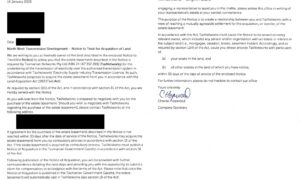
The meeting comes as TasNetworks’ permit application for a section of the North West Transmission Upgrades Project is currently under review by the Tasmanian Planning Commission. The Commission is accepting public representations until 18 October 2025.
Those wishing to make a submission can send their written representations to: planning.tas.gov.au. The permit application can be viewed on the Planning Commission website at assessments.
A Critical Moment for the Community
Ryan stressed the significance of the 25 October gathering, describing it as potentially “the only chance remaining to stand together and be heard for the good of our communities and Tasmania as a whole.”
For more information, contact:
Malcolm Ryan (Meeting Chair)
Email: [email protected]
Background:
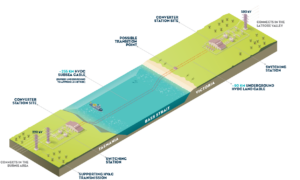
The NWTD is the transmission half of the Project Marinus proposal, which itself is one half of the Battery of the Nation plan.
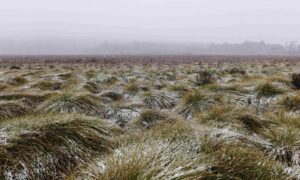
Originally, a global corporation called UPC (now ACEN) formed a deal with the Hammond family to build windfarms on Jim’s Plains and Robbins Island and to sell that power to the Mainland, via a new 170 kilometre transmission line to hook into our Basslink grid, passing through forests and farms across our north.
The government approved and even gave UPC the rights to forcibly acquire lands if and when negotiated deals fell through. A town hall meeting was called and communities made it clear they weren’t happy.
Alarmed, UPC pled their case to the Minister. Subsequently, TasNetworks, as a corporatised Jurisdictional Planner of the Energy Sector, ‘owned’ by the government, declared they’d build the most contentious section of the line through the Loongana Valley region, at our expense rather than UPC’s.
As a result, communities now faced a much more powerful opponent – the state government.
Since then, Battery of the Nation planning has evolved to a $6.7 billion dollar (and counting) cost that has required millions of dollars in PR, advertising, “community engagement”, “community benefits programs” and focus groups to “hear community concerns” and use that information to refine the narrative justifying it all.
From a single transmission line, we now have a new grid and up to four new Marinus Links planned to cross the Bass Strait, to take new privately-owned renewable energy to where it might make the most money.
But first, the NWTD is planned to back the Marinus Links and to attract foreign investment in new renewable energy generation, and any form of business that might use that energy here in Tasmania.
So far, the only serious interest is from AI data centres which are looking for cheap energy and to greenwash their industry. We understand bitcoin miners are also signing MOU’s.
The NWTD is now a single project with several components – a ‘coastal route’ to be built first, with a secondary loop travelling from Burnie to Hampshire Hills, then east through the Loongana Valley to Staverton.
The Development Application is before the Tasmanian Planning Commission, and is open for submissions until the 18 October. (Our communities have had less than a month to comment on a vast pile of 60 documents – over 2 Gigabyte of data!)
This meeting is for affected landholders, adjacent landholders and local communities who will be directly or indirectly impacted by the construction of the NWTD and by the ongoing issues and impacts after construction is completed.
With TasFarmers’ negotiations with TasNetworks stalled because of ‘bad faith’ tactics, this meeting might help everyone form a better plan going forward.
Tasmanian Times (TT) is a community-based news and current affairs service covering the island state of Tasmania. It exists to provide a diverse presentation of Tasmanian issues. TT creates and supports independent media content utilising the best of modern technologies and tried-and-true practices of public-interest journalism.
Support us in expanding our coverage and developing new content by and for Tasmanians.
New initiatives on the way include … what our contributors and readers suggest! Please get in touch with your suggestions.