
Part Two
Four years ago the fossil-fuel acolytes served up all the “lights out”, “blackouts” and “dinky batteries” tropes to warn of the impending doom. Well… not here in Tasmania. We’d be OK, but our Victorian cousins would suffer as their degenerating coal generators wheezed to a halt.
Their salvation would come from our long duration, water-filled storage battery.
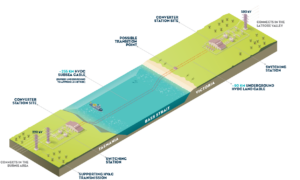
Open the valves at the top of the hill, and Tasmania could release up to 20 hours of solid “baseline” energy via the new 1500MW undersea cable, so at least the Vics could see what it was they were eating for their evening meal.
In 2017 an American mob called Tesla, through their flash boss, made an amazing pitch to the South Australian Government. We’ll build you the largest battery on the planet, and if it’s not up and running in 100 days, you get it for free!
By December that year it was operating (a month ahead of the deadline); the boss of Tesla added to his global ego as well as his riches, and the SA energy boffins then upped the size of the Hornsdale Battery from 150MWh (megawatt hours) to 194MWh.
It’s a slow story, but by now we’re really tucking into the “The Marinus Wellington”, and have reached the simple absurdity of the Marinus proposal.
Energy technologies encompassing the source of generation, its storage, its usage have changed so exponentially that our five year-old Tasmanian Renewable Energy Target is as relevant as T-Model Ford blueprints in a Chinese EV plant.
While endless calls by Liberal ministers assisted by highly-paid media teams invoked the determination of Labor deity “Electric Eric” Reece and Tasmania’s glory days of “hydro industrialisation”, they refused to entertain the possibility that something as archaic as a 10-year time-span to build a bit of kit was already a dinosaur idea.
Across the energy sector, once state-of-the-art fossils are being buried by a diverse and spectacular array of energy sources and storage options.
Back to the mushy Marinus meal. Second helpings are being offered.
There was resistance immediately from when Barnett revealed his “vision”, consisting of a Tasmanian map with three Renewable Energy Zones (REZ) marked on it. These large blobs marked areas picked out by the Australian Energy Market Operator (AEMO) – in conjunction with the aforementioned sage.
(If energy terminology seems difficult, by now you’ve realised you’ll need to study hard to keep up with the industry acronyms).
Tasmania would become the stabilising force on the NEM (National Electricity Market) supplying long duration, deep water battery storage.
There seemed no consideration that this state contributes just over 4% of the energy consumed by the eastern states consumers.
And no rational explanation as to how we keep the battery fully-charged and ready for the air-con catastrophe to be unleashed by Victorians on stinking hot, after-school days.
The government here proudly touts “net zero emissions” without any particular regard to a basic fact. It is our tracts of old growth forest which until disturbed, sequester the carbon which balances out toxins from vehicle exhaust or furnace gases. Somewhat more scientific organisations like the Bureau of Meteorology are producing models of rainfall trends in Tasmania between now and 2100.
The location of Great Lake should have both Luddites and technophiles alike figuring that a flat battery is useless.
Renewables and Climate Future Industries Tasmania (ReCFIT) published this summary on their website:
“There is no significant projected change to total statewide annual rainfall. However, significant changes are projected in the regional and seasonal pattern of rainfall across the State:
The west coast is projected to experience a significant increase in rainfall in winter; and a significant decrease in rainfall in summer after 2050.
The central plateau district is projected to experience a steady decrease in rainfall in every season out to 2100.
The north-east coast is projected to experience a steady increase in autumn and summer rainfall.
Significant increase in pan evaporation.”
Those ridiculing wind or solar power as a reliable energy source roll out their endless chants about the doldrums and darkness.
But every day the sun and wind re-energise a massive and totally underestimated 23.3GWh of Large Scale Battery installations across the country. The sun rises on four million domestic solar units which produced 12.4% of Australian production last year (Clean Energy Council, 2024 figures).
Industry statistics show wind blows enough to keep turbines rotating for 40% of the day – about 10 hours. It would be unusual for dead calm right across the eastern seaboard, and as unlikely that the entire country would be plunged into darkness by a continental-sized cloud.
Is there the same level of chortling when we ask how we’ll maintain maximum hydro storage levels, or just a derisive sneer of “it rains, mate”?
There are interesting ways these reserves are reported, but the graph below is an irrefutable way to see how our big battery has been faring.
This is the lake levels for the past 30 years. While the mid-90s look good, the top of the graph showing 1036 metres above sea level is still a long way from “full” at 1039 m ASL.
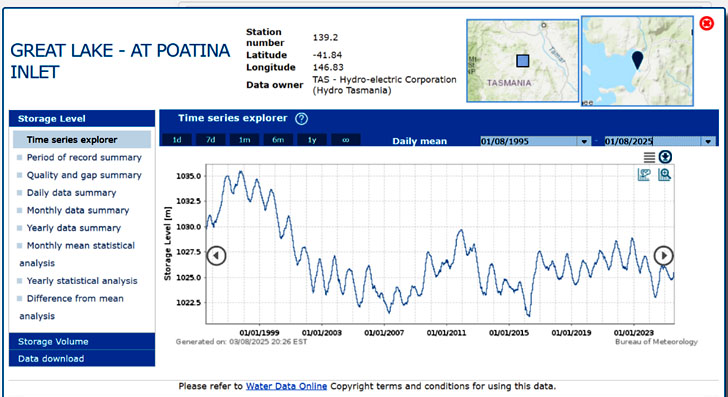
Great Lake is now sitting 13.83 metres short of that elusive goal.
Since the 2015 debacle brought on by ministerial intervention to crank up Hydro’s exports via Basslink, a Prudent Supply Level (PSL) of between 30 to 60% of capacity must be maintained.
Then there’s HRL – High Reliability Level – which is a reserve held for energy security, especially in situations like a Basslink outage and low inflow periods.
What we don’t have from our hydrologists, and what the Tasmanian public would be interested in, is the percentage of water held in storage. (It’s not aligned mathematically to the level of a reservoir which is essentially cone-shaped).
Going out on a limb (but a safe one) I’d suggest that our storage is below 40%.
Driving past, it looks wonderful. But watching the level regularly, I note the scrooge-like control over water which now falls through the Poatina power station.
Commentators, including briefed-up politicians, will tell us that water can be switched on and off through our hydro generators “within minutes”, enabling Hydro to jump in and keep the NEM stable.
That’s untrue. But what is easier to understand is the ability of battery electronics linked to the grid to undertake this vital procedure in milliseconds.
Which is why global giant Neoen is building a whopping 560MWh unit at the foot of the Tiers, below Poatina, beside the Palmerston substation.
Their $2 billion investment is to make money by delivering or absorbing energy as demand requires (frequency control and load shifting) on occasions where that cost to Hydro begins to tally in the millions of megalitres and the millions of dollars.
Four of the five solar projects to be built in this state will have a Large Scale Battery (LSB) as part of the development. Of the 13 wind projects currently at various stages of approval in Tasmania, five have indicated that they will also install LSB storage.
Operators have seen the financial disadvantage in switching off the turbines or giving the solar power away free. Tumbling battery prices have seen to that.
Barnett’s call for the open-slather turbine build was predicated on this cheap-as-chips wind power which allows Hydro valves to remain shut, holding the precious water battery in readiness for the “Big Call”.
It’s also worth remembering that it’s this “free” wind power which is to push water back uphill for reuse at our $3.3 billion Cethana pumped hydro scheme – perhaps the Shaggy parasol fungus to complete our now cold Marinus mushroom serve.
So in between courses and elected governments, here we are, having dined from the mushy menu – the unashamed “piece de resistance”, the proud legacy of a bloke and his staff who may be relegated from chefs to dish-pigs within days.
However, Tasmanians are still in the dark.
Dean Winter’s Labor team unabashedly supported Project Marinus and all it entails, while signing away the right to disseminate what little they knew as they gave it a second caretaker period nod.
Professor Anne Twomey’s worthy opinion sees an incoming Labor-led government with no recourse to annul the deal made with the Commonwealth and Victoria.
We’re a long, long way from enjoying the sweet tastes of desserts – and the mushroom complex should weigh heavily on our minds as Tasmanians try to ignore that sick feeling growing in the gut.
Part One of Greg Pullens article is here.
Greg Pullen has a keen interest in renewable energy transformation, in particular its benefits for Tasmania. He is a firm believer in the KISS Principle.
Tasmanian Times (TT) is a community-based news and current affairs service covering the island state of Tasmania. It exists to provide a diverse view of Tasmanian issues. TT creates and supports independent media content utilising the best of modern technologies and tried-and-true practices of public-interest journalism.
Support us in expanding our coverage and developing new content by and for Tasmanians.
New initiatives on the way include:
- a weekly podcast covering current affairs
- a revamped website
- a monthly cartoon competition
- a user-friendly app for both Android and Apple devices
- a weekly roundup of key stories