
What’s on the Menu?
· Energy entrée
· Cable consommé
· Victorian-style mushroom main
· Decades-on dessert
Tasmania is now inextricably tied to Project Marinus.
While the billions needed to repay associated infrastructure loans will soon filter to all power consumers, it could be a decade before we review how this state ceded its energy autonomy last week, and was shackled to the millstone of stranded assets.
Is a “progressive dinner” the way to go, after years of relentless force-feeding?
Part One
Using an expression like “the mushroom complex” after the recent focus on a Victorian dinner party might seem a touch insensitive, but it truly describes the poisonous process which now sees Tasmania committed to Project Marinus.
The similarities are strikingly similar in that poison was baked into the offering, and the guests of the cook (read “taxpayers”) failed to realise they were being “kept in the dark and fed bullshit.”
Our power will surface near the court town of Morwell, where the details of a noxious meal were examined forensically, long after the demise of close family.
It’s not a blanket criticism to suggest that very few Tasmanians really understand the nature of the renewable energy transformation that’s happening in this country, because it comprises highly-specialised and ever-evolving technical issues.
But if we stick to the KISS principle (Keep It Simple, Stupid), one thing should have been abundantly clear: Tasmania is not “transitioning” to a green energy power system. We have one, and it’s been ticking along for 110 years.
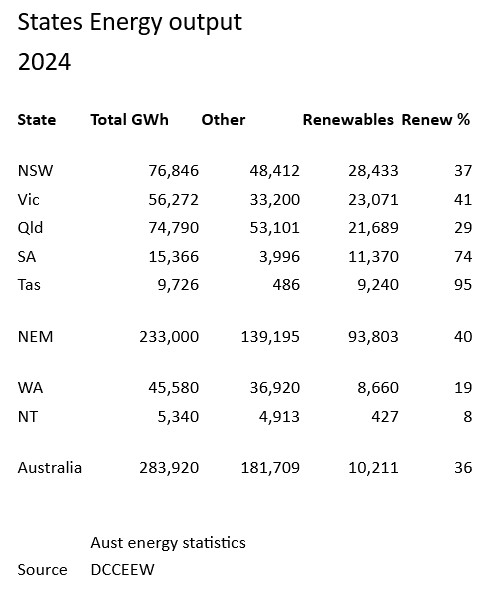
The Australian Energy Statistics report from June 2025 states Tasmania produced 95% of its 9726 GWh (gigawatt hours) of power from renewables – down from 98% the year before. Tamar gas and Victorian coal have been a growing staple in our energy diet every day.
The first Death-Cap to flavour the energy “sauce” is the outdated and total false belief that we are the greatest “source “of renewables in the country.
We’ve recently been usurped by South Australia, and sit in fifth spot – that’s 5th – losing another place in the past twelve months.
Our island contributed just 4.2% of all energy on the National Electricity Market (NEM) and a falling 9.4% of renewables.
 Without the need for complex explanation, even those least interested in where their power comes from see the daily tide of technical innovation swirling around them – from the way they order fast food and make a bet on the footy, to the clothes they wear, the cars they drive, and what AI passes off as reality.
Where their interest most definitely lies is at the hip pocket – and having been invited to the renewables feast unaware of the recipe, have found out at the literal “last minute” that it’s not a free feed.
Someone (and it wasn’t the Salvos) have quietly placed a donations bucket on the table. It has “network charges” inscribed in very fine print.
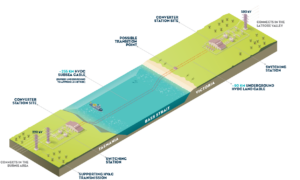
Project Marinus – the bit which a constitutionally constipated premier and his dugong sidekick signed us up to on Thursday evening (31 July) – is billed as the main course. Many of its dubious political ingredients have been scraped from the bottom of the barrel.
No-one knows “the deal” that was negotiated – literally no-one, other than a handful of caretaker politicians and their unknown advisors.
Is Tasmania’s cash injection of just $103m (and not a red cent more?) our total commitment to the “bloody good deal” which caretaker Rockliff has negotiated?
Will energy minister Duigan ever abandon his “commercial in confidence” crap and reveal to Tasmanian shareholders how much equity TasNetworks transferred into the new Marinus Link Pty Ltd when it, too, was quietly transformed with Labor support during our previous snap electoral disruption in March 2024?
If we sell out after construction as he suggests (and that’s at least a decade hence) what would be the return? More frighteningly, what would be the return on a useless, stranded asset, and the billions owed for publicly-owned, debt-funded infrastructure that is to be built to underpin it?
It’s these add-ons to make the cable viable that form the Ghost Fungus in the pie.
Firstly, there’s $950 million for the North West Transmission Developments, stage 1. The total cost is estimated to be $1.45 billion. Then the yet-uncosted upgrade of the Waddamana to Palmerston transmission line – all funded with borrowings by TasNetworks. These lines are necessary to get privately-owned wind power to the Marinus Link export hub at Heybridge.
Currently we have Hydro Tasmania’s rebuild of the Tarraleah power station – estimated at $750 million today. On top of that there is the Cethana pumped hydro scheme – a debt-funded component to justify Marinus cable #2 with a ballpark price tag of $3.3 billion. Another liability on Hydro’s balance sheet – which is raided by government for the Renewable Energy Dividend, and paid out annually at around $30 per Tasmanian household.
The cost of constructing and operating these energy assets will be added to all power bills – domestic, business and industrial. It’s not a simple matter of servicing the debt, but a fixed annual rate of return will be applied to Marinus by the Australian Economic Regulator. That “privatise the profits and socialise the losses” flavour is also present in the Marinus meal.
Dr Bruce Mountain, Professor and Director of Victoria Energy Policy Centre at Victoria University, calculates this cost as over $400 million per year.
According to this energy veteran we’re through the crust and into the meat. It’s about this time, over a glass of sparkling red (debt) that those gathered begin to reminisce.
In 2020 the Marinus idea really got a boost when perennial energy minister Guy Barnett was able to pass his 200% Tasmanian Renewable Energy Target (TRET) glibly assisted by the vacillating Rebecca White “opposition”.
Government energy policy departments were rebranded with glitzy websites and glossy brochures, all geared to hit hard at any person or group – expert or increasingly alarmed – who might oppose this Liberal “vision”.
This is a critical juncture in the table talk, and unequivocally pinpoints Tasmania’s falling position in the renewables stakes.
Barnett asserted that by doubling Tasmania’s energy output by 2040 the newly-minted “battery of the nation” phrase would become a reality (rather than a handy slogan). We’d increase our 2022 output up to 150% by 2030, and double it by 2040.
Nothing, not one word, was said when just days later the South Australians had the temerity to raise their energy target to 500% of current output.
(Cynics like this writer were astounded, that after a quick consultation with Liberal advisors the Federal Hotels Group, our energy minister didn’t up the ante to 700%).
That increase to Tasmanian energy output is more than doubling. From 3023MW (megawatts) of installed generation in 2021 there are now around 1300 turbines with a combined nameplate capacity of 7525MW on the drawing board, plus 1111MW of proposed solar.
Our landscape is about to be changed in a manner which will (sadly) have to be seen to be believed, much of it to fulfil the Marinus prophecy.
The question needs to be asked: Why? Why pay to have wealth-creating energy shipped out of our state?
Part Two of the article (to be published next week) challenges the core assumptions behind Project Marinus, arguing that the technology it relies on is outdated and that Tasmania’s hydro resources are not as reliable or abundant as the government claims.
Greg Pullen has a keen interest in renewable energy transformation, in particular its benefits for Tasmania. He is a firm believer in the KISS Principle.
Tasmanian Times (TT) is a community-based news and current affairs service covering the island state of Tasmania. It exists to provide a diverse view of Tasmanian issues. TT creates and supports independent media content utilising the best of modern technologies and tried-and-true practices of public-interest journalism.
Support us in expanding our coverage and developing new content by and for Tasmanians.
New initiatives on the way include:
- a weekly podcast covering current affairs
- a revamped website
- a monthly cartoon competition
- a user-friendly app for both Android and Apple devices
- a weekly roundup of key stories