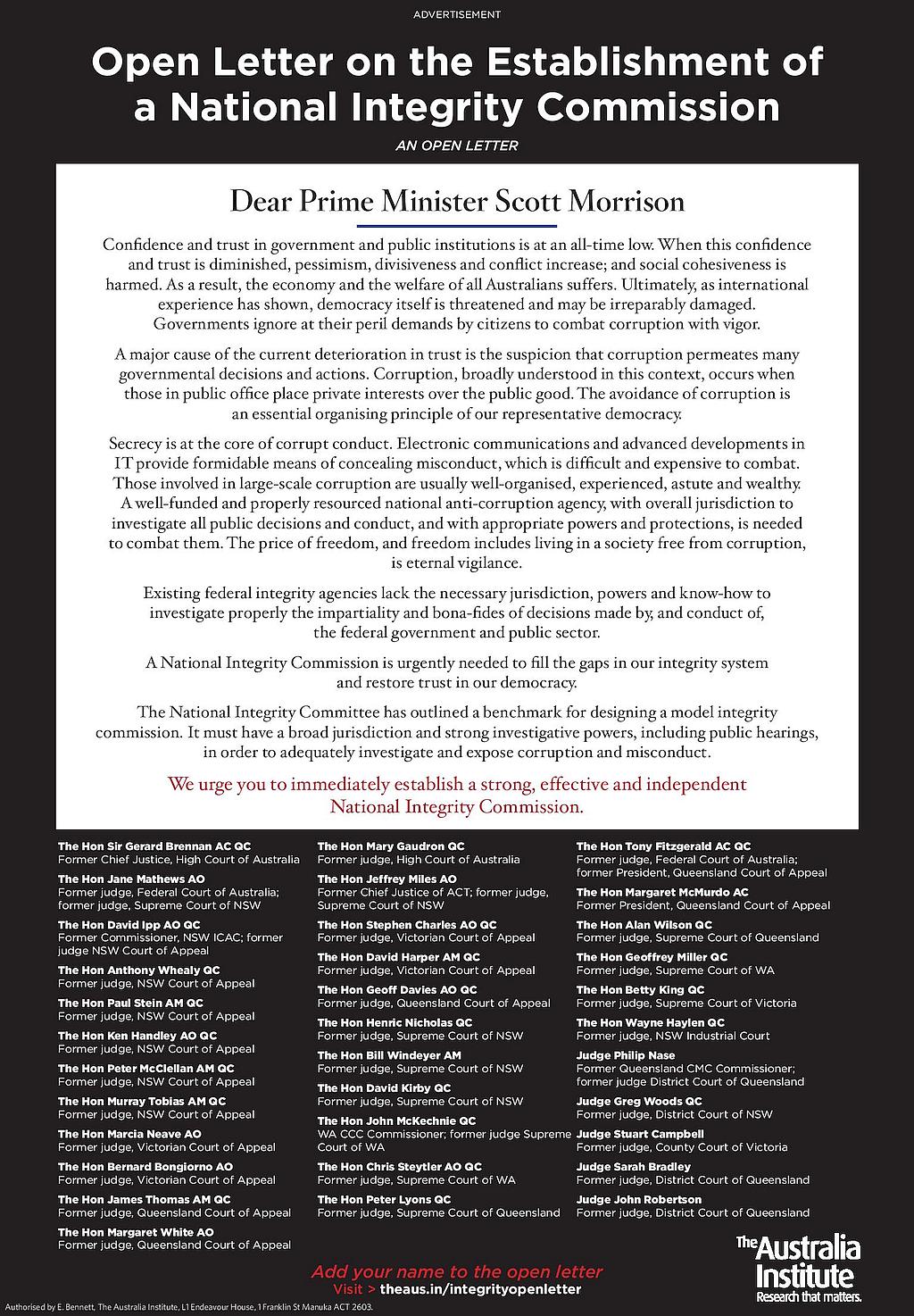

It is interesting that 59 eminent Australians have now signed an Open Letter (see below) calling on the federal government to enact legislation for an urgently needed Federal Integrity Commission.
Why has it taken 10 years for Rebecca White to ask why the Tasmanian Integrity Commission has no legislative power? Who was responsible for setting up the legislation for the Integrity Commission and how much in public funds have been wasted on this powerless organisation over a ten year period?
In addition to this failure, why does a complaint to the Ombudsman take approximately three years to be processed. Why are the federal and state government cost shifting their responsibilities onto ratepayers. Why are councils accepting these responsibilities and costs on behalf of ratepayers?
GRAINpower (Glenorchy Residents Action Information Network) was born out of the clear failure of public policy linked to the state government and Glenorchy City Council and the need to establish an effective means of communicating with the Glenorchy community. Public policy failure has a human cost and members of the community are no longer prepared to accept the stories that are spun through the conventional news sources here in Tasmania.
The community wants truth in reporting. A recent example of this was when mainstream digital headlines on 17 June reported:-
Glenorchy City Council “2.5% rate increase and back in surplus”. This headline was misleading and failed to take into account the rate increase was really 5% and the Council would not be back in surplus till 2025-26 with 3.5% rate increases each year until then. There was no mention of dealing with the massive $9.6 forecast in February and $7.7 million revised deficit forecast in April for this financial year. Why has there been no mention of this massive deficit?
This is truly concerning for the community as the transparency and accountability Peter Gutwein promised after the dismissal of the previous council has not eventuated. This council took over in January 2018 with a surplus and introduced a 12.5% rate increase which has yet to be explained. The council blamed the $887,000 cost of the Board of Inquiry but most of that was include in the 2017/2018 budget with less than $200,000 outstanding. The rate 12.5% increase was the equivalent of $4 million per year.
GRAINpower has asked a list of questions to candidates standing for the Glenorchy by-election.
Public Policy Failure & The Spin Continues
A simple explanation of ‘public policy’ concerns why, how, when and where of decision making. Systems around public health, education, transport, housing and justice should (in an ideal world) be designed and resourced to respond to the most pressing challenges in those areas. Competent public consultation, transparent design, accountable management and audited oversight of public resources should lead to public policy outcomes that are robust, sustainable and reliable.
Sound public governance in Tasmanian government sectors should lead the Tasmanian public to confidently invest their trust in those responsible for the oversight and investment of vast sums of public money to manage and drive improved outcomes for Tasmanian citizens.
Sadly, the reality of trying to navigate the public policy systems are harrowing intergenerational stories of policy continually failing even the most basic needs of ordinary Tasmanians. Tasmanians forced to navigate the increasingly toxic systems are constantly met with complex, poorly designed, poorly resourced, crisis managed stop gap short cuts.
For things to change ordinary Tasmanians need to drive a hard-headed and honest reality-based outcomes assessment process. That is, concentrate on the reality and cut the spin. The question of why so many public policy failures are normalised and see Tasmania at the bottom of so many measurement indicators requires serious, respectful and honest conversations. Tasmanian citizens need to be able to clearly identify and understand why, when, where, how and who is repeatedly driving public policy settings in the wrong direction.
The failure of public policy is the reality but the politics of Tasmania is the spin.
Parents trying to get help for their children can tell you this.
Tasmanians trying to catch a bus that their family budget can afford ( e.g. including paying costly daily bus fares to get to their children to Taroona High School because there is no local inner city High School), while trying to stay dry and warm and get to their destination on time will tell you this.
Tasmanians stuck on the waiting list of over 12,000 for medical treatment that will help them regain their independence or save their lives will tell you this.
Tasmanians on the public housing waiting list of over 4000 including over 2000 single and two parent families will tell you this.
Tasmanians living on their streets rather than in a home will tell you this.
Victims of crime waiting for their cases to be heard whilst they sit in the justice system stockpile (just like the serious health system waiting list) will tell you this.
Andrew Wilkie MHR, Senator Eric Abetz and the YMCA in March 2019 announced a $6 million Community Development Grant to upgrade the YMCA for the benefit the people and young families in Glenorchy who have very limited facilities. The inaction on the spending of this federal grant is of great concern to the community. It now appears impossible to find out what is happening about the upgrade and the $6 million Federal Community Grant.
The community who had their hopes and expectations raised about this much needed redevelopment will tell you this.
The allocation of public funds requires greater scrutiny, audit and transparency if these failures are to be addressed. Public policy failures have a human face and come with a human cost and involve human suffering, frustration and pain.
The political spin attempts to distort, distract, confuse or blur the failure.
The financial return on investment (ROI) and the social return on investment (SROI) has to be clearly understood by the elected members of state and local government whose responsibility is to clearly and coherently be able to explain to their communities why decisions are made.
 Janiece Bryan is Coordinator of GRAINpower, the Glenorchy Residents Action Information Network.