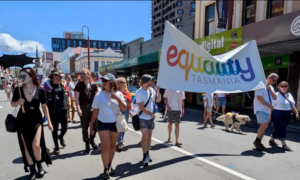

Transcript of media conference with Noel Mundy, Anglicare Tasmania General Manager, Housing & Community Services; John Stubley, CEO Hobart City Mission; and Brad Watson, Salvation Army, on the harm caused by poker machines and the need for increased regulation to reduce harm, Parliament Lawns, Hobart, 27 April 2021.
They are part of a coalition (see image below) calling on all candidates and parties to commit to making poker machines safer — and a genuinely recreational product — by introducing:
- $1 bet limits.
- Slower spin speeds (six seconds).
- Prohibit ‘losses disguised as wins.’
- Smaller jackpots.
- Higher return to player.
- Reduced opening hours for poker machine venues.
- Mandatory staff intervention when harm is occurring (as is the case with responsible service of alcohol).
Read the full 2021 State Election Joint Statement on Poker Machines in Tasmania.
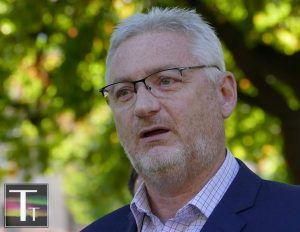
Noel Mundy.
Noel Mundy
We know that there’s too many poker machines in Tasmania. We also know that they are a recreational facility for some people. But sadly, we, we know that there are so many people in Tasmania, who are addicted to poker machines and the harms that we see every day through our services from people that just can’t stop. This is a fantastic opportunity with an election for each and every politician to come out, each candidate to give us their their views on how we can reduce harm from these machines. There are many things that we’ll be calling for today. But we believe this is a fantastic opportunity for that to happen.
Journalist
(inaudible) disappointing at this stage?
Noel Mundy
Absolutely. It’s, as I say, it’s something that’s affecting everyone in the community, whether you’re the person that’s addicted, we all know people that are addicted to these machines. So a great opportunity for every politician, every candidate to come out and state their personal and party views on these machines.
Journalist
What sort of policies would you like to see?
Noel Mundy
There are a number of things that we believe could reduce the harm of addictions to public machines. One would be immediate introduction of a $1 bet limit so that people cannot lose so much. Increasing the speed from three seconds to six seconds. So again, you’re not constantly losing that money. Every hour, you can lose $600 in the current situation. We can also look at reducing the opening hours of the facilities; they are open 20 hours a day. That is not targeting people that are looking for recreational support.
Tasmanian Times
One of the measures you’ve mentioned here is mandatory staff intervention when harm is occurring. Are there other jurisdictions where that occurs?
Noel Mundy
Absolutely. Our services across the state are running programs for venues on how to identify and reduce the risk of harming through gambling. So we’re providing that support to the venues. We need the staff trained and being willing to identify those people that are addicted. And then we can put in place supports around those people and their families and their local communities.
Journalist
Would you like to see pokies out of pubs and communities?
Noel Mundy
Yes, we’ve called for that at the previous election. Obviously, that didn’t get up. But certainly we believe that there are too many machines, and a lot of them are based in the lower socio-economic areas, which are really targeting vulnerable people.
Journalist
The ABC understands Labor has done a backflip on its policy. Are you disappointed in that?
Noel Mundy
Yes, absolutely. The Labor Party went to the last election with a very clear policy on pokie machines, and it does appear that they have backflipped, as you say, on on that commitment. We are very disappointed. We are disappointed they didn’t come back to the community services sector and get our views. We worked very closely with them at the last election.
Journalist
If Labor though was punished at the polls for their policy, what does that mean for (inaudible)?
Noel Mundy
What we understand is that there’s legislation that will go before parliament in the next parliament. So certainly, we would be very keen to continue to advocate on behalf of the bundle of people of Tasmania that are addicted to these machines. So that that legislation has a number of protections in there to stop the ability to lose $600 an hour.
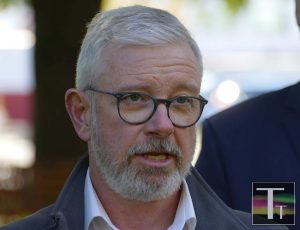
John Stubley.
John Stubley
John Stubley, CEO of Hobart City Mission. Poker machines are designed to be addictive. They are essentially as addictive as heroin. So that’s a hard concept to get your head around, but they work in the same way on your brain. So people who are addicted to gambling don’t actually have control. It’s not recreational, they don’t have a choice of walking away from the machine. They are addicted to it. The impacts are immense throughout the community. Obviously, it doesn’t only impact the person who is addicted, it impacts their family, it often results in them losing everything they own into a poker machine, and then ultimately they’ll lose their family. And we’ve seen recently in the media, it often results in them losing their life.
The impacts are immense. The benefits are, dare I suggest, only financial to those who control the poker machines and probably to governments who get some of that revenue. We see no valid reason for continuing to have poker machines in the community.
The last election was not decided on poker machines, that was fairly obvious. At the time, it was very clear that 80% of the Tasmanian population wanted the removal or significant reduction of poker machines from pubs and clubs. I don’t believe that view has changed one bit. If anything, it’s probably more strongly in that vein. We are now in a position where we we only have the choice between the main parties and independents as to whether we support poker machines or not. Which is why we’re asking candidates to come forward and express or outline their approach to poker machines. It seems we’re in a position where we don’t have any choice but to now look to try and minimise the harm caused by poker machines.
Journalist
Is it disappointing that any policy commitments from other people or from the major parties?
John Stubley
It is disappointing, I guess, when you have Labor and Liberal on the same platform, and there’s an expectation that one of those parties will form government. It becomes a bit of a non issue. I guess there is the potential in this election for more independents to be elected, who may well have a sway in the party room as to what the decisions. In voting for an independent, if there is a hung parliament, that independent will have significant sway when negotiating with the major parties about forming government.
Journalist
(inaudible)
John Stubley
I think we saw in the last election that the industry voice is quite strong. I think most people would would say that that had a fair influence on the way the election was conducted at least. But as I said, I’m not sure that poker machines were a significant enough issue to be the swaying factor in the election. But it’s very clear that there are forces that have vested interests. And they obviously will do everything they can to make sure that their interests are served. From a government perspective, my view is that the government’s revenue streams have diminished over time, they have fewer revenue streams. And unfortunately, I think, across the country, governments are seeing poker machine revenue as a way of helping sustain their financial position to the detriment of the community, quite possibly at a higher cost than the financial gains to the government.
Tasmanian Times
At the candidates’ forum last Friday in Glenorchy, Labor Member for Clark Ella Haddad said ‘There will not be a right refusal for industry, if we’re elected, to veto any harm reduction measures.’ Is that commitment strong enough?
John Stubley
I guess it’s hard for us to get into the detail. Fundamentally, I guess the law should be the law. If there is harm minimisation measures in place, they need to be clear, they need to be strong. We certainly don’t want harm minimisation measures that are open to interpretation, or to be applied gently or lightly. Because we know once someone who is addicted to a poker machine is in front of the poker machine, they’re not easily or readily going to walk away from that machine. The measures do need to be very clear and very strong, in their interests.
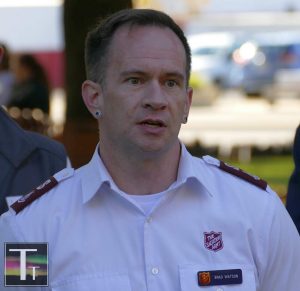
Brad Watson.
Brad Watson
Brad Watson from the Salvation Army. We’d like to see the major parties take seriously the harm that these cause in the community, to consider the disproportionate placement of them in low socio-economic disadvantaged areas, and to understand the nature of addiction and how that needs to be assisted. And that would mean instead of just leaving the door open for potential harm minimisation, actually putting on the table what those harm minimisation measures are.
The consequences of poker machines are significant. And we see every day in our addiction services, our financial assistance programs, financial counselling programs, emergency relief programs, homelessness programs, the far ranging effects. It’s been seen in the paper today as well, with the testimony of someone who died as a result. So it’s not too serious to say that people’s lives are at risk through these machines.
Journalist
(inaudible)
Brad Watson
For every person who lives with problem gambling, there are families, workplaces, and extended networks that are adversely affected as well. The cost of the community is unbelievable.
Journalist
During the pandemic a lot of people apparently took up online gambling. In your experience, what proportion of addicted gamblers are actually sitting at the poker machines?
Brad Watson
I don’t know the proportion of pokies versus others, but what we do know is that when it comes to poker machines, that 80% of the revenue that goes through those machines comes from problem gamblers. So regardless of the proportion of the population that are at risk, the significant cost is high.
PAT CAPLICE: Pokies Reform – the Path Forward.