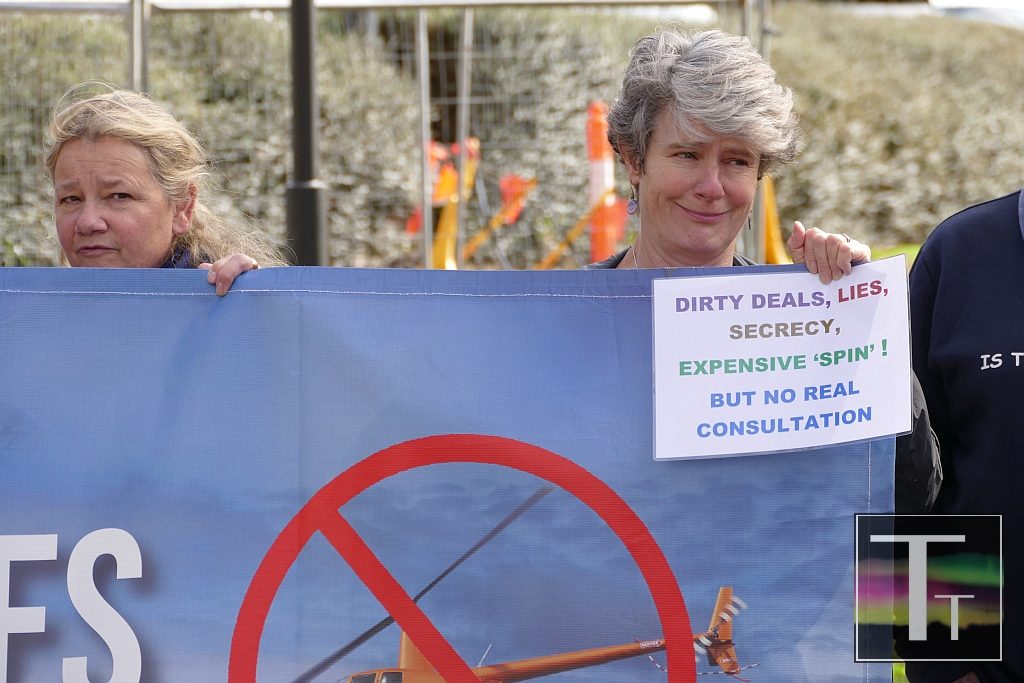
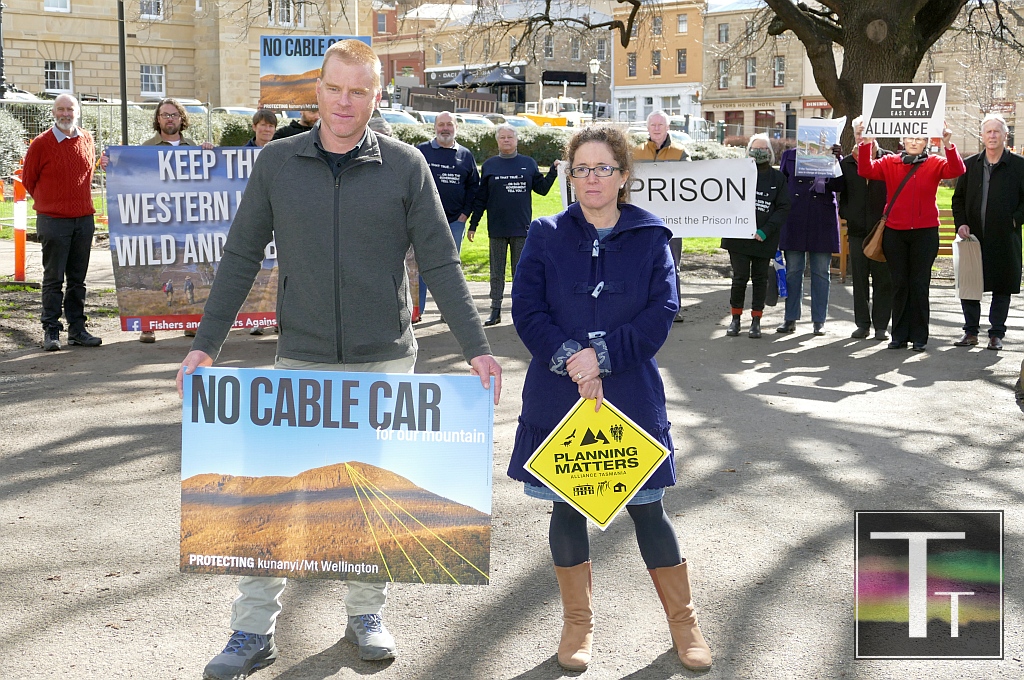
Media conference featuring David Ridley, Chair of No Turbine Action Group; Vica Bayley, spokesperson for Residents Opposed to the Cable Car (1:03); Fishers and Walkers against Helicopter Access in Tasmania (4:22); Peter Wileman, Westbury Region Against the Prison (06:15); Brian Corr, President Hobart Not Highrise (8:08) at Hobart on 24 August 2020, Parliament lawns.
transcript
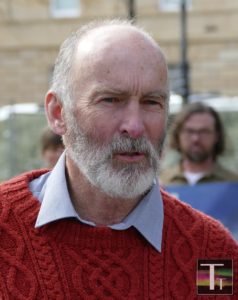
David Ridley, NTAG.
It’s David Ridley, chair of No Turbine Action Group of the Central Highlands. Well the Major Project Legislation does nothing to get the right wind farm in the right spot. It’s not underpinned by zoning where there would be no turbines allowed. Nor is there current best practice such as having five kilometre setback from towns and villages. It seals the government’s thought bubble called the Battery of the Nation, and it cements that into place, even though Tasmania doesn’t need to power and this subsidy, where taxpayers will pay for Marinus or part of Marinus. And it also cements in the killing of wedge-tailed eagles, which is authorised by the EPA.
Journalist: So what would you say to a politician who is sitting on the fence on this issue?
David Ridley: Make sure that there is proper underpinning legislation so that there are no turbine zones.
Yeah, Vica Bayley, spokesperson for Residents Opposed to the Cable Car. Well, we’re expecting the major projects bill to be debated and voted on tomorrow. We’ve had an opportunity since last week to look through the bill, the final bill in detail, compare it to the draft bill that we were consulted upon. And it confirms our worst fears that the government’s consultation process looks like little more than a tick-a-box exercise. Many of the key concerns that people have been raising over the last month remain unaddressed and still diminishes the level of community consultation and still has no rights of merits based appeal. It overrides, you know, it allows the development assessment panel to approve a development even if it is contrary to a planning scheme or a reserve management plan.
So (there are) some fundamental concerns about this bill and the process that it establishes. And an analysis of the submissions posted on the Department of Justice website shows that an overwhelming 98% oppose the bill and raised concerns about, you know, appeal rights and consultation, etc. And so 98% opposed it, less than 1% supported this bill and of them eight were organisations with a vested interest. There’s a sum total of three individual Tasmanians who wrote submissions to support this legislation. So, you know, given Labor’s commitment to put people first, to read every submission and to ensure that a final or to look closely and see whether a final bill, you know, takes into account community concerns. You know, this consultation process is an indictment. You know, 98% of people oppose this. And the bill, the final bill doesn’t correct the concerns people have been raising. So, while the Greens are deeply opposed to this, this bill, Labor and Madeleine Ogilvie have been sort of equivocal So, you know, we’re looking for some strong leadership on behalf of the community from them.
Journalist: Last week, Minister for Planning Roger Jaensch said that with all the submissions received that the government had considered each of these carefully and refined the final bill based on that feedback. Have you detected any changes that actually verify the Minister’s statement?
Vica Bayley: Oh, look, there’s been some minor changes. There’s been some tweaks, nips and tucks I guess you’d put it, but overwhelmingly the bill still enshrines an assessment process that puts the public and their rights below those of private developments. You know, there’s still not adequate consultation over developments and the assessment process of these major projects. There’s still not appeal rights, you know, it still allows major projects to be approved even if they are contrary to a planning scheme or a reserve management plan. So the government may well have read all of those submissions, they may well have considered all the points that have might been made, but they certainly haven’t incorporated them into this final bill that’s going to be voted on tomorrow. So we’re deeply concerned about that fact. And we’re looking to our representatives, you know, to show leadership and stand up for the community.
Fishers and Walkers against Helicopter Access in Tasmania. We can’t have bills like this going ahead, because the right of the common people to have a say in any planning matters, particularly about a place like the World Heritage Area in Tasmania is really, really important. It’s crucial. It’s our World Heritage Area. In fact, it’s not just ours, it’s the world’s World Heritage Area. And they taking away our right to have a say on it. The consultation would be done in secret, that’s not on it’s already secretive enough, what sort of backroom deals are going on we need to know these things.
Journalist: So are you worried? Is there a specific project that you think of concern that could be approved under this legislation that should have more scrutiny?
Fishers and Walkers against Helicopter Access in Tasmania: The Halls Island proposal is one that we’re really worried about. And that’s in the World Heritage Area. So that’s already, as I said, very secretive, it’s taking, it’s changing a boundary on World Heritage Area, it’s giving a part of the World Heritage Area to someone for a peppercorn license, $19 a week at the moment, it’ll go up, it’s gonna go up to $76 a week for a prime piece of real estate in the middle of the Western Lakes. And then they’re gonna have helicopters flying across the top. And that is across the Western Lakes, which is the one of the world’s best trout fishery areas. That’s not wilderness, that’s not on.
And the laws are already very weak. And the rules that have been drawn up around those laws have just been bent to suit their mates. And so we need a government that will represent us rather than represent their rich mates. We don’t know who’s made political donations from the last election still, and suddenly we’ve got all these backroom deals happening. So and they talk about red getting rid of red tape, but that’s really just Orwellian doublespeak for let me do this deal with my mate without you looking. The people are angry and we need people that represent us in power.
Okay, my name is Peter Wileman. I’m here today protesting against this proposed Act, because we’re fighting against the prison that’s being imposed on us by this right wing government and equally right wing local council. If this is passed, then other communities are going to have similar things imposed on them but not being able to object the way that we are able to object.
I’m particularly concerned that the Labor Party are still thinking about whether to support it or not.
If they do support it, then the point of difference between the two parties shrinks to nothing.
And I’m sure that there’ll be a backlash from the voters against the Labor Party. So they really have to stand up and support those that support them.
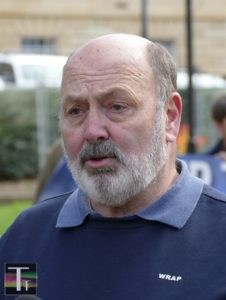
Peter Wileman, WRAP.
Journalist: Is there a case for saying that major projects, by definition, have a great impact across society and they deserve more scrutiny rather than less?
Peter Wileman: Well, I can only take I can only take our case as an example. With this, it’s been a secret business that’s been going on for years, behind our backs, and then it’s just been imposed on us. If they if they carry on with with this bill, and they say that this is state importance or whatever. This prison is of state importance, then, as I say anything can be imposed on any community without any community involvement without any community objections to it. We’ve been subject to a lot of expensive spin, lies, cheating, really dirty work over the over the last year that we’ve been fighting this in. In the future if this bill goes through then no, you won’t have the chance to object to it. It’ll just be imposed. And that’s getting towards a police state.
Brian Corr, I’m President of Hobart Not Highrise. The problem with this legislation is it still allows high rise towers into Hobart, it really is at the discretion of the Minister. There’s no other thing you can say, it allows and it’s against the wishes of the people who responded to the legislation. It’s against the wishes of 14,000 voters in the city of Hobart who wants a cap on heights. It’s just effectively giving a fast track to developers to get projects through and it was noticeable that at least Archer on on television last night, she said, this gives certainty to investors. Now, just think of those words: certainty to investors. So it’s not an assessment panel. It’s an approval process, not an assessment process. And that’s really dangerous.
Journalist: Launceston Heritage Not Highrise have been fundraising for an appeal against the Fragrance Hotel in Launceston, and they’ve been attempting to raise something like $40,000 so they can call experts and provide visualizations; that suggests that there’s already a grand disincentive for frivolous appeals. So why do you think therefore that the government thinks this legislation is needed?
Brian Corr: Well, in Launceston they’re appealing because they have the right to appeal. Right? They may win or they may not win, whichever. The new legislation does not give that right to appeal. You can appeal to the high court or the Supreme Court, but that’s going to cost you an awful lot of money. And you can only do it on a point of law. You can’t do it on the merits of the application itself. So Launceston Not Highrise are going through a process. I think that when when I looked at a project, I think they will win. But the main thing is that they have the right to do it.
ROCC: Major Projects Bill – Analysis of Submissions.