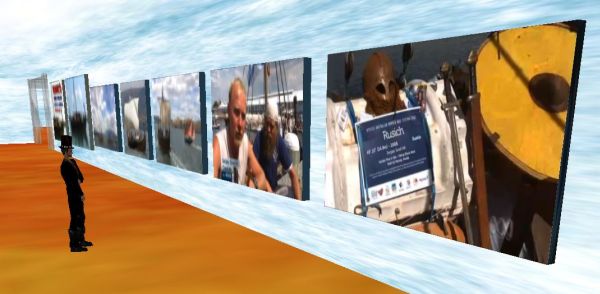
Here, I have started making an exhibition of images of the Rusich adventure. located in the Viking Life room at Sprite in InWorldz ~ and suggestions for images to include will be welcome.
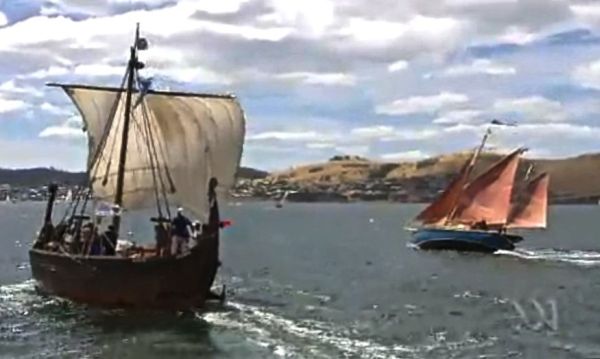
ABC Image from here: The Wooden Boat Festival
Vikings were bitten with a spirit of adventure and a love of gold, frequently gained through the slave trade and pillaging.
Many young Vikings would make their way to the east, where their agile ships could sail any river and be slid along logs past rapids.
In the eastern lands the Vikings were known as the Rus, where they established a vast dominion and gifted Russia with its name.
Just as the British remember their Viking ancestors, so do the Russians.
The first Russian to settle in Australia, John Potocki, was dispatched to Van Diemen’s Land as a convict, arriving in Hobart on 18 February 1804 and settled permanently after gaining his ticket of leave in 1810.
Military tensions between the British and Russian empires are well documented, including the Crimean War that saw the Light Brigade ride into folk legend in 1854.
Tensions rose again in the 1880s and when a Russian naval fleet suddenly upped anchor and left the Derwent River without a word of farewell, the Australian colonies bristled with fear of a Russian invasion.
Fear saw a wave of coastal defences built around the Australian colonies, including the Kangaroo Bluff Battery in Bellerive, with its mighty guns shipped from Scotland.
Cooktown expected comparable defences, with its goldmine nearby, but all they got was a cannon, two rifles and an officer to hold the line.
The cannon is still housed in Cooktown and fired once a year, in remembrance of Captain Cook’s long port call there to repair his ship.
It is in this mix of history and memory that the Russian adventurers, twin brothers Sergery and Alex Sinelink, have built a Viking ship using the boat-building techniques of the Vikings.
They set sail from the far north on a two year voyage along rivers, through pirate infested waters and arrived in Darwin last year, where locals became suspicious about a peculiar looking boat and wondered if it might be brimming with refugees.
Once customs had settled the visa matter, the Rus adventurers were on their way to sail the eastern seaboard of the land Down Under.
They managed to elude the Cooktown cannon, sailed into Brisbane and made their way down the coast to Sydney, where they were a short-lived hit at the Australian National Maritime Museum in Darling Harbour.
Then they were raising the sail again to head further south to Hobart, to participate in the Australian Wooden Boat Festival.
This epic adventure is dedicated to the memory of another Russian, Nikolay Mikluho-Maklay, who arrived in Australia as a free settler in 1878 and married the daughter of the Premier of New South Wales.
Mikludho-Maklay was an anthropologist who voiced concern about the Australian slaving habit in the Pacific and the push to colonise New Guinea.
The Rus Viking maritime journey to Hobart was a success and in time to be at the Boat Festival.
Those guns at the Bluff Battery looked on in steely silence, but the only shot of consequence that ever came from them hit the sand dunes in Sandy Bay, creating an alarm of a different kind.
By all reports the Rusich Viking ship is greatly loved in Hobart and it may be wondered if the Hobart Port authority might impound the ship as a treasure and good tourist drawcard for the town.
The Rusich is not the first replica Viking ship from Europe to reach Australia, as this honour must go to the Saga Siglar from Norway, which sailed into Sydney Harbour in 1985.
Sadly, the Saga Siglar was lost in a storm at sea in 1992, near Saville along the coast of Spain.
In 2005 there were three smaller replica Viking boats from Denmark at the Wooden Boat Festival, arriving in a container, but it is the Rusich that is the first replica Viking ship to reach Hobart upon the ocean waves from the other side of the World.
Some reports suggest that the Rusich will be sailing back to Sydney for a museum future upon the harbour.
Should Hollywood gold fire the imaginations of the Viking adventurers, they may decide to sail east to New Zealand, where Peter Jackson may be inspired to start scripting an epic Viking movie, or three.
Whatever the future of Rusich and I hope it is to avoid the fate of the Saga Siglar, welcome and thanks for the inspiration.
Now for a horn of mead to honour the ancestors.