A Tasmanian Times exclusive – solutions based journalism
I attended the Tasmanian Beekeepers Association Conference last week and was surprised to hear about the lack of vigour in mitigating the risk of Varroa mite entering Tasmania. Then I heard about a new risk on the horizon.
There’s a lot to unpack, so let’s dive in…
The big picture:
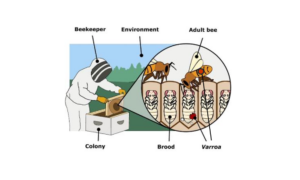
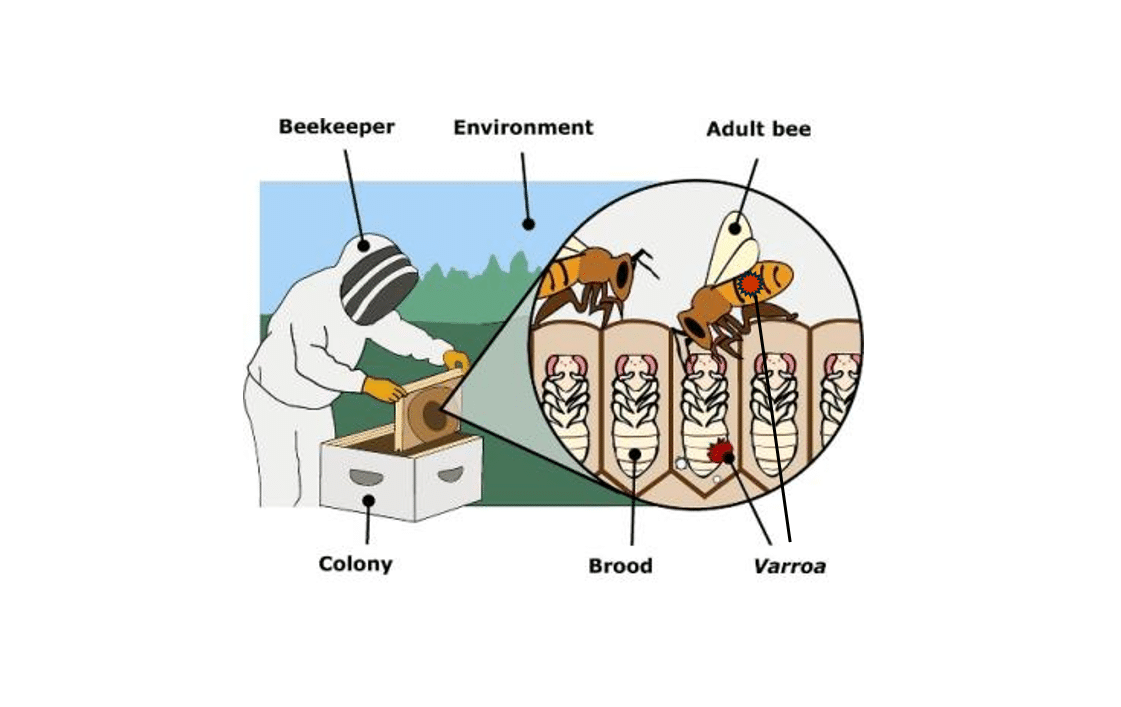
There are two cohorts of honey bees across the world: wild/feral bee colonies that live in natural places like tree hollows, and bee colonies that live in constructed bee boxes and are managed by commercial and recreational beekeepers (managed beehives).
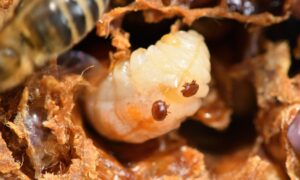
The bee mite, Varroa destructor, is a natural parasite of the Asian honey bee (Apis cerana), which is resistant to Varroa, as are several species of African bees. Movement of Asian bees and bee products throughout Europe and the Americas spread the Varroa mite globally.
Without a natural resistance, Varroa is devastating to European honey bees (Apis mellifera).
There are only a dozen or so Varroa-free places left on the planet and almost all of them are surrounded by water.
They include Newfoundland (Canada), the Åland Islands (Finland), Colonsay (Scotland), the Isle of Man (UK), the Hawaiian islands of Kauai, Lanai, Molokai and Maui, the Chatham Islands (New Zealand), Niue Island (South Pacific), parts of Norway, the islands of Comoros, Seychelles and Rodrigues in the Indian Ocean…and Tasmania! The strategies employed at both seaports and airports have been critical in excluding Varroa from these islands. The Isle of Man has managed to stay Varroa-free for over 30 years, since the incursion of Varroa into the UK in 1992.
European honey bees were imported to Australia in 1822, originally for honey and candle wax production. European honey bees are the sole source of commercial honey production in Australia, at around 40,000 tonnes per year. In Australia there are around 1,800 commercial and about 50,000 recreational beekeepers, with pollination services for the agricultural industry becoming a growing source of income for commercial beekeepers.
Australia was the last continent in the world to be infested with the Varroa mite (2022). Currently only Western Australia, the Northern Territory and Tasmania are left Varroa-free. Due to the inability to monitor long and remote borders, it is expected Varroa will enter WA and NT in the next few years.
When Varroa was detected at the Port of Newcastle (NSW) in June 2022, an emergency response was initiated, but it failed to eradicate Varroa. In September 2023, the National Management Group gave up on eradication and decided to move to a Transition to Management (T2M) plan instead. They created The National Varroa Mite Management Program. The A 24-month (T2M) plan was approved in February 2024 and ceased on February 6 2026.
In Victoria, the Varroa mite has now been detected in Geelong. As Geelong and Devonport are the connecting ports for the Spirit of Tasmania, Varroa is now on Tasmania’s doorstep. Even so, there is a feeling of hope within the Tasmanian beekeeping community that we can keep it out, like other islands around the world. That hope relies on increased government action and appropriate funding.
What happens when the Varroa mite arrives?
Throughout several areas in America the Varroa mite wiped out 95% to 100% of European feral bee colonies within four years, and in New Zealand feral bees were wiped out within two years. In a lot of places globally, feral European honey bees are now extinct (some naturalists say this is a good thing). Managed beehives reduce by around 40%, with some areas of America seeing a reduction in managed beehive numbers of up to 80%.
The use of chemical treatments can help manage the Varroa mite and numbers gradually recover. When beehive numbers recover, the remaining beekeepers’ workload increases by about 50% in monitoring and chemical management of Varroa. RNA-based treatments have emerged in the USA, but remain an option only when mite numbers are low. There is also some success using heat treatments to remove up to 90% of Varroa from hives, but this is also labour intensive. The cumulative impact pushes a third to half of beekeepers out of the industry.
There is some natural resistance to Varroa in European honey bees, with genetics being held up as the main hope going forward.
There is also now evidence that the Varroa mite is showing resistance to the major synthetic chemical treatments, plus the use of chemicals to treat Varroa is leaving synthetic residues in honey and wax products. Synthetic chemical treatments last a few months, while treatments using natural formic and oxalic acid last a few weeks, meaning increased labour costs in the natural/organic approach.
The jury is still out on the impact to native bees from Varroa, but viral spillover (not direct impact from the Varroa mite) is the real concern. Viruses are transmitted between bee species when they visit the same flower. The introduction of the Varroa mite changes the honey bee viral landscape catastrophically, and the viruses aren’t host-specific the way the mite is. Native bees contain more viruses where honey bees’ virus loads are high, and this occurs even in the absence of Varroa. Deformed Wing Virus (not in Australia) went from ~10% to 100% prevalence in Hawaiian honey bee colonies after Varroa arrived.
More information on the potential impact on native bees can be found here.
Honey bees in Tasmania:
Managed beehives are kept for two main reasons: pollination services and honey production. Wild bee colonies are a significant source of pollination services for home gardeners.
Wild bee colonies also account for around 50% of pollination services for the agriculture industry, effectively giving the Ag industry a free pollination service.
As of 2025, there were 42,613 registered hives around the state, and an unknown number of unregistered hives held by recreational apiarists. Tasmania has 1,867 registered beekeepers, with 77% of registered hives (32,812) owned by commercial beekeepers. Once a beekeeper has more than 50 hives, they are deemed to be a commercial operation. The vast majority of these operations are small, family-owned and operated (and financially marginal) businesses. In a lot of cases, becoming a beekeeper is a passion, not a commercial decision.
Risk to Tasmanian agriculture
If (when) the Varroa mite arrives in Tasmania, the impact will be most keenly felt by the Tasmanian agriculture industry.
The latest Tasmanian Agri-Food Scorecard (2023-24) places a combined farm gate value of $832 million per annum on the state’s fruit and vegetable sectors. Of this farm gate value, it has been estimated that $677 million is fully or partially dependent on honey bee pollination. Important fruit production sectors such as apples, blueberries, raspberries and apricots rely almost entirely on pollination for fruit set. Similarly, seed production for broccoli, carrots, clover and onions relies entirely on honey bee pollination.
It has been estimated that feral bee colonies being wiped out by Varroa represents a farm gate loss to Tasmanian producers of between $203 million and $338 million per annum.
What’s the current plan?
The Tasmanian Government, through Biosecurity Tasmania, issued a six-month General Biosecurity Direction (Emergency) on 7 January 2024. This direction to beekeepers means the importation of bees, bee products and used apiary equipment is restricted. This restriction is now permanent. A key issue for Tasmanian beekeepers has been the banning of queen bee imports into Tasmania. (Beekeepers introduce a new queen into a hive for a variety of reasons.)
Biosecurity Tasmania also developed the Varroa Action Plan 2024-2034 in May 2024 which outlines Plan A – Keeping Tasmania free of Varroa mite and Plan B – Minimising the impact of varroa mite in Tasmania (5 actions).
Plan A details actions on Prevention (6), Detection (4), Response preparedness (6) and Combined Actions (4). The majority of these actions are to be carried out by Biosecurity Tasmania and T2M partners (which no longer formally exist).
Plan B is the management plan for once Varroa arrives.
Biosecurity Tasmania also created the Varroa Mite Task Force to collaborate with industry, and has eight sentinel hives around the state, near ports, to monitor for the Varroa mite.
What’s the problem?
In short – lack of funding, which likely accounts for the slow response by Biosecurity Tasmania.
For example, five of the six actions under the heading of “prevention” in Plan A are required to be carried out by Biosecurity Tasmania. A key action is to complete an Import Risk Analysis, and more than two years later this key analysis has still not been completed.
The Minister for Agriculture, Gavin Pearce MP, stated in his responses to questions taken on notice (12 June 2026) that Biosecurity Tasmania has completed three of 25 actions in the Varroa Action Plan 2024–2034 (actions 2.2, 3.2 and 4.2).
There is also a belief that the government has already given up on prevention and is simply waiting until Varroa arrives, at which point it will move into management. While having a weather eye on Plan B is wise, surely Plan A must be implemented quickly, especially when other global risks are considered.
A further problem was outlined at the Tasmanian Beekeepers Conference, and that is the potential threat from another Asian mite called Tropilaelaps, which is more deadly to European honey bees than Varroa. This mite has now spread around the world and is already in Papua New Guinea. It can outcompete Varroa and kill a bee colony in three to six months.
If we simply take the Plan B management approach and hang our hats on genetics providing some resistance to Varroa, what happens when Tropilaelaps arrives on our doorstep?
What’s the solution?
The federal and state governments have reportedly spent over $100 million combatting Varroa already, but that funding is drying up as mainland states move to management and leave it to industry to carry the costs.
In Tasmania there are calls for an immediate and significant increase in public awareness campaigns for tourists, especially at airports and seaports, and a funding boost to complete the Import Risk Analysis and implement the findings.
There are calls to dramatically increase the number of sentinel hives used for surveillance around the state. Training of recreational beekeepers could help greatly in surveillance at minimal cost.
The Menzies Institute for Medical Research, University of Tasmania, offered to develop rapid tests (basically like RATs for COVID) to allow beekeepers to self-monitor and also be used for border biosecurity. They made the offer in July 2024 and, due to the skills already being in place, expected to “…develop and validate the test in six to 12 months with proper support”. If the Government had actioned this, the test would have been validated and in beekeepers’ hands by mid-2025, before Varroa reached Geelong.
There has also been a proposal put forward to develop a Tasmanian queen rearing facility, which could mitigate the need to import queens. If this is viable and scalable, it could future-proof Tasmania’s honey bee industry and help support Tasmania’s agricultural pollination service. There is also industry-led work on insemination of queen bees to help with the queen issue.
Due to the importance of the bee industry to Tasmanian agriculture, and the annual costs from Varroa entering the state running into hundreds of millions, the Tasmanian Government could provide immediate initial funding of at least $1m to better support Biosecurity Tasmania and the above industry initiatives.
Doing so would put us in a much better position to exclude or manage Tropilaelaps arrival, rather than beekeepers taking another hit just as the industry start to recover from Varroa.
Comparing apples with potatoes
Soon after the virus was found in Tasmania, the state government invested $200,000 to fast-track research into managing Potato Mop-Top Virus, and a further $500,000 over four years to TasFarmers for a Strengthening Biosecurity Outcomes On-Farm project.
With the farm gate value of potatoes reaching $346m in 2023-24, it represents a similar number to the impact Varroa may have on the rest of Tasmania’s agriculture industry.
If Tropilaelaps also arrives it could get much worse for Tasmanian agriculture.
Hopefully common sense will prevail…
f you’re interested in this article, please join our mailing list. It’s all free … and we won’t share your information with anyone!
Truly independent media is a cornerstone of democracy.
Remember: once they gain power the first action of every despot in modern history is to take control of the media, so please consider supporting us.
Your kids will thank you and so will your Granny, but the aspiring despots won’t…