In this Op-Ed, Jenny Branch-Allen argues that the long-discussed light rail project for the Granton to Hobart corridor is financially unviable for Tasmania. Branch-Allen suggests that transforming the disused rail line into an active transport highway would provide better health outcomes and economic value without the burden of heavy government subsidies.
For years now, the disused northern rail corridor from Granton into Hobart has captured public imagination as a potential site for light rail—or even a dedicated bus system. Headlines, advocacy and local council ambitions have all flirted with the idea of transit running along the old track, touted as a transport solution that will reduce congestion, connect communities, and shape a more sustainable city. But the hard reality, reflected in every credible report done on this issue, is that such visions simply don’t add up for Tasmania’s population and planning context.
The financial case is shaky at best.
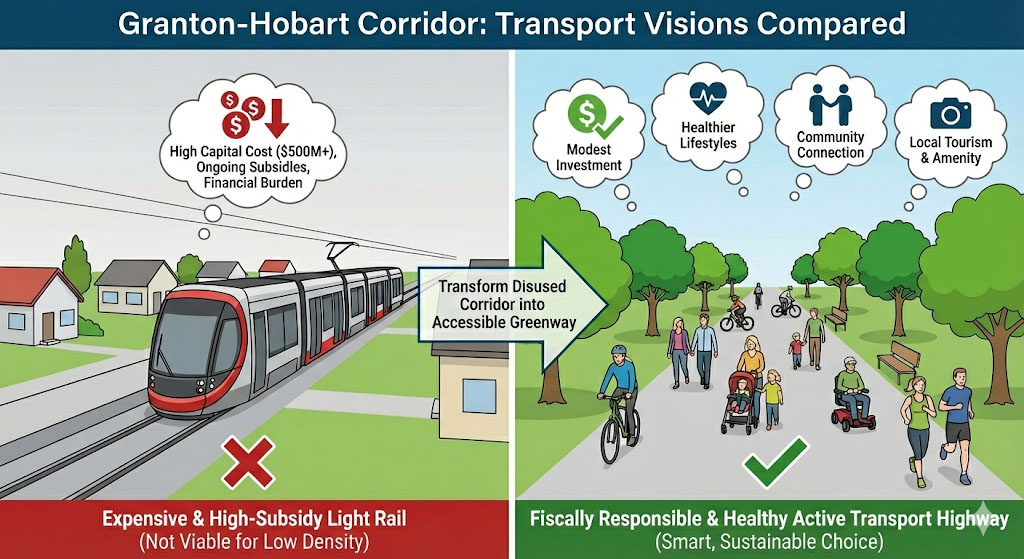
Multiple government-commissioned studies over the past decade have consistently shown that reinstating rail-based transport in this corridor would be extremely costly. A 2011 ACIL Tasman report estimated light rail at around $70 million and rapid buses at $115 million; a more recent 2020 PricewaterhouseCoopers study put light rail at between $517 million and $685 million and rapid bus transit at over $500 million. Operating costs alone were estimated at $8.3 million per year for light rail and $6.6 million for buses, figures that would inevitably require ongoing government subsidies just to keep the service running.
For a state with Tasmania’s modest population and density levels, these figures are sobering. Greater Hobart’s population simply isn’t large or dense enough to generate the sustained ridership needed to make such services financially viable without heavy, long-term subsidies. Compare that with systems in cities like Canberra or overseas urban centres: those operate at significantly higher densities and draw on larger tax bases to shoulder operational costs. Hobart’s density and mobility patterns don’t support a similar economy of scale.
We risk a burden, not a benefit.
The experience with Tasmania’s Metro bus network illustrates the point – despite substantial government support, it continues to run at a loss and relies on subsidies to operate. Repeating this model on an entirely new corridor, with vastly more expensive infrastructure, would simply compound fiscal pressure on both state and local resources for decades to come.
But there is a better, fiscally responsible alternative.
Instead of a transit line that economic reality tells us can’t pay its way, we should be looking at transforming the corridor into a world-class active transport pathway, an upgraded bike, walking and mobility scooter highway. Other places have done this with remarkable success, reimagining disused rail alignments as rail-trails or greenways that deliver tangible economic, health and community benefits.
In Australia, rail trail cycling generated 1.1 million trips and an estimated $862 million in direct spending in 2024, with benefits spread across regional economies and not just concentrated in a few urban centres. Internationally, well-used rail trails like New Zealand’s Otago Central Rail Trail see thousands of users annually and have become key local attractions.
These kinds of pathways don’t just attract tourism dollars, they deliver ongoing, accessible community amenity. Rail trails and greenways are accessible to people of all ages and abilities, including walkers, cyclists, mobility scooter users, families with prams and running groups. They provide safe, off-road spaces that promote exercise, reduce reliance on cars for short trips, and foster healthier, more connected communities.
Health research underscores these benefits. Active transport infrastructure, good-quality walking and cycling routes, consistently correlates with higher physical activity levels, reduced chronic disease risk and improved mental wellbeing. As one European model shows, regular cycling is linked with significant reductions in mortality and lower healthcare costs over time.
Tasmania has already seen what’s possible – the Intercity Cycleway between Hobart and Claremont is widely used, linking homes with schools, workplaces and recreation, and demonstrating the demand and appetite for accessible active transport options in our community.
What’s on the table?
Instead of chasing an expensive transport pipedream, we should be expanding these kinds of active transport networks. With relatively modest investment, we can turn the northern rail corridor into a high-quality, inclusive mobility artery—a space that encourages healthy lifestyles, connects neighbourhoods, supports local tourism and commerce and does so without burdening future budgets.
Building light rail or a busway through a low-density corridor may feel like progress. But progress isn’t defined by shiny projects, it’s defined by smart, sustainable infrastructure that delivers real value. Investing in active transport along the Granton–Hobart corridor does just that.
It’s time we took seriously the healthier, practical, and financially sound path forward.
Jenny Branch-Allen is the CEO of Kidsafe Tas, a Board Member and Vice President of COTA, and Chair and Board Member of the Australian Parents Council. Branch-Allen also serves as the Chapter Vice-Chair for Tasmania ACRS and is a Residents Independent Advocate for ‘The Gardens’ in Claremont.
Tasmanian Times (TT) is a community-based news and current affairs service covering the island state of Tasmania. It exists to provide a diverse presentation of Tasmanian issues. TT creates and supports independent media content utilising the best of modern technologies and tried-and-true practices of public-interest journalism.
Support us in expanding our coverage and developing new content by and for Tasmanians.
New initiatives on the way include … what our contributors and readers suggest! Please get in touch with your suggestions.