Media release – Neighbours of Fish Farming, 12 September 2023
Tania Out of Touch
Tasmanian MLC, Tania Rattray, will move a motion in the Legislative Council this morning designed to provide political cover for the expansion of the multinationals running Tasmania’s salmon industry in the face of growing community resistance.
Peter George says Ms Rattray’s motion is particularly ludicrous as she represents one of the few areas of Tasmania that doesn’t play reluctant host to open-cage salmon pens. Yet her electoral division of McIntyre includes Flinders Island where the entire council and the vast majority of the population absolutely rejects government plans to open the west coast to industrial fish leases.
NOFF President, Peter George and campaigner, Jess Coughlan, will be at Parliament House this morning to comment on the debate. The debate is scheduled for 11am, today, Tuesday Sept 12, 2023.
The motion, which originated with the lobby group, Salmon Tasmania, is intended to provide uncritical support for the industry despite mounting evidence of the impact it is having on the state’s waterways and rivers and the potential extinction of the Maugean skate in Macquarie Harbour.
The most recent opinion polling recorded 72% of respondents wanting salmon cages out of shallow, coastal waters as recommended by the Legislative Council’s own fin fish inquiry last year.
Ms Rattray’s motion refers to a Deloitte Access report commissioned by Salmon Tasmania but never publicly released for assessment, a copy of which was obtained by Neighbours of Fish Farming and subsequently denounced by eminent economist Dr Graeme Wells as containing numerous “overestimations and misrepresentations”.
The document issued by Salmon Tasmania to which Ms Rattray’s motion refers amounts to no more than industry spin in any effort to restore the social licence which Minister Jo Palmer acknowledges it has lost.
The motion proposed is:
That the Legislative Council:
1. Notes the economic analysis provided by the Deloitte Access Economics Report dated 2020 regarding the Tasmanian Salmon Industry; and
2. Acknowledges that the Tasmanian Salmon Industry is a vital social and economic contributor to the Tasmanian community.
STATEMENT BY JESS COUGHLAN, NOFF CAMPAIGNER:
It’s ludicrous that the upper house is asked to vote on this, the Deloitte’s economic report prepared by Salmon Tasmania is not the business case and cost benefit analysis that thousands of Tasmanians asked for in a petition tabled earlier this year. It is nothing but a marketing campaign, and asking Tasmanian Upper House of parliament to formally endorse it is a motion that Tasmanians should be concerned about.
Over the past month what we have seen from Salmon Tasmania has been straight out of the tobacco industry playbook. When scientific evidence has been delivered showing that this industry does cause harm, to our wildlife, our environment and even our drinking water, the industry’s play has been to cast doubt on that science, and use that doubt as a shield against cause for action.
It is deplorable that our government, the upper house, our law makers, are being asked to endorse a marketing campaign by this industry. All Tasmanians should be concerned.
This industry is not vital, it is contentious.

Media release – Australia Institute Tasmania, 12 September 2023
Support For Tasmanian Salmon Motion Would Ignore Voters, Economics and Science
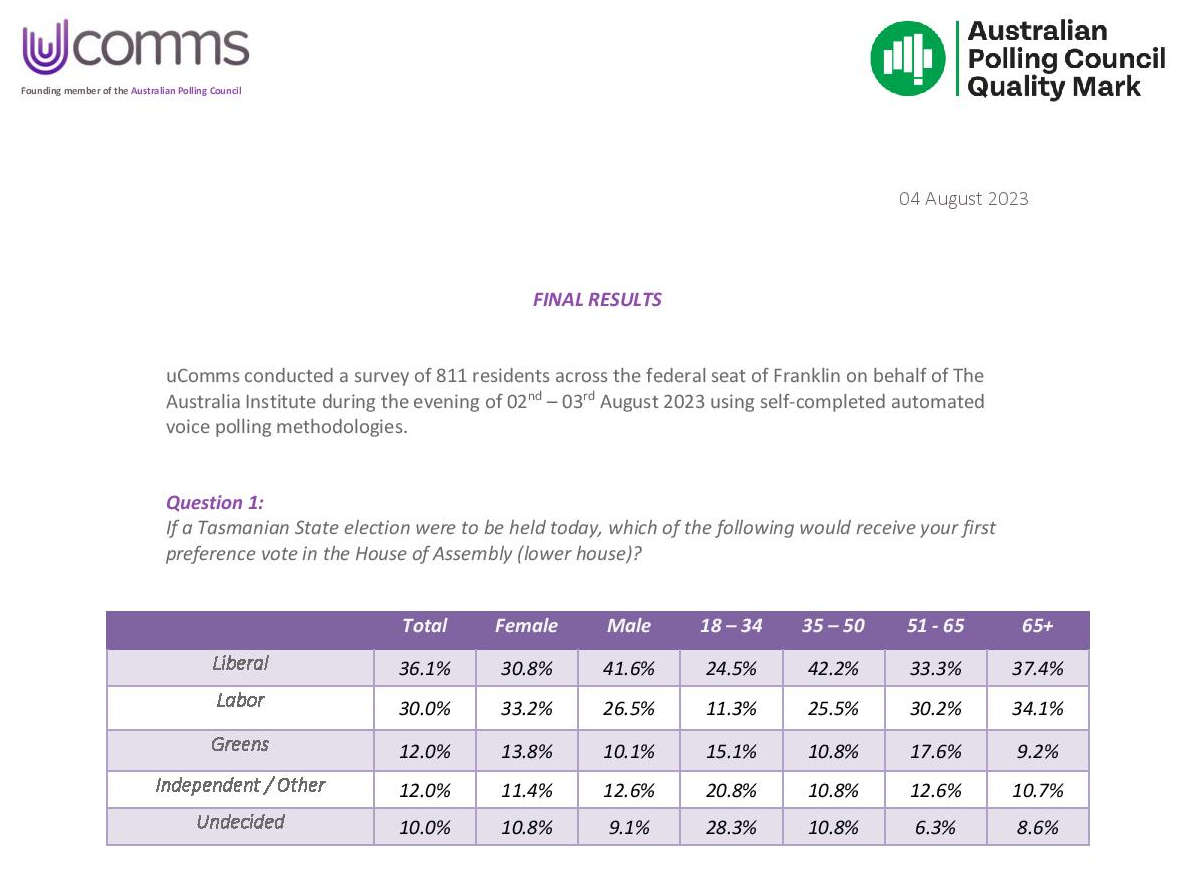
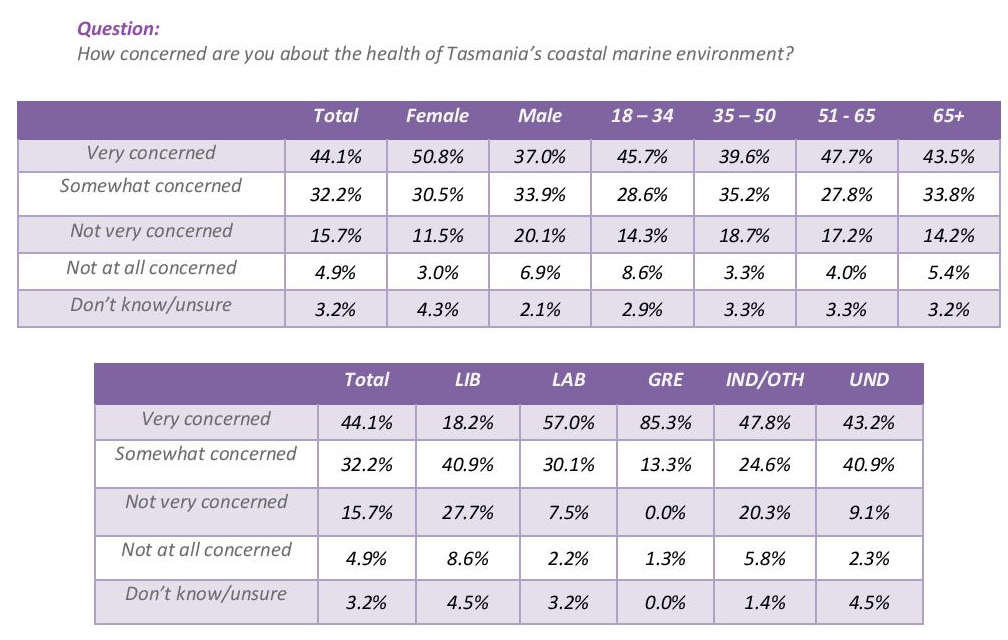
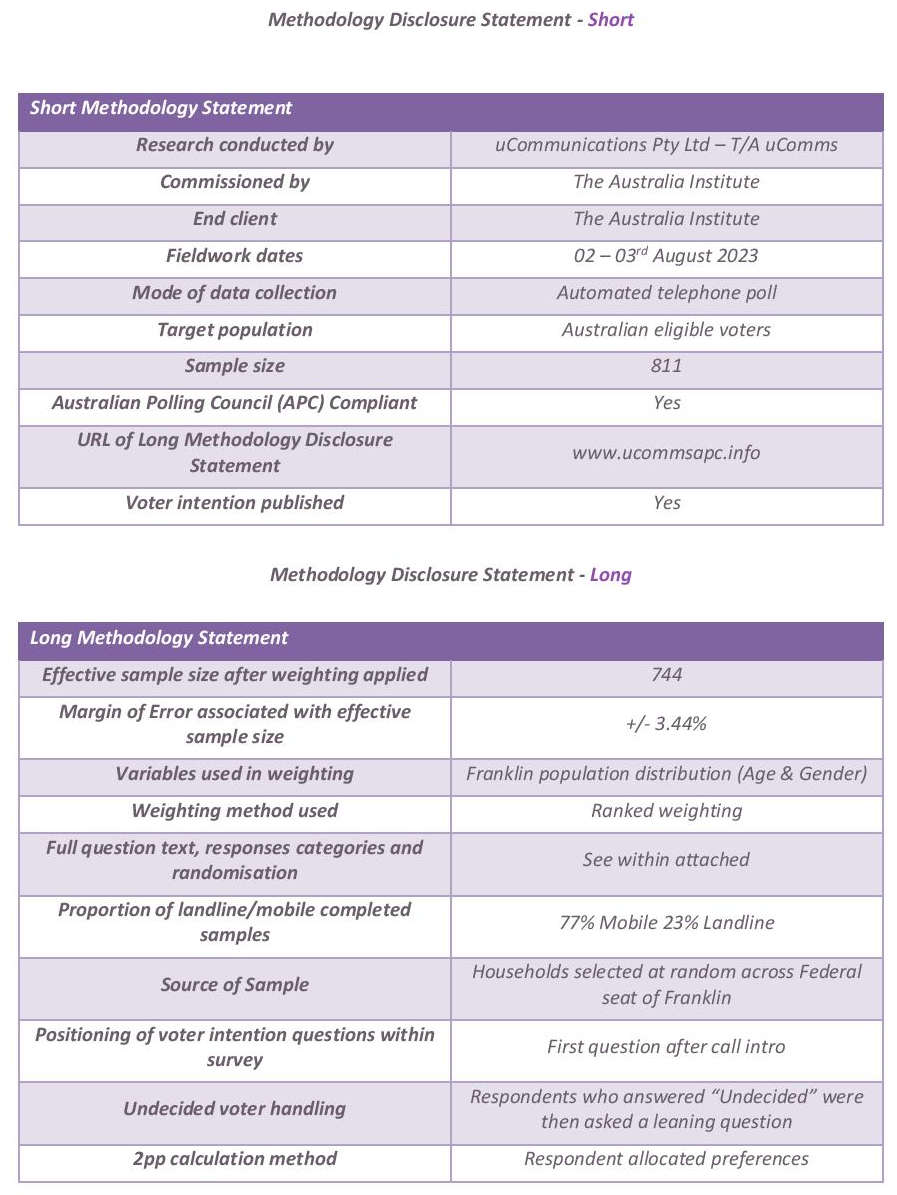
With Tasmania’s Legislative Council set to vote on a motion praising the state’s salmon industry, research released today by the Australia Institute Tasmania shows a strong majority of residents in the Tasmanian electorate of Franklin are concerned about the health of the state’s coastal marine environment, including the impacts of salmon farming on marine life.
Separate research also calls into question the industry’s claims about employment in the state.
The motion, listed for debate on Tuesday, ‘Acknowledges that the Tasmanian salmon industry is a vital social and economic contributor to the Tasmanian community’.
Waters adjacent to Franklin, the Huon Estuary and D’Entrecasteaux Channel are host to the highest proportion of fish farms in Tasmania.
Key points – Frankin voters:
- Three in four Franklin voters (76%) were concerned about the health of Tasmania’s coastal marine environment
- Concern ranged from 59% of Liberal voters to 99% of Greens voters
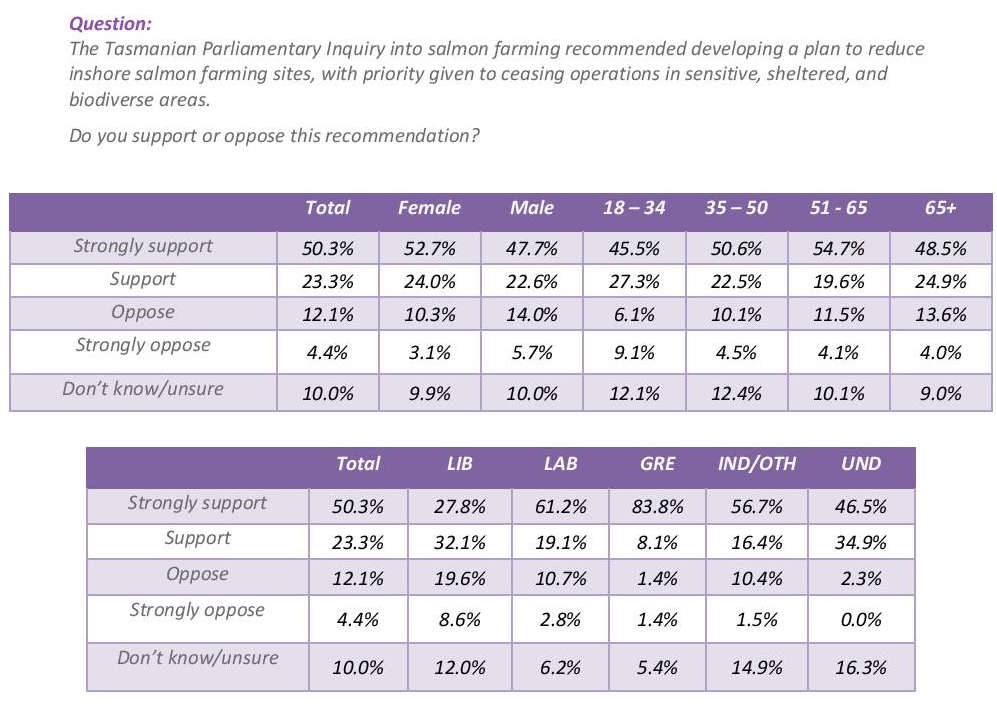
- Three in four Franklin voters (74%) support the Parliamentary Inquiry recommendation to reduce inshore salmon farming, with priority given to ceasing operations in sensitive, sheltered, and biodiverse areas
- Just one in six (17%) oppose this recommendation
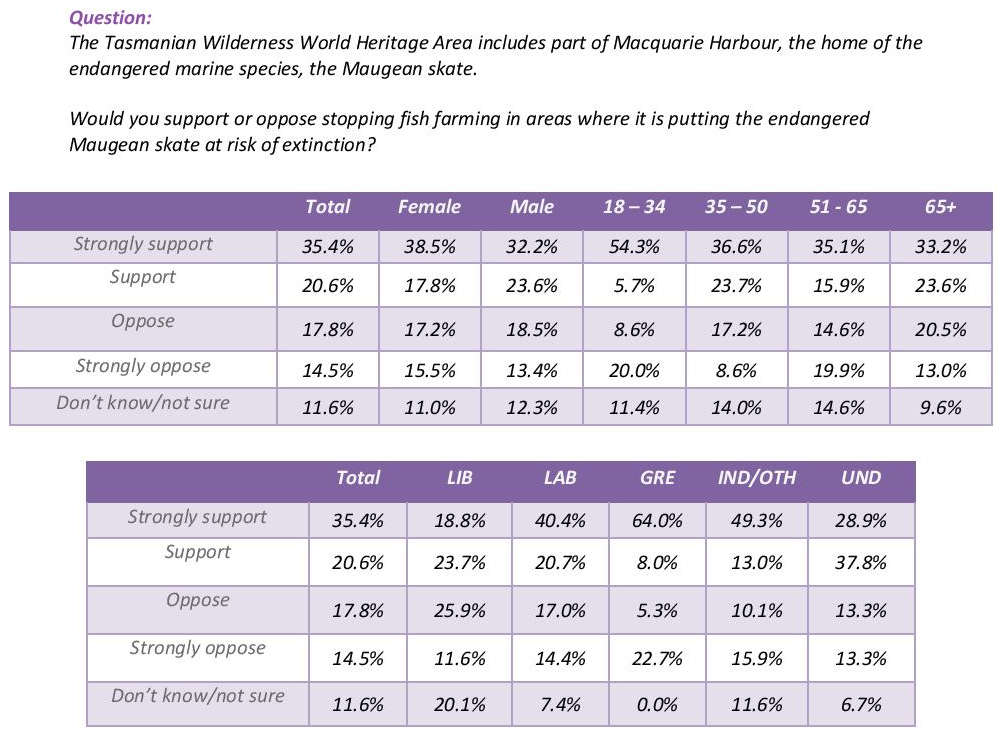
- A majority of Franklin voters (56%) support stopping fish farming where it risks the extinction of the Maugean skate
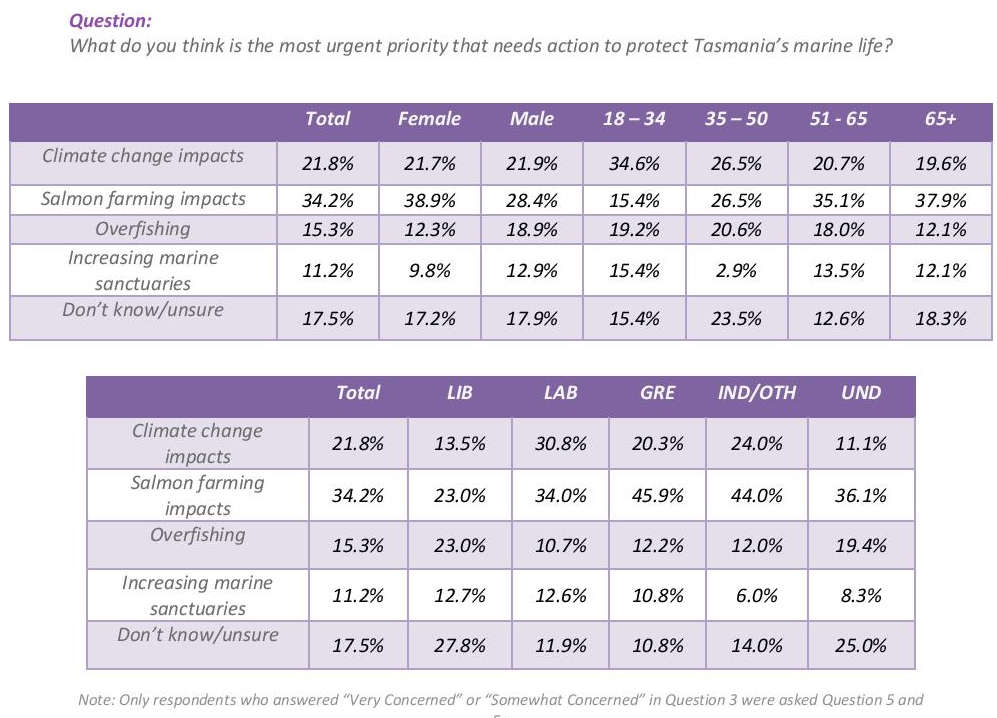
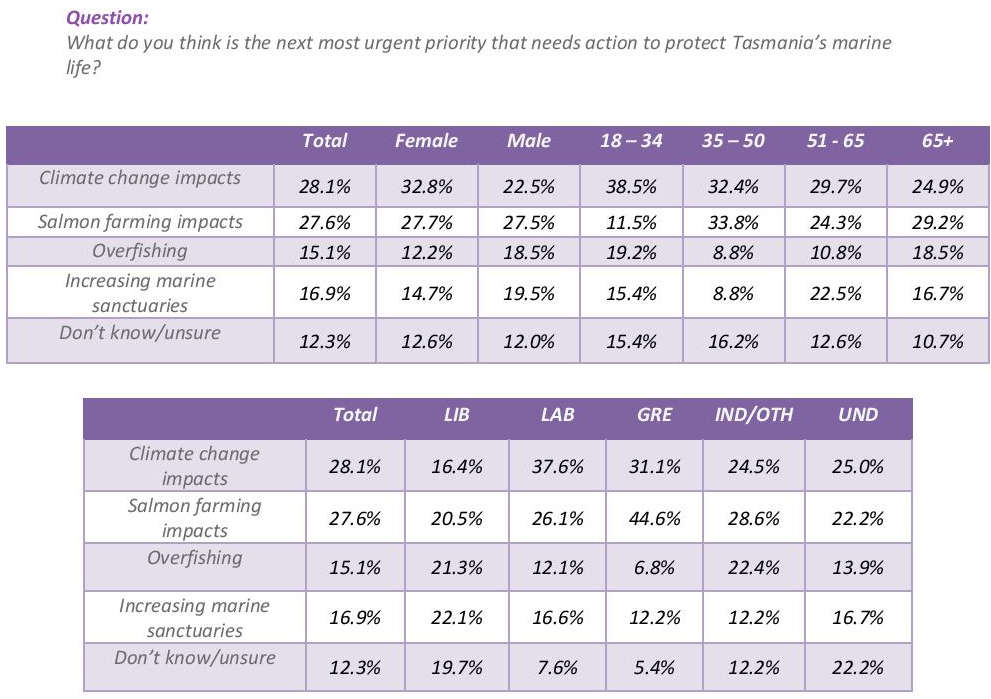
- Salmon farming impacts were ranked as the most urgent priority that needs action to protect Tasmania’s marine life, with one in three Franklin voters (34%) choosing this option
“The salmon farming industry is running an intentional campaign to exaggerate the significance of their contribution to the Tasmanian community – and supporting such a motion would show that Tasmanian politicians are swallowing their rhetoric,” said Eloise Carr, Director of the Australia Institute Tasmania.
“Franklin voters live at the heart of the salmon industry and our research shows they are deeply concerned about its impact on marine health.
“The waters off the coast of Franklin host the most salmon farms of any coastal environment around Tasmania and a vast majority of residents there want salmon farms out of sheltered inshore waters.
“Our research shows that when it comes to protecting Tasmania’s coasts, we have public opinion and scientific evidence on one side, and the vested interests of the salmon industry on the other.
“This research supports previous nationwide research, which found that three in five respondents (61%) support stopping fish farming where it puts the endangered Maugean skate at risk of extinction, while one in six (17%) oppose it,” said Ms Carr.
Key Points – Employment:
- According to Australian Bureau of Statistics census numbers, there are at best 1,722 people employed in the salmon industry in Tasmania
- This figure is almost certainly an overestimation by including employment in other seafood industries. The figure also includes seafood process workers and seafood wholesaling
- 1,722 makes up about 0.7% of employment in Tasmania, meaning 99.3% of Tasmanian workers are not employed in the salmon industry
- On Tasmania’s west coast, including Strahan, Zeehan, Roseberry, Tullah, and Trial Harbour, aquaculture accounts for 4.2% of total employment, not the 17% the industry is claiming
- According to Tourism Tasmania, 19,400 people are employed in tourism, ten times as many as the salmon industry
- Tourism employment makes up 6.3% of Tasmanian employment
“We’ve looked at the census data – the most accurate and independent data available – and the industry’s figures just don’t stack up. For the area on the west coast, including Strahan, Zeehan, Roseberry, Tullah, and Trial Harbour, aquaculture is only 4.2% of all employment. This is important to point out, because the industry claims it is responsible for 17% of all jobs on the West Coast and is therefore integral to the economic and social wellbeing of the region,” said Matt Grudnoff, Senior Economist, the Australia Institute.
“The salmon industry continues to exaggerate its economic significance to the Tasmanian community. All jobs are important in a place like Tasmania, but it is important to report accurate figures, not exaggerated ones,” said Ms Carr.
“Tourism is a major employer in Tasmania. This is particularly so for Strahan and surrounds where many tourism jobs rely on the health of Macquarie Harbour and far outnumber those in aquaculture.
“Macquarie Harbour has been so damaged by this industry that its recovery is going to require drastic action. The industry’s reductions to date have not improved the situation. Clearly, they need to go much further and not renew their licences to operate, for the Harbour to have a chance to recover. Our research shows Franklin voters support measures to protect the skate and Tasmania’s coastal waters.
“The time for “business as usual” for the salmon industry is long past. Without immediate, decisive action, this government and the salmon industry will go down in history for being linked to the extinction of a species.”
Additional information:
The Parliamentary Inquiry into Finfish Farming report tabled in May 2022, highlighted the many problems faced by the industry. The top recommendation has only been partially implemented, while nothing has been done towards implementing recommendations 2 and 3. Many of the other key recommendations arising from the Inquiry also await action. The Australia Institute has again included a question about Recommendation 3 in this latest research.