Media release – Environment Tasmania, 27 Jan 2026
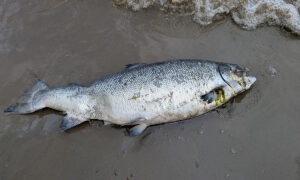
4 Million farmed salmon dead in the water in 2025
EPA documents show an industry spiralling with skyrocketing mortality figures for December last year.
The Tasmania Inquirer and The Guardian Australia have reported staggering increase in salmon mortalities as Tasmanian waterways start warming up for the summer.
The combination of P.Salmonis, now listed as endemic to Tasmanian waterways, alongside other environmental factors could see climbing numbers of dying fish becoming the new normal for the Tasmanian industrial salmon industry.
-
EPA figures released show December figures at 1,250 tonnes for one month alone
-
2500 tonnes in the last three months of 2025
-
Newly Approved antibiotic florfenicol has now been used to treat 13 pens in Tasmania’s south east waterways.
-
It remains unclear as to whether there are any penalties or deterrents at all for the industry in response to high mortality rates, leaving Tasmanian regulation well below world’s best practice, where hefty fines are applied in countries.
-
Norway penalises companies for salmon deaths in accordance with their Animal Welfare Laws.
“Increased reliance on antibiotic use is not the only solution – and it’s clearly not the most effective one, as the evidence is suggesting,” said Jess Coughlan, Senior campaigner at Environment Tasmania.
“The industry is facing increasing mortality rates, which is a situation likely to become the new normal due to the endemic nature of P.Salmonis in our waterways, and other environmental factors. While farmed Atlantic salmon and trout remain the only species to be at risk of infection by the bacteria, the obvious solution should be mandatory fallowing, with the goal of eradication,” said Coughlan.
“Penalties must apply, as they do in Norway, as a disincentive to allowing current mortality rates to become the new normal, and bring animal welfare back into focus for an industry that is clearly beyond control.”

Media release – NOFF, 27 January 2026
LATEST MASS MORTALITY DATA SHOWS TIME HAS RUN OUT FOR SALMON FARMING
500,000 prematurely dead salmon in three months show Tasmania’s salmon industry is unable to operate ethically and sustainably.
New figures from Tasmania’s Environment Protection Agency reveal more than 2,500 tonnes of farmed salmon (over half a million fish) died in the last three months of 2025.
Overall, at least four million salmon died prematurely in fish farms last year, statistics that confirm what coastal communities have been warning for years: Tasmania’s salmon industry is pushing ecosystems, animals and regulators beyond breaking point.
The latest data, released just before the Australia Day long weekend on Friday, shows that more than 2,500 tonnes of fish died in the last quarter of 2025. The total death toll of salmon dying prematurely was 20,133 tonnes.
As ocean temperatures – already at record highs – warmed in December, and the industry released tonnes of antibiotics into waterways, more than 40 tonnes of salmon died prematurely per day on average, almost triple the monthly average through winter.
These unprecedented deaths are not an anomaly. They are the predictable outcome of warming waters, overstocked pens and marine environments being exploited beyond capacity by the continuing onslaught of fish waste and antibiotics.
This is no longer a bad season — it’s the business model.
“These are shocking figures, and they’re only the beginning,” said Lilly Henley, Neighbours of Fish Farming’s Campaigner.
“If 2,500 tonnes died in the last quarter of 2025, it’s not unreasonable to expect double or triple that next quarter as waters continue to warm. Anyone pretending otherwise is not being honest with the Tasmanian public.”
-
Atlantic salmon are cold-water fish who in their natural environment spend almost their entire adult lives in North Atlantic waters between 2-12°C.
-
Atlantic salmon require water below 20°C to function normally, above this, they must actively seek refuge, something farmed salmon cannot do.
-
Ocean warming makes these impacts more frequent and longer-lasting.
-
No amount of spin, ‘innovation’ or antibiotic use will change the biological reality that an Atlantic salmon cannot survive long-term in waters above 20°C.
These limits are not debated in science, it’s pure biology.
Industry body Salmon Tasmania and the Tasmanian Government must have the foresight to see that mass deaths are only going to get worse.
NOFF respects the scientists tasked with monitoring and responding to incidents. But monitoring alone is not enough. Without enforcement, transparency and real consequences, regulation becomes theatre.
“There needs to be absolute transparency around the EPA’s investigation, and there must be fines for the companies responsible,” Henley said.
“Mass mortalities are now being treated as an inevitable part of doing business. That should alarm every Tasmanian.”
NOFF are demanding immediate public release of the EPA’s investigation findings, financial penalties for companies responsible for last year’s mass mortalities and a serious reckoning with the incompatibility of industrial salmon farming and a warming Tasmanian ocean.
“This industry has been warned for years,” Henley said. “The science is clear. The communities are watching. Salmon are dying in the thousands of tonnes. What we’re seeing now is not sustainable, not ethical, and not acceptable.”
Media release – Friends of the Bays, 27 January 2026
COMMUNITY RALLY TO PROTECT OUR BAYS ON FEBRUARY 1, 12 NOON
There will be a beach rally and paddle out at Cremorne Beach in a show of continuing community opposition to the expansion of the farmed salmon industry. Friends of the Bays is a community group originally formed on the South Arm Peninsula out of alarm that the Tasmanian Government had encouraged Petuna, a salmon company, to develop leases in Storm Bay.
Petuna a company owned by Japanese and New Zealand interests, was once owned by members of the Rockliff family. Petuna have already been granted a huge lease south of Betsey Island. This lease, close to 3 sq. kilometres, enough to include Hobart, North Hobart and much of West Hobart has a footprint that could hinder the movement of yachts in the Sydney-Hobart Yacht Race.
Petuna now seek another lease, close to the west coast of Tasman Peninsula, a wild and untouched area not far from marine reserves and the habitat of the rare red handfish.
There are no benefits for communities around Storm, Frederick Henry and Norfolk Bays. A large raft of salmon pens will degrade this area through pollution, debris, decline in water quality and harm to wildlife.
Friends of the Bays is pleased to announce that it has won a generous grant to increase public knowledge and awareness of the wild and unspoiled part of Storm Bay, an area we call the Black Jack Coast. Today we launch Project Black Jack.
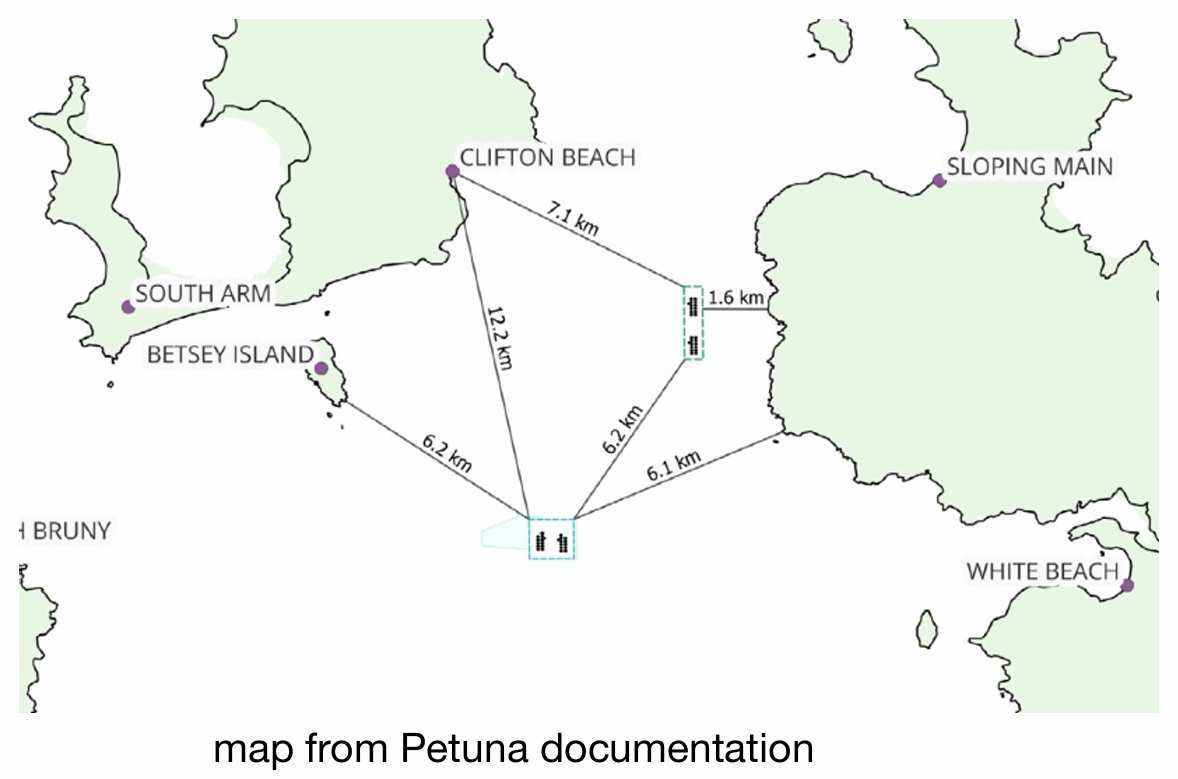
In addition to pens there would be barges for feed and power generation, various work boats and well-boats that will be present. It should be noted that Petuna has declined to provide more detailed information