Leonardo da Vinci’s famous maxim: “Learn how to see. Realize that everything connects to everything else.”
For several years I have researched aspects of World War One (WWI). Here, I strive to commemorate a handful of men and by doing so, honour all those who served in WWI.
My Irish grandfather joined the British Royal Navy in May 1915, aged 17. He was assigned to the HMS Alfred which throughout 1916-1917 patrolled the western entrance to the Strait of Gibraltar, unsuccessfully searching for the SMS Mőwe. The SMS Mőwe was a merchant raider of the Imperial German Navy which operated against allied shipping. Disguised as a neutral cargo ship to enable it to get close to targets, Möwe captured and sank forty ships. This made her the most successful and dangerous German raider in WW1 and WW2. My grandfather survived the war. My two great uncles, serving in the British Army, did not.
Two months later, in July 1915, Englishman George H. Marshall, aged 26, left England for Gallipoli in the role of Army Chaplain. He was the Chaplain for the Australian hospital ship, anchored 5-6 km from the shore. George also served in the trenches before becoming ill. When the troops evacuated Gallipoli, George went with them. By July 1917, George had joined the British Royal Flying Corps (RFC), 101 Squadron at Bertangles, in France.
Shortly before his 18th birthday in May 1915, Prussian-born Baron von Richthofen (the Red Baron) was commissioned as an officer into the German cavalry. He transferred to the German Air Corps in 1916 and quickly distinguished himself as a fighter pilot. Over a period of 17 months, he was officially credited with 80 air combat victories.
Of the Red Baron’s credited combat victories, one was Australian. On 23 January 1917, 28-year-old New South Welshman, Second Lieutenant John Hay, became the 17th victim of the Red Baron. Serving with the 40 Squadron RFC, John had shot down two German planes earlier that day. His plane caught fire and it is said he lept or fell to his death. RFC pilots were not issued with parachutes, and it was not unusual for pilots to leap to a quick death, rather that burn in the highly combustible aircraft. His body was recovered by Canadian troops and buried at Aire Communal Cemetery in France.
On the 12 April 1918, 22-year old-Hobart born Lieutenant George William Best and 21 year old Victorian Lieutenant Owen Lewis were stationed with the No. 3 Squadron, Australian Flying Corps at Poulainville, near Bertangles, France. Tragically, they burned to death when their RE8 burst into flames shortly after take-off. George had only just joined the Squadron from pilot training in England. George and Owen are buried beside each other in the Vignacourt British Cemetery in France. To add to the tragedy, George’s personal effects were lost in the sinking of the Australian troop ship SS Barunga. In Hobart, to honour George, a bronze plaque is located at tree 396 on the Soldier’s Memorial Avenue on the Queen’s Domain. As I live in Hobart, I often walk along the Avenue. I can recall the Anzac Day I came back with water and cloth to clean his plaque. I sat there, talking through my tears to George, telling him he is not forgotten.
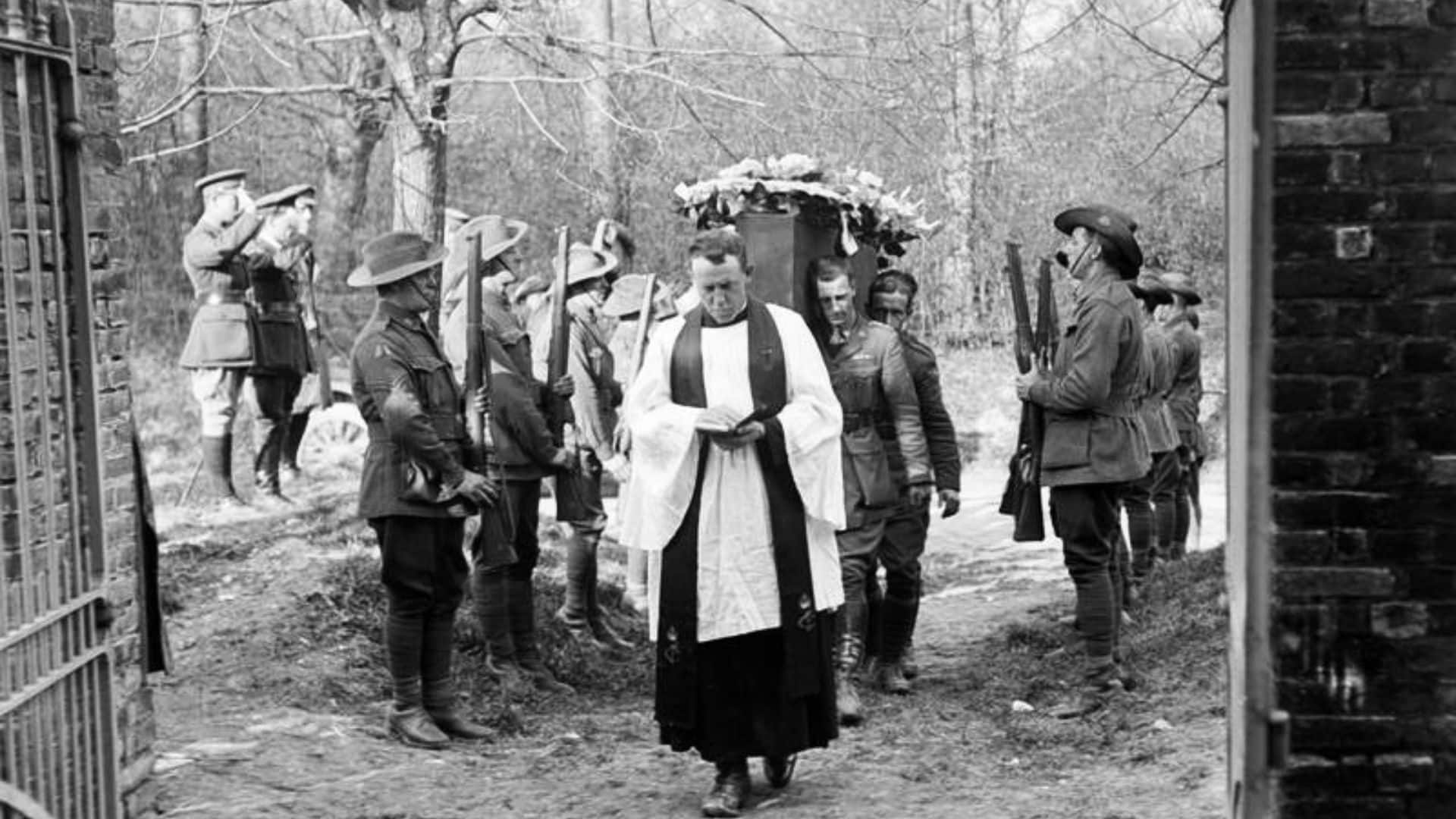
Only eight days later, on 21 April 1918, the Red Baron was shot down near Amiens. In the last seconds of his life, he managed to make a rough landing just north of the village of Vauz-sur-Somme, in a sector controlled by Australians. In common with most Allied air officers, Australian Major David Blake, who was responsible for Richthofen’s remains, regarded the Red Baron with respect. He received a full military funeral, conducted by the personnel of No. 3 Australian Flying Corps at the Bertangles Cemetery. The same chaplain who had cared for the Australians at Gallipoli, Rev. George Marshall, conducted the service. Six officers served as pallbearers, and a guard of honour from the other ranks fired a salute. Ten days after the guns on the Western Front fell silent, pallbearer Lieutenant George Pickering, died of pneumonia in London. His journals in the Australian War Memorial are full of his memorabilia from the Baron’s funeral. George was only 23.
“Learn how to see. Realise that everything connects to everything else.”
In World War 2, Reverend Marshall donated the steel cylinder from the Baron’s plane (given to him by the Australians) to the British War Effort Scrap Drive. At the end of WW1, the SMS Möwe was awarded as war reparations to Britain. She operated as the British freighter Greenbrier before being sold back to the Germans in 1933. In WW2 she operated as the German freighter Oldenburg to eventually be bombed and sunk in Norway by Australian, British and New Zealand squadrons in WW2. In Belfast, Northern Ireland, at the famous Harland and Wolff Belfast shipyards, approximately 1,750 ships were built including 174 Royal Navy vessels. The dockyards stand silent now, but the massive German made shipbuilding gantry cranes Samson and Goliath continue to dominate the landscape. Using these cranes, the largest ship every built at this shipyard (Coastal Corpus Christi) was a colossal crude oil tanker, 1205 feet (367 m) long. Built in 1977, she carried approx. 2.4 million barrels of crude oil. She was scrapped in Alang, India, in 2002.
Lest we forget.
Suzanne Curry is a writer of history. Like her grandfather, she was born in Belfast, Northern Ireland.