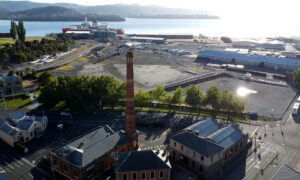

Despite escalating social crises like homelessness and hunger, the Premier Rockliff is aggressively pushing Parliament to approve the new debt-financed AFL stadium at Macquarie Point, writes Solomon Doyle.
This move, he says, is a stark contrast to the state’s urgent need for collective welfare goods against speculative, capital-intensive projects and prompts a deep debate about state priority versus capacity.
Major Parties Show Continued Push for Stadium Despite Social and Economic Grievances
By Solomon Doyle*
Just minutes after speaking at a Salvation Army charity event where individuals shared stories of families sleeping in cars, details of the ongoing hunger crisis and volunteers struggling to raise money to care for those in need- the Premier urged parliament to approve the new AFL stadium at Macquarie point.
The proposed Macquarie Point stadium has largely been discussed within the context of a tension between opportunity and “state-growth”, versus the consolidation of “state-sustainability”; whether it be the optimisation of already existing infrastructure, or meeting immediate socio-material needs.
This is only part of a much wider picture. The stadium debate is not just a question of tourism or public-institution as it is currently framed by both major parties, but is instead an inherent conflict between state capacity and state priority – whether government allocates scarce public resources toward collective welfare goods—which are by all accounts waning within the state—or toward capital-intensive projects justified through speculative economic returns.
A Debt-Financed Megaproject
Whilst the AFL and AFLW have made the requirements of a modern and closed stadium central to the conditions of Tasmania securing a team, the projects financial conditions have shifted significantly over-time, raising questions over what portion of the funding is expected to come out of state and federal subsidies.
The state government has pledged to cap its capital contribution at $375 million, while the Commonwealth has committed $240 million, and the AFL has agreed to contribute $15 million.
Everything beyond that—currently the bulk of the cost—is expected to be covered through state borrowings, making the stadium a debt-financed megaproject. Thus, the stadium functions as a symbolic policy, reflecting both the culmination of the normative values of development and modernity and the attempt to codify these within the identity of ‘Tasmania’— rather than as a rational response to Tasmania’s documented public needs.
Both Labor and the Liberal party argue that these borrowings will be returned over the course of the stadium’s existence through long term economic benefits, though this claim is disputed by both the Planning Commission— which was usurped by the Liberal party— as well as several independent MLCs.
Since the initial legislation, cost estimates have risen sharply.
Originally expected to cost $715 million, it quickly rose to $775 million— then again, to $945 million when draft legislation was introduced. As of now, the expected price has increased by a further $185 million — currently sitting at $1.13 billion, with total costs set to rise as unaccounted variables are considered.
The Political Contradiction
As the proposal passed the lower house with bipartisan support from both the Labor and Liberal parties on the 13 November with a vote of 25 to 9, key concerns over project cost, impact on state debt and whether the allocation of public funds could be better used to address community needs and failing state infrastructure loomed heavily.
Despite diverging public sentiment, both parties increasingly share economic development paradigms, insulating themselves from public preference as members of the public resign themselves from having any choice in the matter.
While this may eliminate competition through maintaining the status quo and shoring up technocratic governance—ideally resulting in a more stable government— this has largely come at the expense of the public’s trust in the two major parties’ ability, or want, to represent the will of the people. As we can observe, the total popularity of the two major parties has dropped starkly. Whilst this drop is part of a larger national trend, it is one particularly concentrated within Tasmania—giving rise to independents that can better action upon the niches unmet by the Labor-Liberal duopoly, presenting themselves as directly serving their base in retaliation to the “absent government”.
Who Really Benefits?
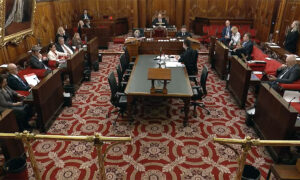
The crucial next step for the stadium’s approval depends on a majority verdict in the states upper house on 3 & 4 December—both Labor and Liberal parties remain in strong support with 6 combined votes out of a needed majority of 8, pushing attention to 2 key independents Bec Thomas and Dean Harriss—who have vocalised critiques of cost, debt risk, equity and who benefits from the deal.
Leading economist Dr Nicholas Gruen warned in an independent report commissioned by the state government, as a deal between the Jacqui Lambie Network and the Liberal Party, that the benefits are “overstated”, whilst the risks are “significantly understated”.
Most alarming being the extremely weak cost-benefit ratio.
In an ABC article, Gruen states that the project, “can reasonably be estimated to exceed $1 billion, with a benefit-cost ratio of 44 cents in every dollar invested in Tasmania”— meaning its economic losses are twice its gains. Additionally, the Tasmanian Planning Commission has recommended outright the project “not proceed”—arguing the stadium would “diminish the economic welfare” of the state, citing issues of too much debt, weak benefits, and landscape/heritage damage.
The Commission’s report notes that the government’s initial construction debt would begin at $1 billion, before rising to $1.8 billion over the next 10 years. To compensate taxes would then need to increase $50 million per year over 30 years from the implementation date, creating a high burden on Tasmanian households amidst already failing public infrastructure such as housing, education, and health industries.
The Tasmanian government has acknowledged all of this, but has ultimately rejected the critiques.
A projected debt of $1.8 billion over 10 years needs to be contextualised in conjunction with the state budget. Increased debt comes at the direct detriment of allotted funding towards state infrastructure, this means less room for hospitals, housing, education, and essential social services that are already rapidly backsliding.
As of now, more than 5,200 Tasmanians are waiting for public housing— a rise of 10.1%, the largest it has ever been— whilst also having average wait time of 82 weeks.
Over 200 public homes lie completely empty, some vacant for over 5 years, Tasmania currently faces the worst hospital bed shortage in Australia—with ambulance ramping having doubled in the past five years. As further evidence of the mismanagement of public institutions operating beyond capacity—public school infrastructure has a maintenance backlog of hundreds of millions, whilst Tasmanians indicate housing access, healthcare, and cost-of-living as their greatest concerns.
Beyond immediate costs of the project are a range of unfunded or underfunded infrastructure costs. Tasmania, as it is, is simply not built to accommodate the influx of people that both major parties claim the stadium will bring—transport upgrades, access roads, car parking, sewerage and short stay accommodation are nowhere near adequately costed, the Tasmanian Planning Commission says.
Furthermore, independent analysts warn of massive lifecycle costs that are yet to be acknowledged in public discourse.
Erosion of Public Trust
Critics have also noted that enabling legislation for the stadium hands extraordinary power to the Planning Minister, representing a broader trend of executive-driven planning systems.
This centralised decision-making within the minister weakens deliberative, consensus-based oversight in an aim to fast-track the megaproject through executive governance, whilst neutralising protections otherwise built into the planning system. The observed side-lining of these systems and growing concentration of decision making within the executive regarding infrastructure-planning poses a greater risk that ‘procedural fairness’ could become increasingly eroded.
The stadium project has been a subject of constant division amongst the Tasmanian populace and underscores a fundamental tension embedded within the Australian subnational political structure. This conflict is fundamentally ideological – whether Tasmania’s development strategy continues to prioritise tourism-driven models of accumulation or reorients toward strengthening public goods in an era of intensifying social vulnerability.
The almost three year long policy drafting process codifies a structural contradiction within the current Tasmanian political system.
Where a state with limited fiscal capacity attempts to pursue a megaproject motivated by ideals of “state-modernisation” whilst its foundational welfare institutions deteriorate. How the debate within Legislative Council in early December unfolds, whether it combats or enforces this contradiction will be a revealing test as to whether the current Tasmanian political apparatus is adequately organised to resolve this tension.
It will demonstrate whether Tasmania can still prioritise public good over the fantasies of growth, or whether our political system has already determined a different path.
Solomon Doyle* is a state-organiser for the Lutruwita Socialist Alliance as well as a writer for the Green Left.
Tasmanian Times (TT) is a community-based news and current affairs service covering the island state of Tasmania. It exists to provide a diverse presentation of Tasmanian issues. TT creates and supports independent media content utilising the best of modern technologies and tried-and-true practices of public-interest journalism.
Support us in expanding our coverage and developing new content by and for Tasmanians.
New initiatives on the way include … what our contributors and readers suggest! Please get in touch with your suggestions.