
The annual meeting of the Commission for the Conservation of Antarctic Marine Living Resources (CCAMLR), which concluded this week in Hobart, delivered a severe setback for the Southern Ocean by failing to adopt a single new conservation measure or a science-based krill fishery management plan.
This failure was a direct consequence of the geopolitical deadlock caused by China and Russia who have historically blocked such motions which require an unanimous vote. It is understood China opposed these measures which would restrict its strategic goal of expanding its krill fishing industry, and Russia used its veto power to challenge the Western-backed rules of international governance. To China krill is a resource used for aquaculture feed, pet food and Omega-3 supplements.
The Antarctic Peninsula, is a region facing a critical dual threat – it is one of the most rapidly warming areas on the planet, and it is the site of a large-scale industrial krill fishery. This confluence of pressures is driving major fluctuations in wildlife populations, particularly for Antarctic krill—a keystone species in the ecosystem—where climate change-induced shifts in distribution and declines in abundance have already been recorded.
This inability of CCAMLR’s members to prevent an existential threat to the Southern Ocean ecosystem was met with fury by campaigners, notably the Bob Brown Foundation (BBF), whose highly visible protests—including staging a “dead whale crime scene”—underscored the danger posed by industrial krill fishing and recent whale deaths caused by supertrawler nets.

Media release – World Wildlife Fund (WWF), 1 Nov 2025
WWF calls for moratorium on krill fishing after negotiations fail to protect Antarctica’s tiny superheroes – WWF-Australia
· Leaders have failed to come to an agreement on critical fisheries management measures to protect Antarctic krill, penguins, whales and seals at a meeting in Hobart.
· Krill help regulate the Earth’s climate and are a critical source of food for iconic marine wildlife.
· Countries must bridge geopolitical differences and protect this pristine wilderness before it is too late.
WWF is calling for a moratorium on Antarctic krill fishing to protect krill and the wildlife that rely on them after leaders failed to come to an agreement on critical fisheries management measures at a meeting in Hobart.
The annual meeting of the Commission for the Conservation of Antarctic Marine Living Resources (CCAMLR) wrapped up late last night (31 October).
After lengthy negotiations, there was no agreement on long term improvements to the krill fishery or designating a new marine protected area in the Antarctic Peninsula region.
For the first time ever, the krill fishery was forced to close early in 2025 after its entire 620,000T annual quota was rapidly caught. The early closure was a consequence of a critical protection measure – which spatially distributed krill catch – being allowed to lapse in 2024.
Due to CCAMLR’s failure to resolve this issue, the krill fishery will continue to be managed without precautionary regulations in place with the whole quota able to be taken from any small area around the Antarctic Peninsula.
The Peninsula is a hotspot for Antarctic wildlife, especially whales and penguins.
As the industrial krill fishery has expanded, reported incidents of seabird, seal and whale bycatch have grown, indicating the fishery is concentrating in key foraging grounds for these krill predators.
Sir David Attenborough’s Oceans documentary showed the impact krill fishing can have on these magnificent animals and that risk will only be heightened as a result of this year’s meeting.
WWF is calling for a moratorium on krill fishing to protect these vital species until a new, highly precautionary and ecosystem-based management framework is agreed.
Emily Grilly, Ocean Conservation Manager at WWF-Australia, said:
“Antarctica is one the world’s last truly pristine environments and already under immense pressure from climate change. Without safeguards in place, krill fishing cannot continue at current levels – let alone be increased, as some are proposing.
“Australia has historically shown great leadership in Antarctic conservation. We were one of the original signatories of the Antarctic Treaty and former Prime Minister Bob Hawke played a pivotal role in preventing mining of Antarctica.
“Now, we are witnessing the slow erosion of Antarctic protection by a small number of countries. It’s time for ocean leading countries like Australia to support a moratorium on krill fishing until adequate fishing safeguards and marine protection measures are put in place.”
Rhona Kent, Polar Oceans Programme Manager at WWF UK, said:
“Antarctic krill are the superheroes of the Southern Ocean, sustaining incredible marine life, but climate change and unsustainable fishing are putting them at risk. With sea ice declining and industrial fishing growing, we urgently need CCAMLR to better manage the fishery and protect krill and krill predator habitats within a network of marine protected areas.”
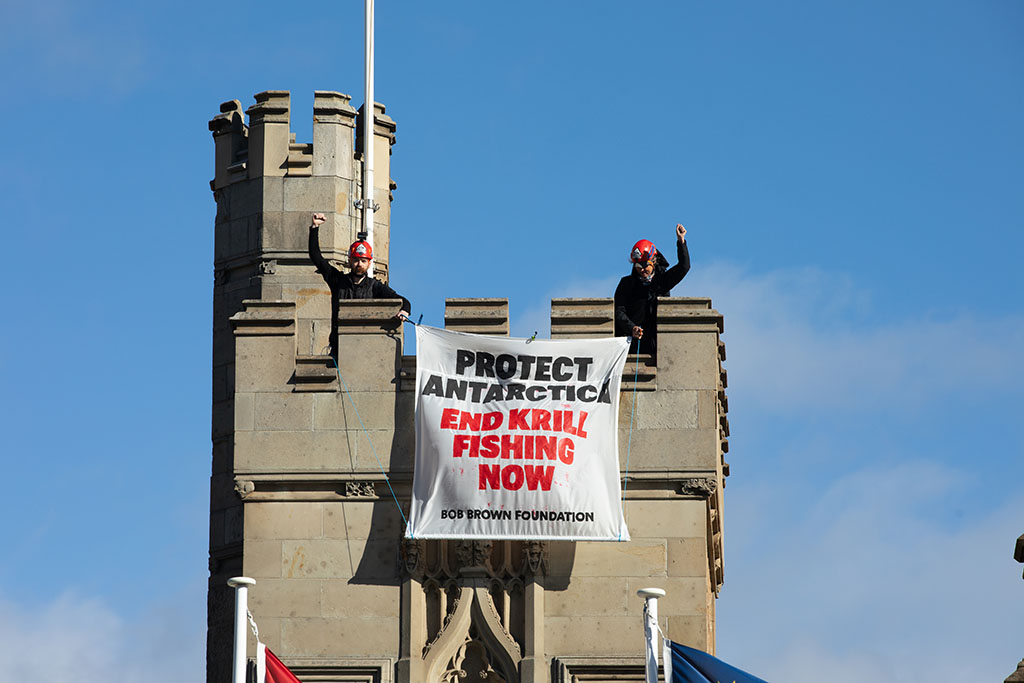
Krill fishing must end now!” said Jen Seccull, a retired farmer, from up high up on the roof.

Media release – Bob Brown Foundation, 28 October 2025
Aerial protest for Krill at global treaty meet
Today in Hobart, as the second week of the annual Commission for the Conservation of Antarctic and Marine Living Resources (CCAMLR) begins, activist scaled the flagpoles and unveiled a giant banner reading: KRILL SUPERTRAWLERS KILL WHALES.
The second week of CCAMLR is when nations consider scientific advice and negotiate proposals. Bob Brown Foundation is calling on Australia to propose a ban on krill fishing in Antarctica.
“Now is the time for CCAMLR to live up to its conservation mandate and ban krill fishing to protect the whales, penguins and seabirds that rely on krill to survive,” said Alistair Allan, Antarctic and Marine Campaigner at Bob Brown Foundation.
“Krill fishing is an environmental crime that must cease. Since 2021, eight whales have been killed in the nets of the krill supertrawlers. Penguin colonies adjacent to where the supertrawlers operate are declining. CCAMLR is meant to be about Antarctic conservation. They must act now to end this destructive fishery.”
“Every year, Australians revel in and enjoy the humpback whales swimming up our coasts. Those very same whales are now at risk of dying in the nets of a supertrawler in Antarctica. Australia must propose a ban on krill fishing and ensure Australia is protecting whales,” said Allan.
Media release – Bob Brown Foundation, 22 October 2025
Activists stage dead whale crime scene at the Commission for Conservation of Antarctic and Marine Living Resources (CCAMLR) to protest industrial krill fishing
Activists have today unveiled a life sized dead juvenile humpback out the front of the CCAMLR building calling for an end to krill fishing in Antarctica.
While international delegates were entering the building to discuss the future of krill fishing in Antarctica, activists established a crime scene that showed supertrawler company, Aker BioMarine fingerprints and DNA all over the dead whale.
Since 2021, eight humpback whales have been killed in the nets of krill supertrawlers, seven of which Aker BioMarine were responsible for.
With the krill fishery responsible for so many whales’ deaths, alongside huge environmental impacts on penguins and the Antarctic ecosystem, Bob Brown Foundation is calling for a complete end and ban on krill fishing in Antarctica.
“Whaling has ended in Antarctica, but there are still giant supertrawlers killing whales, only this time it’s in the nets of krill trawlers,” said Alistair Allan, Antarctic and Marine Campaigner at Bob Brown Foundation
“Allowing supertrawlers to plunder the foundation of an ecosystem, all while they kill whales in their nets in the process, is an environmental crime. CCAMLR is meant to prioritise the conservation of Antarctic wildlife, but Krill trawling is the complete opposite of that and must be banned.”
“Krill is sucked out of the Antarctic to make products that we don’t even need. It goes into pet food, farmed salmon feed and to make supposed health supplements. There are alternatives to all of those. The whales, seals and penguins of Antarctica have no alternative.
Krill is vital to their survival and CCAMLR must do everything they can to protect them. That means ending krill fishing,” Allan said.
Media release – Bob Brown Foundation, 20 October 2025
Activists occupy roof of CCAMLR Hobart headquarters as international meeting commences with an urgent call for ban on krill fishing
Today in Hobart, activists from Bob Brown Foundation have occupied the roof of the Commission for Conservation of Antarctic and Marine Living Resources ( CCAMLR) building as international delegates arrived for the start of the annual treaty meeting.
A large banner has been hung above the building demanding that CCAMLR bans highly destructive krill fishing in Antarctica.
Bob Brown Foundation is calling on CCAMLR to enact their conservation mandate and ban krill fishing, which is responsible for the killing of whales as bycatch, declining penguin populations and falling whale pregnancy rates.
Large mobile billboards are also out the front of the CCAMLR building and around the city of Hobart calling for an end to krill fishing and to close Antarctica to fishing at this critical time.
“Krill are the foundation of the Antarctic ecosystem, yet every year supertrawlers plunder krill from the mouths of whales and penguins to make products we don’t need. It’s time to protect Antarctica and the animals that live there and ban this destructive fishery” said Alistair Allan, Antarctic and Marine Campaigner at Bob Brown Foundation.
“There are growing global voices calling for krill fishing to banned. At this years United Nation Ocean Conference, an event focused on ending krill fishing was endorsed by world famous ocean explorer Dr Sylvia Earle, actors such as Benedict Cumberbatch, and scientists and environmentalists. CCAMLR must act now to protect the Antarctic ecosystem from these marauding krill supertrawlers.”
“Australia can and should be leading the charge and propose a ban on krill fishing at this year’s meeting. They must also block any attempts to increase the krill quota. The very same whales that swim up and down Australia’s coastlines are the same ones dying in the nets of krill supertrawlers that are plundering their food source. Australia is failing the Antarctic environment by allowing krill fishing to continue,” Allan said.
“Protecting krill, a keystone species, and vital player in the carbon cycle is essential for the health of the entire Antarctic food web and the overall resilience of the region against climate impacts. Prioritising conservation efforts is crucial to ensure the continued existence of this essential and unique environment for a liveable planet & for future generations.
Images courtesy Bob Brown Foundation.
Tasmanian Times (TT) is a community-based news and current affairs service covering the island state of Tasmania. It exists to provide a diverse presentation of Tasmanian issues. TT creates and supports independent media content utilising the best of modern technologies and tried-and-true practices of public-interest journalism.
Support us in expanding our coverage and developing new content by and for Tasmanians.
New initiatives on the way include … what our contributors and readers suggest! Please get in touch with your suggestions.