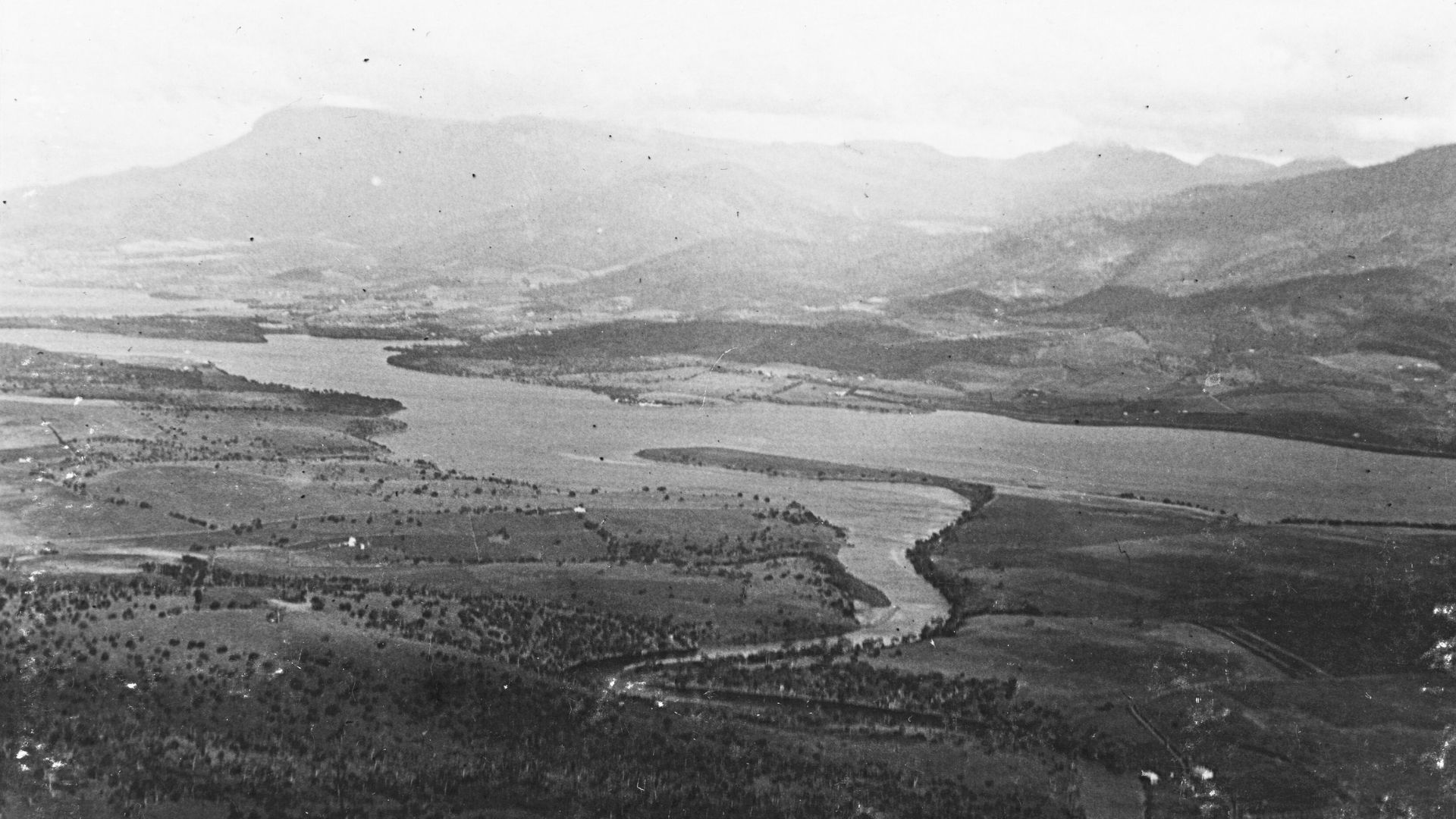
This photograph of the Derwent River was taken in 1921 – 128 years after British Royal Navy officer John Hayes first sailed up the river and named it after the Derwent in Cumbria, England.
A French expedition team led by explorer Antoine Bruni d’Entrecasteaux had also entered the river in the same year as Hayes (1793) and explored it.
Before European arrival, the entire Derwent Estuary area was part of the traditional lands of Tasmanian Aboriginal (Palawa) people. They used the river for fishing and travel.
In 1798, Matthew Flinders and George Bass – both British Royal Navy men like Hayes – sailed into the Derwent River and spent some time surveying and mapping parts of it.
Five years later, in 1803, another officer of the British Royal Navy, John Bowen, led a small party of convicts, marines and free settlers in establishing Tasmania’s first European settlement at Risdon Cove, located on the eastern bank of the Derwent. The site was later abandoned in favour of Sullivans Cove on the western shore, which had a better fresh water source. Hobart Town would grow out of this new settlement.
The River Derwent’s source, Lake St. Clair in the Central Highlands, was discovered in 1835 by a surveyor named George Frankland.
Throughout the rest of the 1800s, the River Derwent was used for shipping and shipbuilding as Hobart Town continued to grow and develop. Environmental issues such as pollution started to impact the river during this time, but it wasn’t until 1999 that the Derwent Estuary Program was created to address them. Work on improving the river’s water quality remains an ongoing process.
A floating arch bridge connecting the eastern and western shores of the Derwent was built between 1938 and 1943. It was replaced by the current Tasman Bridge in the 1960s. On 5 January 1975, the bulk ore carrier Lake Illawarra collided with two of the Tasman Bridge’s pylons, causing a large section of the bridge to collapse into the Derwent. Twelve people died during the incident, which significantly affected transport around the Greater Hobart Area until 8 October 1977, when the Tasman Bridge was re-opened to traffic after being repaired.
In June 2025, the historic Bridgewater Bridge (built between 1939 and 1942) was replaced with a new $786 million bridge due to safety and maintenance issues.
Today, the Derwent River is used for recreation, boating, shipping and ferry services.
Swept away
On Thursday, 25 January 1872, the Illustrated Adelaide Post published this flowery description of the Derwent River:
“The Derwent is the principal river of Tasmania and on its banks Hobart Town is situated. It has two mouths, occasioned by a long narrow island at its entrance and ships of any size can find good anchorage in the Derwent, from its southern mouth to 12 miles above Hobart Town.
“The Derwent abounds with fish of various kinds; whales frequently come up as high as Hobart Town and not unfrequently they are caught. The scenery along the whole course of this river is extremely beautiful and in some places highly romantic and picturesque.”
Despite its beauty, the River Derwent has been the site of a few tragedies. One was the Tasman Bridge collapse in 1975. Another occurred on Wednesday, 25 February 1925, when a young man likely drowned in the river.
The Register reported:
“Peter Davie, aged 24, shepherd, employed at Ouse, was swept from his horse this evening when attempting to cross the River Derwent, four miles from Hamilton. Search parties have failed to locate the body.”
This is a reminder that beauty can be deceptive and that nature is never within human control.
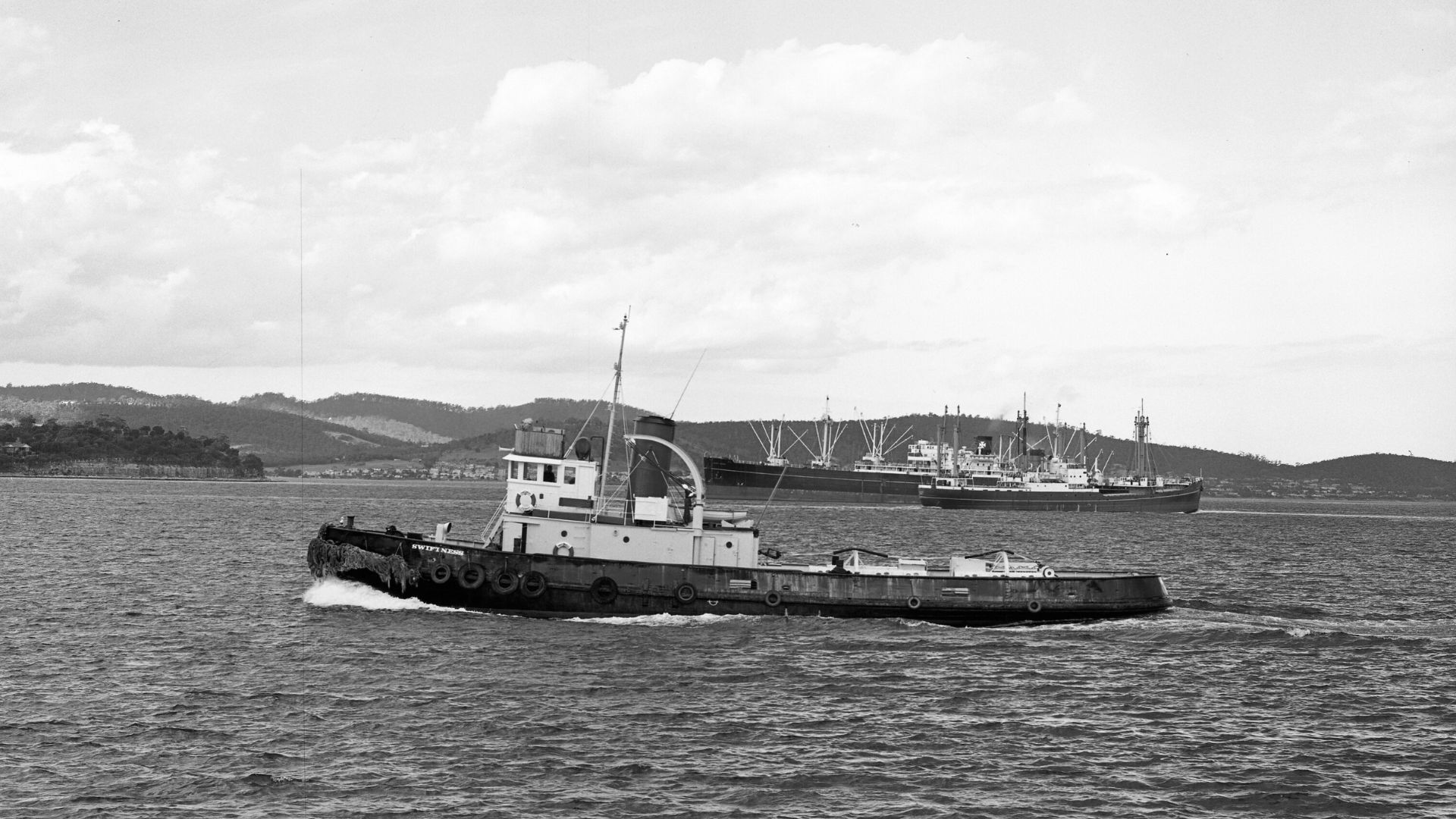
Ships on the Derwent River in 1966.
Tas That Was is a column that includes:
- anecdotes of life in Tasmania in the past;
- historical photographs of locations in Tasmania; and/or
- documentaries about locations in Tasmania.
If you have an anecdote or photograph you’d like to share with us, please send it to [email protected].
Callum J. Jones is passionate about telling stories. He studied English, History, and Journalism at the University of Tasmania and lived in Western Sydney from 2022 to 2024 while working as a journalist for Professional Planner, a leading online publication for financial planners. Callum has written for Tasmanian Times since 2018 and has also been published in a range of other outlets, including Quadrant and the BAD Western Sydney anthologies.