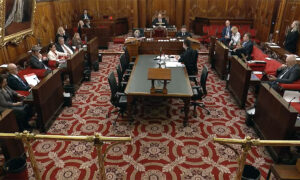

The 22 October Public Accounts Committee hearing into Coordinator-General John Perry’s controversial stadium opinion piece has raised serious questions about the independence of his analysis and the use of government resources to support a major Liberal government policy.
Perry appeared before the committee chaired by Ruth Forrest MLC to explain his Mercury opinion piece published on 11 October, which argued the $1.1 billion stadium project was affordable and would generate $4.97 in economic activity for every dollar spent. The piece has been seized upon by the government as justification for proceeding with the project despite mounting concerns about Tasmania’s rising debt.
Forrest challenged Perry directly on his timing, asking why he chose to do this analysis “at this late hour rather than respond to” the cost benefit analyses that had been in the public arena for some time. Perry’s response raised as many questions as it answered. He told Forrest the stadium “hasn’t been on our list of projects” and his office hadn’t been involved in negotiations or assessments. Perry claimed he began work on the analysis only after hearing “lots of people on radio and in print” conflating the billion-dollar price tag with annual operating costs, and after the issue “became such a key issue in the lead up to and then around the election.”
He insisted “there’s still plenty of time to discuss it” and rejected any suggestion he’d been “sitting on this for two years, waiting for the time to pounce.” However, his admission that he needed ministerial approval and briefed Abetz and Rockliff “a week or two weeks before” publication suggests the timing may have been more coordinated than his defence of spontaneity would suggest.
Throughout his testimony, Perry repeatedly used collective pronouns that fundamentally contradict his claim this was purely personal work.
“We’ve used economy ID as where we don’t have the direct amount of investment,” Perry told the committee. “We’ve looked at the five lowest performing in terms of financial performance of the clubs in the AFL” and “we haven’t included intrastate spend.”
The pattern continued throughout the hearing. “We did a piece of work just looking at Hobart” and “we’ve used the average tenure of home ownership.”
These aren’t casual slips of the tongue.
They suggest a coordinated effort involving multiple people and potentially, the deployment of his office’s resources and staff. Perry never clarified who “we” referred to or whether his government office and staff were involved.
Perry’s testimony about his interactions with government ministers contains significant contradictions. Early in the hearing, Perry stated – “I didn’t speak to any ministers internally. This is something that I’ve done on my own volition.”
But under persistent questioning from Labor’s Dean Winter MHA, a very different picture emerged. Perry admitted that “after I’d done the analysis… I spoke to both Minister Abetz and the premier” because “as a public servant, you’re not allowed to put out comments in relation to these things.”
Perry revealed this occurred “a week or two weeks before the thing was published.”
More significantly, he confirmed he had “presented the analysis… to the minister and the premier beforehand” and “provided it the day that it was provided to others… directly to the minister and the treasurer so that they had a heads up.”
He also acknowledged he “shared it with some other people within government” on the basis that “this is our analysis, our work.”
When Winter challenged the contradiction, Perry’s response was extraordinary.
“I only spoke to them because I needed to seek their permission. If I’d have gone and published something like that without doing so, I would be liable to being fired. So of course, I would have to.”
This statement cuts to the heart of the independence problem. The Coordinator-General, whose office is meant to provide independent advice on major projects, admits he cannot express views without political authorisation or risk losing his job.
The hearing also exposed significant problems with Perry’s analytical approach.
Winter pointed out that Infrastructure Australia explicitly warns that input-output models “should not be used as substitutes for cost benefit analysis” – yet this is precisely what Perry has done. When Winter identified that Perry had double-counted visitor spending and hotel investment stimulus, Perry conceded “there could be 3 million double counted in there.”
Perry admitted he had not consulted “any peer reviewed economic literature” supporting his methodology.
When Winter noted he’d “never seen this used as a way to try and quantify a project,”
Perry’s defence was telling – “I’ve just given you a way of looking at something.”
Perry also admitted he had not attempted to quantify claimed benefits like “youth aspiration, brand value, crime reduction” and had relied not on “empirical evidence” but on having “listened to the discussions.”
Liberal member Roger Jaensch MHA attacked Winter for being “so negative and cynical” and for engaging in “party politics.”
But Winter’s response cut to the heart of the matter.
“We’ve been asked today to interrogate a piece of work, an editorial by a senior public servant that isn’t peer reviewed, is not a cost benefit analysis, it’s double counted spending.”
Chair Ruth Forrest highlighted how “members of government” are now “using your analysis here, your financial analysis as opposed to a cost benefit analysis” to “promote the stadium.” Whether Perry intended it or not, his analysis has become a political weapon for a government desperate to justify an increasingly controversial project.
Perry’s central argument is that the stadium is “affordable” because it will cost only $45-70 million per year to service. But as Forrest pointed out, Perry’s analysis looks at the stadium “in a vacuum” rather than “in the context of the whole state” and its mounting debt problems.
Perry conceded the government “will need to trim its costs in relation to spending something else” to afford the stadium.
In other words, the stadium is only “affordable” if other services are cut.
Committee member Bec Thomas MLC highlighted a crucial flaw – while claiming $5 in economic activity for every dollar spent sounds impressive, “that doesn’t directly pay for the stadium construction, all the ongoing operating costs.”
Perry agreed – “Yes, absolutely.” The economic benefits “doesn’t flow straight back to the state.”
As Forrest noted, “many of the economic benefits… will not accrue directly to government coffers and therefore can’t be used to service debt.” But bridges and roundabouts don’t require $45-70 million in annual operating subsidies in perpetuity.
Forrest also pressed Perry on benefits for Tasmanians outside Hobart. Perry acknowledged “undoubtedly a lot of that economic activity will flow into greater Hobart.”
For the more than half of Tasmanians who live outside greater Hobart, roughly 200 highly paid jobs in the capital is unlikely to feel like a compelling return on a billion-dollar investment that requires permanent cuts to state services.
The evidence suggests this was not the independent personal opinion Perry claims.
The repeated use of “we” indicates office resources were deployed. Ministers received advance briefings and had to grant “permission.” The timing coincided perfectly with political need. The methodology, while criticised by Infrastructure Australia, conveniently supports government policy.
When a senior public servant requires ministerial approval, briefs those ministers in advance, apparently uses government resources and produces analysis that becomes a key government talking point, the claim of independence rings hollow.
When pressed about providing dates for his communications with ministers, Perry agreed to supply them. Those dates may reveal whether the coordination between Perry, Abetz and Rockliff was even closer than his testimony suggested.
What remains clear is that Perry’s “personal opinion” has become the government’s shield against criticism of its stadium project.
When the state’s most senior project adviser admits he would be “liable to being fired” for publishing analysis without ministerial approval, his capacity to provide genuinely independent counsel has been fatally compromised.
Perry’s fear-driven dependence on political authorisation, combined with the deployment of apparent government resources to produce methodologically questionable analysis that serves the government’s political interests, raises fundamental questions about whether he remains fit for the office of Coordinator-General.
Tasmanian Times (TT) is a community-based news and current affairs service covering the island state of Tasmania. It exists to provide a diverse presentation of Tasmanian issues. TT creates and supports independent media content utilising the best of modern technologies and tried-and-true practices of public-interest journalism.
Support us in expanding our coverage and developing new content by and for Tasmanians.
New initiatives on the way include … what our contributors and readers suggest! Please get in touch with your suggestions.