In the pristine waters of Antarctica, a tiny creature is at the center of a conflict between industrial fishing and a fragile ecosystem already under threat from climate change. Krill, the small shrimp-like crustaceans that form the foundation of the Antarctic food web, are being harvested on an industrial scale, primarily for use in fish farm feed and dietary supplements.
A new report by the Bob Brown Foundation, titled “Krilling Antarctica,” highlights the outsized role that Australia and New Zealand play as major markets for these products and calls for an immediate halt to the practice.
Antarctic krill, scientifically known as ‘Euphausia superba’, are a keystone species, meaning their presence is vital to the survival of the entire ecosystem. They are the main food source for whales, penguins, seals, and other marine life.
According to the report, krill provide a staggering 96% of the calories for seabirds and mammals in the Antarctic Peninsula.
Yet, despite this crucial role, a combination of global heating and industrial-scale fishing is threatening their population.
The report notes that the krill fishery is managed by the Commission for the Conservation of Antarctic and Marine Living Resources (CCAMLR), but the commission is struggling to maintain adequate control. The problem is not just the targeted fishing of a keystone species, but also that the fishing areas are concentrated exactly where predators like penguins and whales expect to find food.
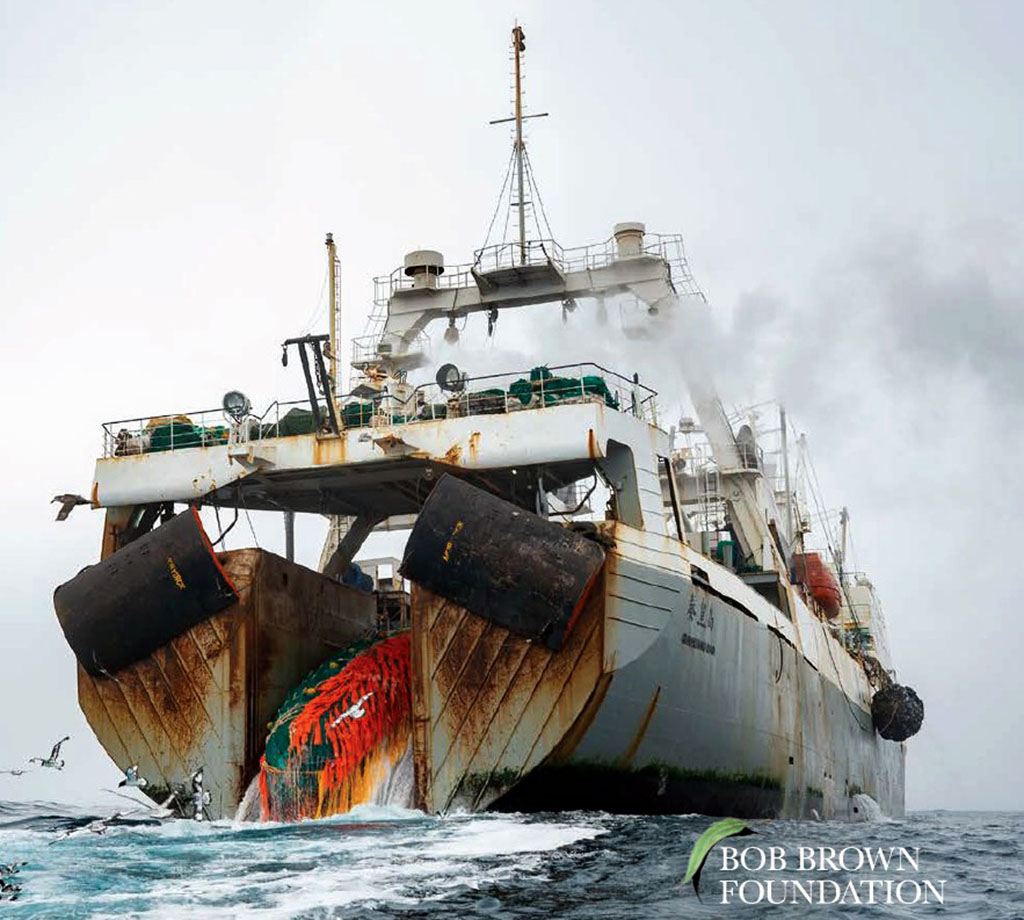
The Bob Brown Foundation’s investigators witnessed this firsthand, observing supertrawlers fishing directly through groups of fin whales and chinstrap penguins. The report also details other harmful impacts, including seabird bycatch and whales being caught in trawl nets. A 2021/22 report noted four whales were caught as bycatch.
The krill fishing industry is dominated by Norway’s Aker BioMarine, which took 65% of the catch in 2021.
Other countries involved include China, South Korea, Chile, and Ukraine. The industry’s primary products are krill meal for fish farm feed and krill oil for diet supplements. The report reveals that Australia and New Zealand are significant markets for both, with 76% of the 26 surveyed retailers and suppliers in both countries either stocking or using krill.
In Australia, major supermarkets like Woolworths and Coles sell farmed salmon that has been fed krill, while Woolworths also sells krill oil supplements.
All surveyed pharmacies and health food stores in both Australia and New Zealand were found to carry krill supplements. The investigation also uncovered that two major Australian aquaculture companies and their feed suppliers use krill.
Biomar, a Tasmanian-based feed supplier for Huon Aquaculture, uses 1,200 tonnes of krill meal a year, equivalent to 3.3 billion individual krill.
The report takes issue with the industry’s claim of sustainability. It states that companies, especially Aker BioMarine, have invested heavily in promoting their products as ‘sustainable and green’.
The industry has even had its Antarctic krill fishery certified by the Marine Stewardship Council (MSC), a move that has been met with strong criticism from conservation groups. The report argues that this certification is a “smokescreen” that fails to consider the impacts of climate change on krill populations or the effects on krill predators. Furthermore, the report alleges that Aker BioMarine has a history of promoting misleading, self-funded studies to support its claims of the health benefits of its products.
The report concludes that the krill fishery is unsustainable and its continued existence is an “environmental crime hidden from sight”.
It argues that krill is being caught for products that are entirely unnecessary, whether for feeding farmed salmon or as a health supplement, and that viable, plant-based alternatives are available.
Based on its findings, the Bob Brown Foundation makes a number of recommendations:
A ban on krill fishing: A call for an immediate moratorium, followed by a total ban on krill fishing.
A shift by aquaculture and aquafeed companies: They must stop using wild-caught fish, including krill, and transition to more sustainable alternatives.
Retailer responsibility: Retailers are urged to immediately stop selling krill dietary supplements and adopt policies to phase krill out of their farmed seafood products.
Consumer action: Consumers are encouraged to stop using krill supplements and to demand that their farmed seafood is krill-free.
The report asserts that the krill industry is aware of its “flimsy social license” to operate in the pristine Antarctic ecosystem but continues its efforts to expand.

Media Release – Bob Brown Foundation, 21 August 2025
Australia must act urgently to protect Antarctica and propose a ban on krill fishing.
New research, which urgently warns of irreversible sea ice loss, catastrophic global sea level rise, and species extinction, must be acted upon by the Australian Government.
The research, led by ANU climate scientist Professor Nerilie Abram and co-authored by 20 other scientists, has been published in the science journal Nature.
The report said it was imperative for the world to reduce carbon emissions.
Bob Brown Foundation is calling for Australia to propose a complete ban on krill fishing at the upcoming Commission for the Conservation of Antarctic and Marine Living Resources (CCAMLR) treaty meeting, held in Hobart in October. Krill are both the foundation of the Antarctic ecosystem and a vital carbon sink.
“This report is an emergency warning to all nations, including Australia, that urgent action must be taken to protect Antarctica,” said Alistair Allan, Antarctic and Marine campaigner at Bob Brown Foundation.
“With warnings of massive sea ice loss, on which krill rely to survive, now is the time for Australia to show real environmental leadership and propose a ban on krill fishing at this year’s CCAMLR meeting in Hobart. Krill are an incredible carbon sink, absorbing the same amount of CO2 emitted by 35 million cars annually.”
“With warning after warning of catastrophic and irreversible changes in Antarctica, krill, and all the animals that rely on them, need complete protection. It is an environmental crime that supertrawlers are plundering this keystone species. It must be banned, and Australia should be the country to propose it.”
“Australia must also immediately stop approving any new coal and gas projects, reverse the decision to extend the northwest gas shelf expansion, which is a massive carbon bomb, and ensure Australia is acting to prevent the report’s predicted 3 metre level sea rise, which would have disastrous impacts on people and communities around Australia and the world,” said Allan.
Tasmanian Times (TT) is a community-based news and current affairs service covering the island state of Tasmania. It exists to provide a diverse view of Tasmanian issues. TT creates and supports independent media content utilising the best of modern technologies and tried-and-true practices of public-interest journalism.
Support us in expanding our coverage and developing new content by and for Tasmanians.
New initiatives on the way include:
- a weekly podcast covering current affairs
- a revamped website
- a monthly cartoon competition
- a user-friendly app for both Android and Apple devices
- a weekly roundup of key stories