
What is it about the proposed Macquarie Point stadium that makes it so divisive?
We don’t hear much, if any, opposition to the proposal to have a Tassie team in the AFL. After all, Tasmania has arguably been ‘a footy state’ for many years.
Long before Daryl Baldock captained St Kilda to their first and only premiership, before Ian Stewart won three Brownlow medals and before other Tasmanian champions like Peter Hudson, Alistair Lynch and Matthew Richardson were even born, we have been ardently following teams across the strait.
So of course we rusted-on Aussie rules fans would love to have a Tassie team in the national mix.
Then, why all the fuss about a new stadium?
Tasmanians tend to baulk when outsiders tell them what they should do.
So in this case, with big business – the AFL bosses – not only demanding that we build a new stadium if we’re to have a team, but telling us exactly where it should be plonked, this was bound to rankle with many locals, whether footy fans or not.
Leaving aside such concerns as the lack of transparency and community consultation, an increasingly worrying State debt, and the question of competing priorities, there remains the matter of location.
If a new stadium is really warranted (a question in itself), then where in Tasmania would it best be located?
There being no evidence of any site selection process having been carried out, it would appear that the AFL has seized upon the most visible and apparently available site in the State’s capital city. From their (outsiders’) point of view, perhaps an understandable choice.
But when considering the merits of the stadium proposal we should weigh it up, not only against the range of possible alternative uses for this sensitive and strategically located site, but against its impact on the character of the city.
Why do visitors want to come to Hobart? What makes Hobart a special city? In the lingo of the advertising world, what is our ‘brand’?
Are these questions you would ask the AFL? No, you should more likely ask those locals who have for many years analysed and sought to protect those qualities that collectively give this city its character and identity.
Hobart is a small but striking city on an island at the bottom of the world. Spread along a broad river valley, it resides in a truly remarkable landscape setting.
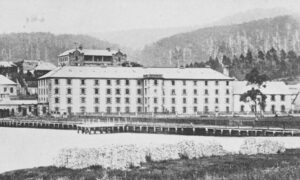
At its centre it is a heritage city, a port city.
From its waterfront precinct, just by turning your head you can see – so close – an ancient mountain looming above forested foothills – a mountain whose belated renaming was a significant acknowledgment of the first people’s long stewardship of this place. Kunanyi.
Turn a little further and observe all around you the history of the town’s colonial days, written often in convict-made bricks and finely tooled sandstone. Then look at the activity on the docks and wharves – the freighters, the fishing boats, the ferries and pleasure craft, the Antarctic supply vessel, the occasional cruise ship. Right there. You don’t need to move.
And on a rise between the docks and the river you can see the city’s war memorial, its Cenotaph, standing to attention in an area of remembrance and reflection.
Central to the experience of this city are many view lines which connect these important features or qualities. Local planners and designers have for many years recognised the importance of keeping those visual connections open; some have been referenced in our planning schemes.
Also of importance is the scale of the city and its buildings. Scale is a nebulous but crucial consideration, one which architects – usually but not always – have given due respect.
Ours is a city of modest-sized buildings or building elements, many historic, rarely interrupted by larger buildings or sterile spaces, and always subservient to the powerful topography. It is a character which we sometimes take for granted.
Now to the stadium: how many of us could argue that the size and character of the proposed structure does not challenge the established scale and character of the Sullivans Cove precinct, that it would not diminish the future civic value of the area and block other dreams and opportunities?
If it is ultimately deemed to be both needed and affordable, then the crew of the alien interloper that is the stadium should look for somewhere else to land it.
Image supplied Jamieson Allom.
Jamieson Allom is a retired architect. He practiced architecture for four decades, leading a prominent Hobart practice which carried out a wide variety of projects around Tasmania and beyond.
Over the years he has held many positions, including national president of the Royal Australian Institute of Architects, chair of architectural design award juries, alderman of the Hobart City Council , member of the Hobart City Council’s expert Urban Design Advisory Panel, and Commissioner of the Tasmanian Planning Commission.
In his retirement, he has acted as a consultant, published a book of his poetry and artworks, and written two novels.)
Tasmanian Times (TT) is a community-based news and current affairs service covering the island state of Tasmania. It exists to provide a diverse view of Tasmanian issues. TT creates and supports independent media content utilising the best of modern technologies and tried-and-true practices of public-interest journalism.
Support us in expanding our coverage and developing new content by and for Tasmanians.
New initiatives on the way include:
- a weekly podcast covering current affairs
- a revamped website
- a monthly cartoon competition
- a user-friendly app for both Android and Apple devices
- a weekly roundup of key stories