
Author, Andrew Leigh.
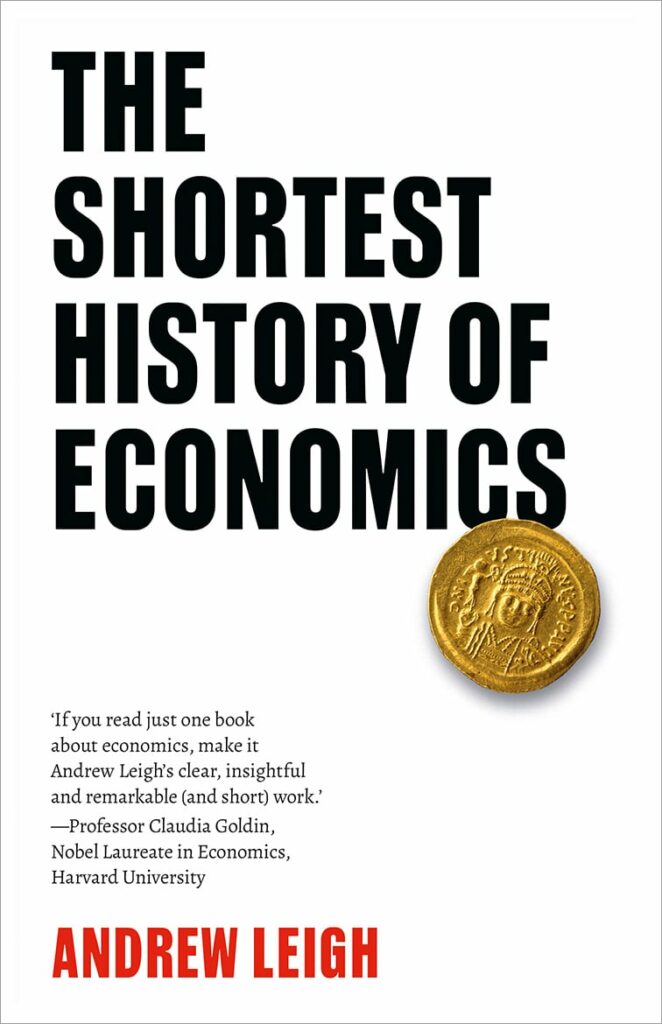
Black Inc. books is releasing an engaging series of Short Histories, including Andrew Leigh’s slim volume on economics, The Shortest History of Economics.
The former Professor of Economics and current Assistant Treasurer writes superbly and distils an ocean of information into a paperback that’s just shy of 200 pages, making the ‘dismal science’ interesting and relevant to everything in our lives.
Andrew Leigh writes well, not just because he knows his subject, but because he’s on a mission – to reassure us that the evolution of a lightly-regulated market economy in a democratic state (arguably what we live in now) is the only rational path to achieve the ‘greatest good for the greatest number’.
He gives us a series of simple, cogent examples of how humans formed societies and economies (almost interchangeable terms in this context), how markets of trade formed and evolved, and how actions taken in and on those markets, according to theory and economic management, had (mostly) expected consequences.
Understanding the basics of economics allows us to distinguish how events in one period can resonate and have consequences that may last through the centuries. In the shorter term, we can see what worked and what didn’t, who is winning and who is losing.
Economics isn’t a science, nor a good predictor, but it is a useful lens to study data on how we live.
Though Leigh admits ‘Capitalism doesn’t guarantee the wellbeing of those who lack capital’, with a modest amount of active government intervention in ‘the market’, most economists suggest the ‘greatest good’ will eventuate, passively, through the mostly unseen mechanisms of that market.
While inequities occur, in sometimes unexpected ways, Leigh regards these as ‘market failures’ – glitches fixable by economic management that steers between totalitarian command and anarchic libertarian ‘small government’.
Invest in a wide range of stocks (from leading world exchanges), indices, exchange-traded funds, cryptocurrencies, smart portfolios, commodities and more on eToro, the world’s premier online investment platform.
Leigh sees government itself in economic terms, as a ‘risk manager’, arbitrating wisely for both markets and people who live in and depend upon them.
This slim history illustrates how economic forces have affected global human societies, and convincingly argues that market economies have extended our lives from the medieval ‘nasty, brutish and short’, to the pleasant, extended and relatively wealthy existences we prize today.
Then, in the final chapter, which I hoped would present a cut-through summary of where our history has led us, Leigh disappoints.
After offering mild warnings about ‘market failures’ leading to increasing inequity, he naively catastrophises about AI, and downplays climate with references to uncertainties of outcomes where there are none.
We know what’s happening and what will happen with climate, and to hear an otherwise thoughtful voice like Leigh’s refer to the climate crisis as merely a ‘key vulnerability’ with a ‘chance of very bad outcomes’ is, frankly, shocking to hear from someone so central to critical decision-making.
Leigh is a solidly Centre-Right neoliberal, but declines to address corporate state-capture that blocks genuine action on the biggest ‘market failures’ – global warming and the extinction crisis. This perhaps explains why his government is widely regarded as failing on climate action in favour of economic management that acts to preserve, at all costs, the system that is itself failing to address climate.
Leigh has also failed to include feminist economics beyond references to the gender wage gap and unpaid labour undertaken by women. Nor does he reference ecological economics, and how dependent our economies are on our ecological life-support systems.
Neoliberal economics only sees the living world as an externality outside the area of study, the market.
Leigh wants us to address ‘market failures’ but appears to ignore that inequity is how the global economic system works – capitalism isn’t about maintaining a level playing field for buyer and seller but about seeking constant advantage; any imbalance of power will ratchet the entire system to favour the wealthy and powerful. To fix the ‘market failure’ on climate, for example, governments would need to change the system that has entrenched share-price and corporate control of government as more urgent than the survival of our species.
Whom the ‘market’ isn’t failing is the wealthy corporate investor sector, and billionaires like Kerry Stokes and the Murdochs who own our media. It isn’t failing politicians of the major parties across the world, who refer to ‘the homelessness crisis’ or the ‘cost of living crisis’ as transient local problems that just need the right ‘risk management’ by government.
While I recommend Leigh’s book to anyone wanting to quickly level-up on economic and social history, his dismaying final chapter inadvertently explains why Labor is failing us – not on the usual macro-economic scale (I understand they’re, broadly, doing well as economic managers in the most conservative sense), but on their failure to address a broken system – market economics itself.
Market economics won’t fix climate or biodiversity crises because market investors profit from them. Market economics won’t fix homelessness because it’s working perfectly for investors, and neither major party will stop prioritising the wealthy and powerful because they bankroll the major parties.
Andrew Leigh wisely advises us ‘[not to] forget externalities – the positive and negative impacts of [our] decisions on other people’, but just as his history of economics leads us to praise the market economy, no amount of just-so stories to support it can ultimately justify a system that no longer supports us.
Leigh’s defense of neoliberalism does not resist injustice and oppression in whatever forms they take, or offer a sustainable path forward.
The Shortest History of Economics, by Andrew Leigh, Black Inc. Books, February 2024, 194pp. ISBN: 9781760644000 $27.99.
B.P. Marshall is a scriptwriter and author.