
Mr Hanson’s recent contribution to the economic case for the proposed AFL stadium has received extensive coverage in The Mercury. It has been described as uncovering a gold mine for Tasmania. He claims to identify deficiencies in the expert analysis provided to the government.
Unfortunately, his creative adjustments to the government business case, which included a benefit cost analysis (BCA), are misleading and based on a misunderstanding of BCAs. This article is intended to correct the record.
The government’s most recent Fiscal Strategy includes a welcome development – that infrastructure investments must return a benefit-cost ratio greater than one. If, as our analysis shows, the benefit – cost ratio is much less than one, the stadium project falls at the first hurdle.
The whole point of a BCA is to assess whether the stadium is a socially desirable investment. Tasmanian government policy requires major infrastructure investments have a benefit-cost ratio greater than one. In other words, benefits need to exceed costs.
The BCA undertaken by MI Global forecasts a ratio of just 0.5. One dollar of benefit for every two dollars spent. The expert analysis by MI Global also conducted sensitivity analysis to test the robustness of its conclusion. In the best-case scenario, with construction costs twenty percent lower and visitation benefits twenty percent higher the benefit-cost ratio, if both favourable cases apply, was, at 0.73, still less than one.
A BCA looks at what benefits result from the outlays regardless of how a project is financed. The question of how to finance a project producing net benefits is a separate issue. It is misleading to conflate the two and conclude that if someone else finances part of the deal, an otherwise dud project gets the thumbs up.
In assessing a project from society’s point of view, a BCA values resources at their opportunity cost. How could the resources used to build the stadium have been used elsewhere? Mr Hanson is untroubled by possible alternative uses for resources. He might believe there is no economic return from health spending compared to returns from a stadium from Day 1, but fortunately few others do.
Opportunity cost is otien easy to measure. The cost of a plumber building the stadium, for example, is just the wage she could have earned on an alternative building site. Similarly for all the other inputs into the construction. For the BCA report, the opportunity cost of Tasmanian resources used to build the stadium was $750m. This opportunity cost is incurred regardless of how the stadium is financed. That the federal government is to contribute $240m to the Macquarie Point precinct has no bearing on the opportunity costs of the resources employed to build the stadium.
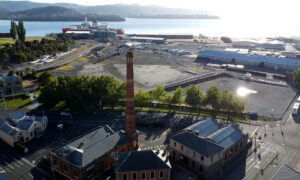
If the federal Treasury guidelines had been followed, the opportunity cost of the stadium’s 5.6 hectares of land would also have been included. Macquarie point is valuable land. From society’s perspective it is not free. To ignore this opportunity cost in a benefit-cost analysis, together with Mr Hanson’s discount to the $750m construction cost, means that his version of costs is understated by a wide margin.
The project should be precisely defined. The government business case is focussed on the stadium and the ongoing costs and benefits directly associated with it. The Hanson report takes a different tack. It includes, as benefits, estimates of the AFL’s annual base funding (on a similar basis to existing AFL teams) and, apparently, spending by the players and other AFL employees living in Tasmania.
These claims are not directly relevant to a BCA for the stadium. If they were, offsetting costs should also be counted. These include the $60m construction cost of the training facility, the opportunity cost of the land on which it is based, and the annual $12m commitment by the government to support the new club. Again, the Hanson report understates the costs.
One of the flaws of the BCA was the assumption that projected occupancy of almost one major event per fortnight (10,000 people or more) would be achieved in the first year. Mr Hanson was happy to accept this absurdity because it suited his predetermined case. Finally, both the government BCA and the Hanson report ignore the penalties for late completion of the stadium, and if AFL atendance falls below target levels. It is difficult to assess the likelihood of these clauses being activated. But it is standard practice in long term contracts to consider these as potential costs.
The Hanson report finishes with an expanded list of possible events to add to the government business case. In my youth I liked the rock band entitled Weddings, Parties, Anything. This would also be a good title for Mr Hanson’s speculative list.
It is often claimed that if resources used on the stadium were reallocated to the health budget, it would yield ‘no economic return’ (Hanson, p.5). A 2021 report by Wells Economic Analysis calculated the private cost of elective surgery waiting lists in Tasmania to be $120m per annum. It would be easy to list many other examples of economic benefits from even marginal increases in health spending.
As the economist Keynes famously remarked, digging holes and paying people to refill them has a significant impact on economic activity and employment. But we are in an economy with a shortage of qualified tradespeople, not to mention vacant inner-city land. Surely there are more socially desirable investments available.
That’s why a BCA is so important. When analysed using consistent principles, the stadium has a benefit-cost ratio significantly less than one. So, while some have described the stadium as a gold mine, a benefit-cost ratio significantly less than one suggests it’s fool’s gold.
Graeme Wells has had an academic career as an economist spanning nearly fifty years in various universities in Australia and overseas. He is presently an independent economist and a Senior Adjunct researcher at UTAS. John Lawrence is an accountant and economist by training, currently a public policy analyst and blogger at www.tasfintalk.blogspot.com. Awarded Tasmanian Times’ 2011 Tasmanian on the Year for his analyses.
TASMANIAN TIMES: