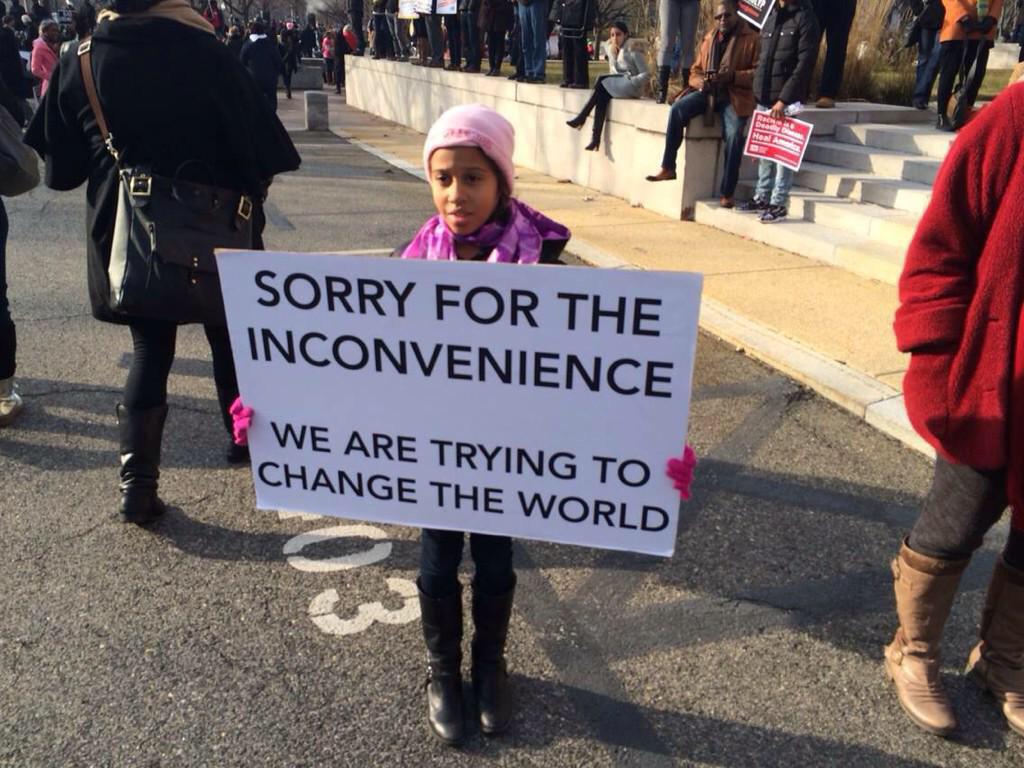
“Education is the most powerful weapon which you can use to change the world”, said Nelson Mandela, anti-apartheid activist and the first president of South Africa.
Education can achieve equality, reduce poverty, create a sustainable planet, deliver good health and prevent disease.
When I was at school, my teachers told me I couldn’t become a veterinarian because I was a girl. I quite simply thought that was ridiculous, paid little attention to them, studied hard and in time proved them wrong. I wrote a letter to one of those teachers telling him he had been incorrect and discriminatory.
From that experience as a teenager, I learnt that you should not accept everything said by those in authority, because they don’t necessarily deliver correct or full knowledge.
You must follow your own instincts, educate yourself and then educate others.
In the early nineteenth century, Jane Austen wrote: “Give a girl an education and introduce her properly into the world, and ten to one she has the means of settling well, without further expense to anybody.”
Yet it was not until the early 20th century, after women had protested peacefully, marched in the streets, chained themselves to railings and were imprisoned, that they achieved the right to vote in elections. A right that we now take for granted.
I was made abruptly aware of another inequality when one of our sons told us he was gay – and set about educating myself. I listened to my son and discovered he had hidden his sexuality and pretended to be heterosexual, at school and then at university, out of an instinct to appear ‘normal’ and to stay safe.
We were living in Queensland at that time and, with another mother whose gay son had been bullied at school, formed a group to advocate for equality and inclusion for all LGBTIQA+ young people in all educational settings. As parents, teachers, school nurses, police liaison officers, mental health specialists and many more, we shared information and learnt from each other.
With all that listening and learning, all those real-life stories, we built a powerful foundation of knowledge from which to protest, to approach the authorities and advocate for improvements in all schools.
Naturally, I participated in the campaign in Australia to gain support for marriage equality. A campaign that culminated in the Marriage Act 1961 being updated to define marriage as ‘the union of 2 people to the exclusion of all others, voluntarily entered into for life’.
Now I live in Tasmania and advocate for climate action, with my grandchildren in mind. Watching time lapse photography of the ice melting at the North Pole was the moment I realised how critical climate change had become and started to read the history, the cause and the effects of global warming.
The most recent reports from the Intergovernmental Panel on Climate Change (IPCC) conclude unequivocally that, without immediate emissions reductions, the temperature will continue to rise and deteriorating weather will have a lethal effect on the environment, our communities and all future generations.
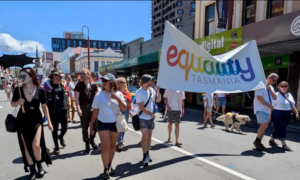
There are many groups in Tasmania and across Australia that are urging governments to act. Some of us write letters, articles and submissions, some gather on the streets with placards, and some brave souls camp for months in the forests.
The protection of forests is one important way to address the effects of climate change. At the COP26 climate conference held in Glasgow last year, more than one hundred countries, including Australia, confirmed their efforts to conserve forests and other terrestrial ecosystems and accelerate their restoration. What must follow such a declaration is for governments to change their legislation and policies concerning deforestation.
Logging operations not only result in the destruction of ancient towering trees and many other native plant species but also the death or displacement of a large number of animals, birds, reptiles and insects. Many of the plants and animals found in the forests are listed on the Tasmanian Threatened Species Lists, such as the Tasmanian devil, spotted-tail and eastern quolls, eastern-barred bandicoot, wedge-tailed eagles, masked owl, swift parrot and more.
The Tasmanian government is delivering new legislation, the Workplaces (Protection from Protestors) Amendment Bill 2021, commonly known as the anti-protest law. It will provide increased powers to remove and charge people engaged in peaceful protests, and impose greater penalties. It has a particular focus on environmental protestors, those very people who have the greatest understanding of the impact that climate change is having on our environment, and the need for urgent action.
Instead of introducing stricter legislation against peaceful protesters, I ask the Tasmanian government to listen to all those asking for climate action in this state.
Universities provide the science and businesses have the innovative capability to respond transformatively to all aspects of climate change.
Action based on education now will ensure a safe future for the environment, our children, grandchildren and all following generations.
Dr Janet Truslove has worked as a livestock veterinarian in Scotland and Queensland and now lives on a farm in Tasmania where regenerative agriculture is practised. She walks the hills and forests and writes in support of climate action. Twitter @janetisnow