I’ve spent the last one and a half years researching the climate benefits of ‘clean’ hydrogen. Here are 10 things I’ve learned:
1. Conventional wisdom is wrong. Hydrogen (H2) made from renewables and water is not inherently climate neutral and can still contribute to climate change.
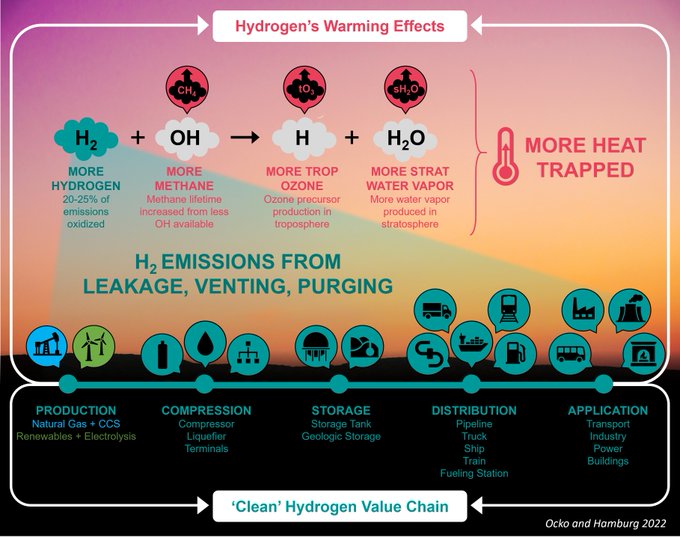
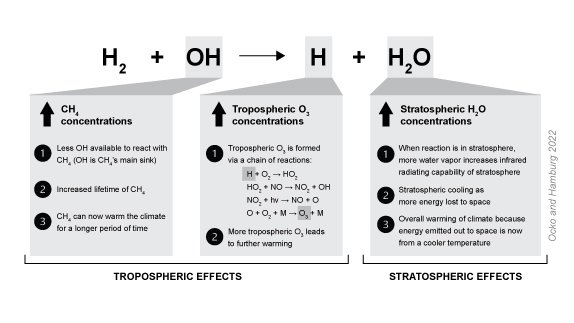
2. This is because H2 is a tiny molecule that can easily escape into the atmosphere, and when it does, it triggers chemical reactions that increase the amounts of other greenhouse gases.
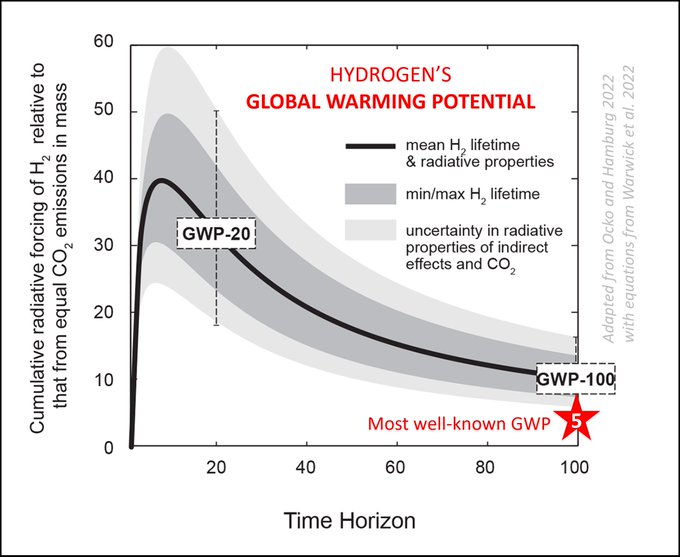
3. Scientists have actually known this for decades. But because H2’s indirect warming effects last only a couple decades, its warming potency has been consistently understated by standard metrics that only assess impacts over a century.
4. So H2’s status as an indirect GHG eventually fell off the H2 industry’s radar, and dozens of reports, plans, and conferences over the past few years and hundreds of newly announced projects worth overUSD $500B never even mentioned the concern that H2 leakage can warm the climate.
5, Plus, only recently have scientists evaluated H2’s impacts on the climate: increasing the amounts of the GHGs methane, tropospheric ozone, and stratospheric water vapor.
6. And when you include all effects and do the maths appropriately, H2’s warming potency compared to CO2 is 2 to 6x higher than previous estimates, depending on the time period you are looking at (over the next 100 or 20 years, respectively).
7. But how serious an issue this is for the climate depends on how much H2 escapes into the atmosphere as production and consumption increase over the next few decades.
8. And it turns out we have no idea how much H2 currently escapes. This is because current sensors focus on leaks at explosive levels, and are unable to detect small leaks (ppb level) that are not safety risks but matter for the climate.
9. So in order to maximise climate benefits from ‘clean’ H2 as a decarbonisation strategy, we must immediately include risks in decisions/planning; do more to understand, measure, prevent leaks; and prioritise applications with no alternatives and systems that have less risks for leaks.
10. The great news is that the ‘clean’ hydrogen industry is still in its infancy. We have an opportunity to ensure H2 yields the climate benefits it promises. Let’s get it right.
For more info, see our new study in Atmospheric Chemistry and Physics: Climate consequences of hydrogen emissions.
Dr Ilisa Ocko is a senior climate scientist and Barbra Streisand Chair of Environmental Studies at Environmental Defense Fund, where she pursues climate science research and provide scientific guidance for climate change communication and policy.