
Since we are in the ‘assess your own risk’ phase of this pandemic, it would be helpful if public health officials would give a master class on assessing risk. Looks like academics and engineers need to do it instead.
To assess the risk of a space, first you need to know how you get infected and what contributes to it. I’ll spend a few threads going into detail about the factors. Here’s the first one.
The primary way you get infected with COVID is by inhaling an infectious dose over a certain period of time. The dose is defined by 4 factors:
Dose = Virus concentration x time x breathing rate x respiratory tract deposition rate
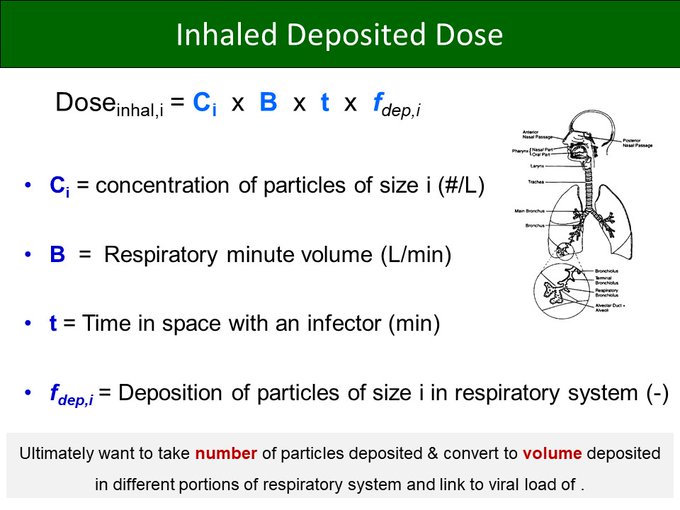
Dose is related to the probability of infection. You can still get infected with a low dose (like outdoors), it’s just lower probability. That’s why it’s problematic to say something is ‘safe’. Lowering the dose reduces risk of infection, but doesn’t eliminate risk.
Breakdown of the factors
Time – the longer you spend exposed to a certain concentration, the higher the risk. For activities that don’t require spending extended periods of time, like going to a store, minimising time is an effective measure to reduce risk.
Breathing rate – For some reason the ‘hold your breath’ method hasn’t been promoted enough ????. When breathing rate is 0, you don’t get infected through inhalation. (For the trolls reading this, incase you couldn’t tell, it’s a joke).
The faster you are breathing, the more air you inhale over a period of time. Putting time and breathing rate together, the risk is related to the number of breaths you’ve taken. More breaths means higher risk.
Deposition rate – Many of the virus particles you inhale do not stay inside you, you just breathe them back out. Only the ones that deposit inside you can infect you. However, I don’t think this is relevant for assessing risk. (I’ll QT if experts disagree at the end.)
One possible exception is you have innate immunity and it can remove particles that have deposited instead of them infecting you. Exposure to low humidity inhibits this and increases the risk from deposition. Run a humidifier when it’s dry inside.
Flu virus’ best friend: low humidity
Low-humidity — not the cold — may be the reason why flu infections are often worse in the winter, according to a Yale research team led by Akiko Iwasaki.
Virus concentration is the final and most complicated factor. The higher the concentration you inhale, the fewer breaths required to reach an infectious dose. So how do you assess virus concentration?
Range – initially when you exhale, there is a jet of concentrated air in front of you (think of a smoker breathing out or smelling someone’s breath). The virus concentration is highest at short range from the source. That’s why infection risk is highest in close contact.
However, the majority of air you breathe in at short range isn’t actually from that person’s breath. Most of the air is still from the room, so low virus concentrations in the rest of the room make a difference – even at short range.
Poor ventilation worsens short-range airborne transmission of respiratory infection – PubMed
After the short range jet, the virus laden aerosols in the air then diffuse into the room. There are many factors that affect the final virus concentration and they’re important for assessing risk. That will be the next thread.
But what affects the virus concentration in a room? The steady-state concentration is proportional to the ratio of the rate of emission to the rate of removal.
Simply, if you double the rate of virus being emitted, you double the final concentration. If you double the rate it’s removed, the concentration gets cut in half. Here’s the formula:
Concentration = Rate of emission/Rate of removal.
So what defines these two rates?
Rate of emission is related to a few factors: how many infected people there are, their viral load and what activities they are doing.
So, Rate of emission = # infected ppl x viral load x activity
Factors that effect rate of emission
1. The risk from # of infected ppl is related to the community prevalence and the # of ppl there. More infected people in the community and larger gatherings means higher chance of having more infected people in a space.
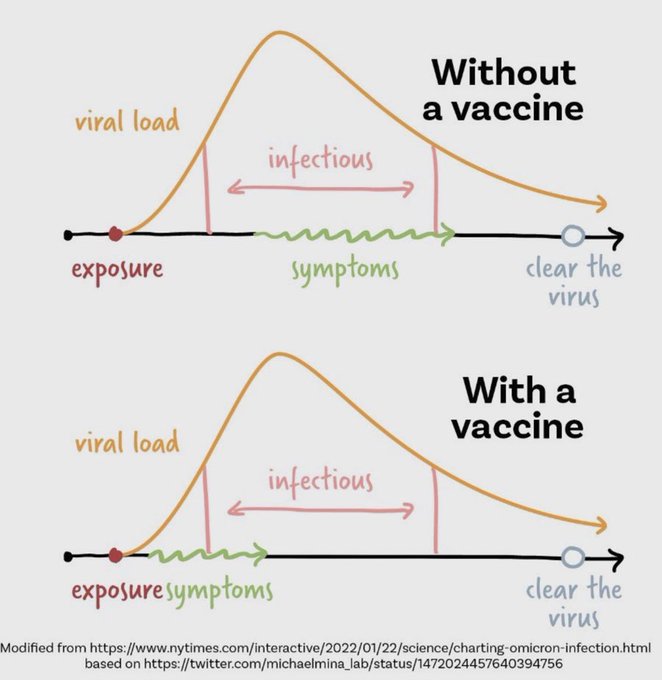
2. Viral load varies over the course of the illness. People are initially more infectious and over the course of illness, they become less infectious. This will be relevant when discussing risk in hospitals in a future thread.
3. Aerosol emission is highly dependent on the activity. Breathing, talking, singing, exercising all have significant differences. “High-risk settings” usually means settings with high emission activities and poor removal mechanisms.
What factors lower the viral concentration in the space?
There are 4 mechanisms to remove the virus:
Ventilation, filtration, deactivation and deposition.
Ventilation is replacing the air in the space with clean air. It can be natural (open windows) or mechanical (HVAC).
Filtration is passing the air through a filter and removing the virus laden aerosols. It can be in the space (HEPA filter/CR box) or in the HVAC unit.
Deactivation is the viruses no longer being able to infect you. It can happen naturally through decay or it can be done actively with UV light. Natural decay rate is dependent on temperature and humidity. There are many ways UV is used.
Deposition is the virus laden aerosol landing on a surface so it’s not in the air and you won’t breathe it in. The rate is related to the humidity and the surface area of the space. Low humidity causes droplets to evaporate and become aerosols instead of depositing.
If the space is well-mixed, these measures are additive. Usually, ventilation is the most significant factor. Most places don’t have filtration or UV. Back of envelope – I estimate the effect of deposition and decay is about 25% of ventilation.
It’s the absolute value you care about for the mitigation measures. Air changes per hour (ACH) measures the flow per volume of the room. CO2 measures the flow per person, but you care about total flow. You need the right metric.
We can add distance to the list as well. At close range concentration is high and reduces to a constant value around 2 m. This is dependent on the removal mechanisms.
One last factor is masking. Whatever the concentration in the room is, the masks remove a certain percent. The final concentration you inhale is the amount that leaks through.
Putting it together, here’s the virus concentration formula and risk formula. This formula is very similar to the I just derived.
In this formula they use air changes per hour (ACH) x volume which is just the total flow.

One last caveat is this is the steady-state concentration. A room starts empty and then the virus concentration increases until it reaches steady-state. Understanding how these factors vary in different spaces requires more threads. They will be coming out soon.