Media release – Australian Energy Market Operator (AEMO, 30 June 2022
AEMO releases 30-year electricity market roadmap
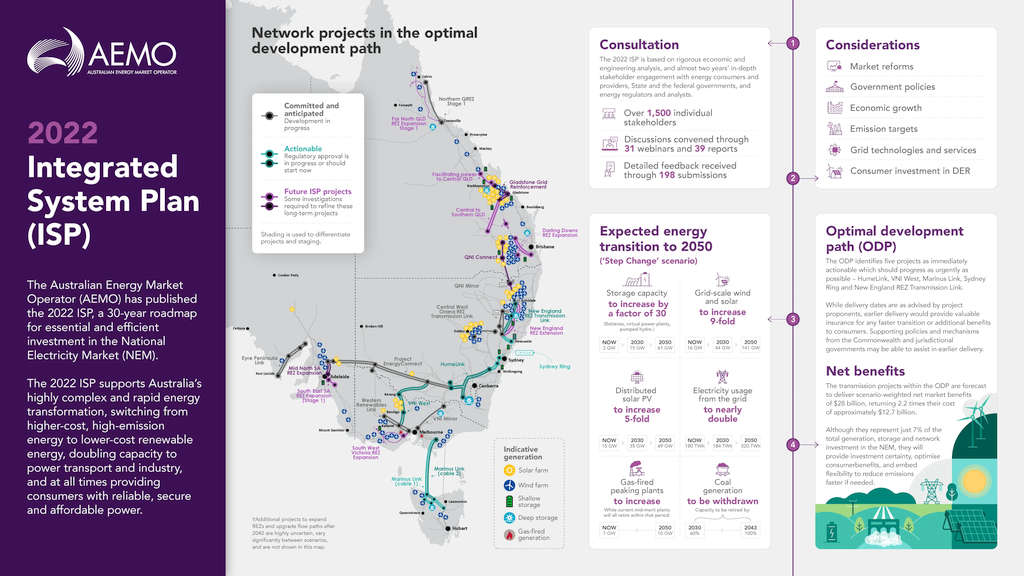
The Australian Energy Market Operator (AEMO) today published the 2022 Integrated System Plan (ISP), outlining a 30-year roadmap of investments for the National Electricity Market (NEM).
AEMO has involved more than 1,500 stakeholders – including policy makers, governments, consumers and energy industry representatives – to produce its third ISP, based on rigorous economic and engineering analysis.
AEMO CEO, Daniel Westerman, said: “Australia is experiencing a complex, rapid and irreversible energy transformation.”
“The 2022 ISP informs Australia’s energy transformation, based on an ‘optimal development path’ of essential transmission investments that will efficiently enable low-cost, firmed renewable energy to replace exiting coal generation.
“These transmission projects are forecast to deliver $28 billion in net market benefits, returning 2.2 times their cost of $12.7 billion, which represents just 7% of the total generation, storage and network investment in the NEM,” he said.
The ODP identifies five projects as immediately actionable which should progress as urgently as possible: HumeLink, VNI West, Marinus Link, Sydney Ring and New England REZ Transmission Link. While delivery dates are as advised by project proponents, earlier delivery would provide valuable insurance for any faster transition or additional benefits to consumers.
As part of developing the ISP AEMO and stakeholders identified the most likely future for the NEM, called the ‘step change’ scenario, having considered ageing generation plants, technical innovation, economics, government policies, energy security and consumer choice.
“The step change scenario forecasts annual electricity consumption from the grid will double by 2050, as transport, heating, cooking and industrial processes are electrified and 60% of current coal generation exiting by 2030,” Mr Westerman said.
“To maintain a secure, reliable and affordable electricity supply for consumers through this transition to 2050, investment is required for a nine-fold increase in grid-scale wind and solar capacity, triple the firming capacity (dispatchable storage, hydro and gas-fired generation) and a near five-fold increase in distributed solar,” he said.
Mr Westerman said that the need to cost-effectively deliver the investment in firmed renewables has gathered momentum in recent months.
“We’ve recently seen market dynamics exhibiting the step change scenario, including accelerated coal-fired power station closures. In addition, generation unavailability and high commodity prices further highlight the need to invest in the transmission plan outlined in the ISP to support firmed renewables,” Mr Westerman said.
“The ISP will help industry participants, investors, governments and communities plan for the decarbonisation of the power system to deliver low-cost, firmed renewable electricity with reliability and security.
“Importantly, the ISP will help meet state and national climate targets, and contribute to economic growth through low-cost, reliable energy,” he said.

Media release – Guy Barnett, Minister for Energy and Renewables, 30 June 2022
Australian Energy Market Operator confirms urgent need for Marinus Link
The Australian Energy Market Operator (AEMO) has today confirmed that the affordable, reliable and clean energy unlocked by Marinus Link is urgently needed.
Today, in a critical roadmap for Australia’s renewable energy future, AEMO’s 2022 Integrated System Plan (ISP) confirms that Marinus Link is an urgently needed and a critical energy project that will deliver $4.5 billion in net benefits to the nation, positioning Tasmania as a truly clean, smart and innovative state.
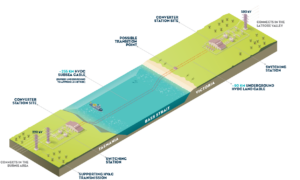
Marinus Link will provide improved access to Tasmania’s renewable energy resources, including deep storage hydropower and our world class wind energy, helping to improve energy system reliability and put downward pressure on power prices into the future.
The development of Marinus Link is a critical enabler of Battery of the Nation pumped hydro development and complementary to the state’s Green Hydrogen Vision.
The opportunities for Tasmania to be unlocked by Marinus are significant.
For Tasmanian families, Marinus Link will support lower wholesale energy prices in Tasmania through its two-way flow of energy, helping to keep future energy bills down for Tasmanian families and businesses. It will also mean increased energy security.
For Tasmanian businesses, it will unlock new renewable industries and green manufacturing, meaning jobs for Tasmanians for decades to come, attracting billions of dollars of investment in regional areas of Tasmania, including 1400 jobs in Tasmania and more than $7 billion in additional economic activity to the State.
There will also be telecommunications benefits, as Marinus Link will carry additional fibre optic capacity, increasing the diversity, capacity and resilience of Tasmania’s telecommunications links to the world. By growing fibre-optic capacity we can help keep downward pressure on the price of data services for Tasmanian homes and businesses, and support new opportunities in IT services and development.
And when it comes to climate action, Marinus Link will deliver a fundamental shift in our national journey to net zero with savings of at least 140 million tonnes of CO2 by 2050, the equivalent of taking a million cars off the road. Through Tasmania’s world class wind energy resources and deep hydro storages we can take a leadership role in emissions reduction that will provide generational benefits through more jobs, lower power prices and a cleaner world.
The Tasmanian Government has always maintained that the project will only go ahead if it is in the best interests of Tasmanians. That’s why we are working with the Australian Government to change the rules governing how large interconnector projects are paid for.
Our rule change request will allow for the costs of Marinus Link to be fairly distributed and ensure that all energy consumers, including those in Tasmania, are better off and receive the benefit of lower power bills. We expect this rule change request to be lodged with the Australian Energy Market Commission shortly, following consultation with the Australian Government.
The Tasmanian Government is also working closely and strategically with the Australian Government as we advance this important project and are continuing discussions in relation to the Australian Government’s Rewiring the Nation policy and the opportunities it presents for Marinus Link.

Dean Winter MP, Shadow Minister for Energy and Emissions Reduction, 30 June 2022
Government needs to be upfront with Tasmanians about who will pay for Marinus
The Rockliff-Ferguson Government and out-of-his-depth Energy Minister Guy Barnett need to come to the table today with their plan around Project Marinus and clarification about whether Tasmanian households will foot the $3.8 billion price tag.
With the Australian Energy Market Operator today reporting the project must be built as quickly as possible, it’s time for the Liberal Government to detail its plan, with costs blowing out to almost $4 billion but Tasmanians are none the wiser about who will pay for Project Marinus.
Tasmania has a big opportunity to play a central role in the national transition to renewables with Marinus but with other states to be the major beneficiaries, Tasmanian taxpayers should not be hit with the significant costs attached to the project.
By Mr Barnett’s own calculations, only six per cent of Marinus’ benefits are expected to flow to Tasmania.
The Rockliff-Ferguson’s Government’s plan to focus entirely on the project has already cost each Tasmanian household $227 in increased power bills next year alone, after they broke their promise to de-link from the NEM, so that they could try to build Marinus.
Mr Barnett can no longer push ahead pretending everything is fine and must reveal the fine detail of his actual plan and how much Tasmanian taxpayers will be slugged.
David O’Byrne MP, Member for Franklin, 30 June 2022
More energy policy chaos while ‘urgent’ Marinus project languishes under Barnett
The Australian Energy Market Operator (AEMO) has today declared Marinus Link to be an ‘urgent’ energy project, but the project remains unfunded and Tasmanians are still facing huge power bill shocks.
Franklin MP David O’Byrne said AEMO’s report was the latest in recent string of energy policy failures by the state government, which has included massive job cuts at TasNetworks and household power bill hikes of nearly 12%.
“It’s no wonder that Treasury listed Marinus Link as a significant risk to the state budget. The project has been plagued by delays and inaction by this government, and we still don’t know who is going to pay for it,” said Mr O’Byrne.
“In 2021, AEMO were expecting Marinus to be fully operational by 2029. The report today confirms that the project has been delayed yet again with earliest full operation in 2031.
“If the state government delay this project any further, there’s a real risk that Tasmanians are going to be paying for a redundant energy asset.
“Energy Minister Guy Barnett has delivered a lot of speeches about Marinus and spent of lot of time doing photo ops in high viz and a hard hat. Meanwhile, Tasmanians are struggling with power bill shock, Marinus is no closer to becoming a reality, and hundreds of energy sector workers are facing job cuts.
“I know that Minister Barnett has got his hands full after inheriting responsibility for the housing crisis from his colleagues, but he and his government need to be honest about their complete failures on Tasmanian energy policy.”
The Integrated Systems Plan (ISP) released by AEMO today sets out the future of the National Electricity Market, including the electricity generation and transmission assets needed across Australia’s eastern seaboard.

Media release – Hydro Tasmania, 30 June 2022
Integrated System Plan confirms Marinus Link should progress urgently
Hydro Tasmania has welcomed the 2022 Integrated System Plan confirming Marinus Link as “immediately actionable” and noting it should progress urgently.
Acting CEO Ian Brooksbank said the 1500MW Marinus Link interconnector is a critical enabler of Battery of the Nation, Hydro Tasmania’s bold vision to maximise Tasmania’s hydropower capacity and add pumped hydro.
He welcomed the Australia Energy Market Operator’s recognition that Marinus Link would provide improved access to Tasmania’s energy resources including deep storages, helping reduce the scale of investment needed on the mainland and provide positive net market benefits.
“What we have seen happening in the market of late places even more urgency on progressing critical projects like Marinus Link.
“Tasmania has exactly what is needed – cost-effective clean energy backed by long duration storage, and Marinus Link will unlock that.
“Battery of the Nation and Marinus Link will give Tasmanians access to the lowest possible power prices, lock in our energy security and create economic benefits through jobs and regional investment.
“It is great to see AEMO also confirm the importance of storage and the vast volumes required to keep electricity supply secure, reliable and affordable,” he said.
The first 750MW Marinus Link cable will unlock flexibility in our existing hydropower system to provide the firming capacity needed. It also opens up potential for capacity upgrades for existing hydropower assets including the Tarraleah scheme.
The second 750MW cable creates the opportunity for Hydro Tasmania to develop our first Tasmanian pumped hydro project which is a 750MW, 20-hour deep storage opportunity at Lake Cethana.

Featured comment – Ben Marshall, 30 June 2022
— untitled —
Again the market seeks to protect itself by socialising the costs of energy production, distribution and storage in order to enable the market to go on making a buck.
We learned nothing from the last crisis, and AEMO has the last people to point out that the industry, when crunch came to crunch, attempted to mug Australian power consumers, thereby forcing our neoliberal governments to suddenly turn socialist for five minutes.
AEMO is paid by the industry. It does not serve us. Any talk of climate is lip-service designed to persuade us that supporting the industry means action on climate.
Clueless politicians hear only one voice – that of the industry, AEMO. AEMO hears only the voices of those who pay it, and who are seeking to profit from a utility, namely energy, which should be publicly owned. Do you remember the bit I just mentioned about the lesson we didn’t learn from the last crisis?
Meanwhile, Tasmanian Labor is still whining about ‘who’s going to pay for it?’ We are, Dean – we ordinary Tasmanians. What don’t you get about that, mate? Your question is 100% redundant.
When AEMO consults engineers and economists they are focused on the moving parts of the system which makes the industry a profit. Marinus is just one variable which AEMO files under the ‘more renewables energy is good’ category without saying who it’s ‘good’ for. (Spoiler: it’s good for, mostly, foreign shareholders .. the ones who already own almost all of our energy production, distribution and storage.)
Yes, we need more renewables and yes, we need more transmission, but handing the keys of the energy, climate and jobs sectors to the private for-profit sector will just result in more of the same – socialising costs while privatising profits.
Worse, more renewables doesn’t equal action on climate. If we simply swap out fossil fuels for renewables (something, for all the talk of renewables, we simply are refusing to do), the planet is screwed in short order. Some renewables projects are appalling on an environmental level, and shouldn’t be allowed.
UPC’s Robbins Island project is ecocide on a massive scale, and TasNetworks’ new grid will devastate wilderness areas because it refuses to bury the line and is rorting the system for its own private profits. (I know they’re state-owned, but they’re still for-profit and corporatised with a single shareholder, namely our greedy state government.)
AEMO haven’t genuinely factored in climate / biodiversity because that’s not their job. Instead, they’re enabling the safe, reliable supply of profits to the market, using energy and our need for it, as drivers.
Marinus is a con, and Tassie doesn’t get anything out of it. AEMO’s insistence that it’s critical isn’t borne out by independent analysis, let alone an actual society and economy-wide cost-benefit analysis – something industry refuses to do while saying it’s not their job.
Labor federally and at our state level is about to fail Tasmania yet again. The Tasmanian Liberals have used TasNetwork’s ad hoc PR promises as a cover for inaction on jobs, climate and energy. All Tas Labor can do is complain that the energy industry isn’t screwing the Tasmanian people fast enough.
When are local politicians of any colour going to fight for Tasmania and begin calling out Marinus and the farce that is ‘Battery of the Nation’?