I am invited to deliver the keynote address at a conference organised by the East African Geological Society. Delegates have come from various regions of the world, most notably Europe and North America.
My paper dealt with a geological comparison between eastern Africa and Australia. After delivering my speech the Chairman of the East African Geological Society sidled up to me and asked if I would like to join their association. Why not? Membership is only US$5. For joining I am rewarded with a copy of the association’s constitution.
Soon after, the Chairman made a special announcement, “I am pleased to announce our Society has its first international member. Our keynote speaker has joined.” Raucous applause followed. Although somewhat embarrassed I stand and acknowledge the applause.
Whilst presentations continue I take the opportunity to familiarise myself with the constitution. You might think that’s boring but it’s what lawyers do you know. Out of curiosity I carefully read the section headed “Qualifications for Membership.” There, in black and white the first qualification reads, “The member must be a geologist.” That was the quickest qualification I have ever earned, or not earned.
The conference is held in Arusha, northern Tanzania, near Kenya. Arusha is a very important city from a legal perspective. This was where the International Criminal Tribunal for Rwanda, established by the UN Security Council in 1994, was held. During the first decade of this century the Tribunal heard many instances of crimes against humanity.
There are many significant tourist attractions within the region. Mt Kilimanjaro, the highest mountain in Africa is about a hundred kilometres away as the gazelle runs. Further west is the famous Serengeti National Park.
Our group is offered a car and driver by a Tanzanian Government Department. The plan is to take us to one of the nearby tourist attractions, the Ngorongoro Conservation Area at the centre of which is the world’s largest intact and inactive volcano. Ngorongoro is a relatively short distance from Arusha on possibly the roughest road I have ever encountered. But it was worth the trip.
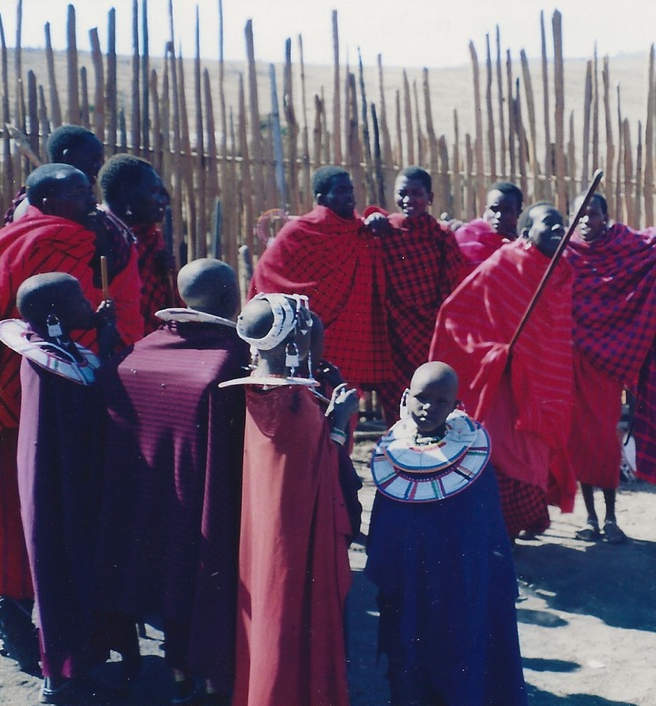
Our first stop is at a Massai village. The Massai are known as Nilotic people, a large group of people indigenous to the Nile Valley and living mainly in east Africa. They dress distinctively in traditional clothes and welcome tourists to their villages with a traditional ‘dance’.
Upon arrival one of the villagers emerged from his mud hut, meandered in my direction, looked down at me and told me he had a headache. “You wouldn’t have a panadol by any chance?” he asked. Here is a giant man dressed in traditional colourful but cloth wrapped around a lean body, bare foot, and carrying a long spear asking for Western medicine. I obliged with a packet, finding them in the glove compartment of our car.
The Massai dance was a sight to behold. A group of about twenty svelte men dressed the same as my patient stood in a circle and jumped vertically in unison whilst making a deep rhythmic sound. Enough to give anyone a headache. If they carried more muscle any one of these men would get a spot on an AFL list as a ruckman, such was their amazing vertical leap.
As the tallest of the whites present the Massai leader chose me to join in. There was a time when I too had a good vertical leap. Not now. I stood in the centre of the circle and jumped possibly six inches off the ground as the Africans laughed. I think I heard one of the locals say, “White men can’t jump!”
The hotel is situated on the outer rim of the volcano. The lounge and dining area has magnificent views across the plain to the opposite rim in the distance. Each single story bedroom had a similar view. The rooms were positioned in a line away from the reception. Small, individual bungalows.
Our group enjoyed a delightful dinner washed down with South African wine and then retired to the lounge to watch the sun set across the misty plain. Aah the serenity. Suddenly the silence was broken by a loud explosion, then another.
“What in the hell is that?” my colleague asked.
“A shotgun,” I replied. “Having spent time in the Army I can tell you that wasn’t a rifle. That was a shotgun. It wouldn’t kill one of the big animals unless a solid cartridge was used, more likely just to scare them.”
One of the hotel staff overheard the conversation and confirmed my guess. “Sometimes the hyenas venture close to the hotel looking for food in the rubbish bins. Staff patrol the grounds. You mustn’t go to your room without being accompanied by a Ranger. Hyenas are aggressive and dangerous.”
That’s comforting.
After breakfast the hotel provided each of us a lunch box. The rule for travelling into the caldera required tourists to be driven by a Ranger. In the early morning we wound our way down a dirt road to the bottom of the rim, past a herd of cattle being ushered along by a young Massai boy. Apparently the cattle graze on the savannah during the day and in the late afternoon are returned to enclosures at the village outside the caldera.
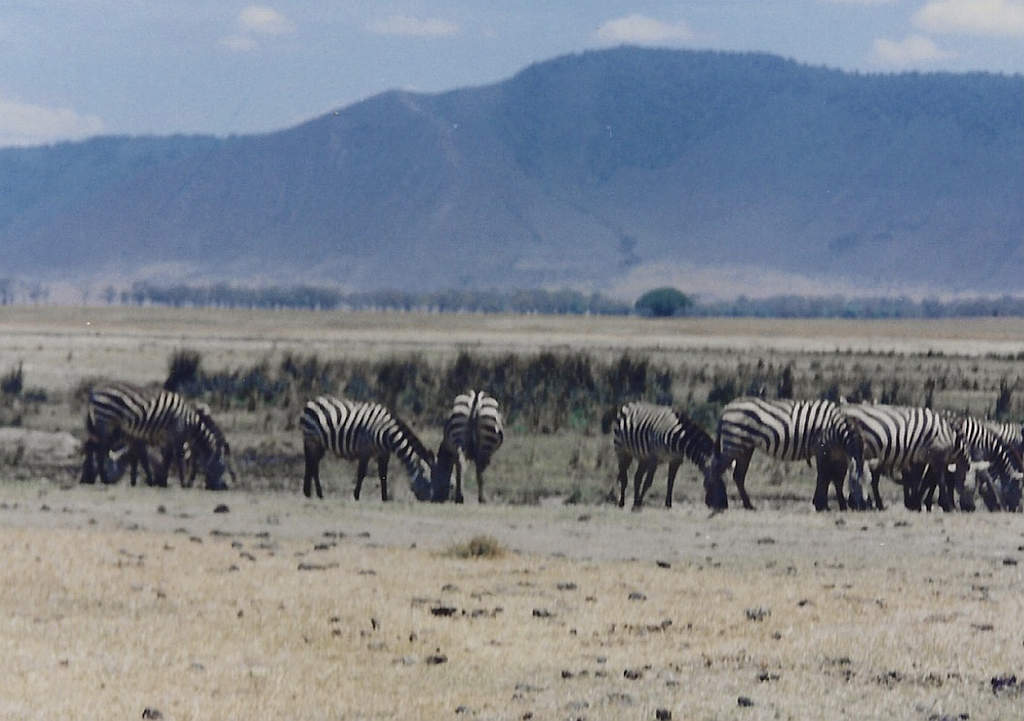
Ngorongoro’s crater is home to all of the African wildlife except the giraffe. It is a microcosm of climates and vegetation. On one side there are waterfalls in a rainforest and on the other an open plain with grassland. In the centre there is a huge lake populated by magnificent flamingos, water buffaloes and hippopotamuses and circled by wildebeests, zebras, antelopes, jackals, hyenas, elephants and all members of the cat family.
At one point our driver spotted a male lion resting in grass about twenty metres from the track. It was difficult to spot. The driver stopped the car. One of our group told him the lion was difficult to see and he should prod him to stand up. He declined.
“Aaw come on, be a sport, we’re visitors from Australia.”
A vigorous shake of the head.
Many African wildlife films are made in the Ngorongoro crater. A great place to visit but be sure to take a packet of panadol.
Gordon d’Venables has been, inter alia, a teacher, soldier, farmhand, lawyer and businessman. As a lawyer he travelled extensively for international clients. His letters from various times and places around the globe (PNG, England, Ireland, France, USA, Saudi Arabia, Serbia, Iran and others) refer to some of his experiences. Gordon’s recently published book, The Medusa Image, can be obtained from Pegasus at www.pegasuspublishers.com, ISBN: 9781784658939 www.amazon.com.au or https://www.amazon.com/Medusa-Image-Gordon-DVenables/dp/1784658936
GORDON D’VENABLES: Letters.
GORDON D’VENABLES: Letter from USA, pre-Soviet Union Breakup.
GORDON D’VENABLES: Letter from Belgrade.
GORDON D’VENABLES: Letter from Iran.
GORDON D’VENABLES: Letter from India.
GORDON D’VENABLES: Letter from Saudi Arabia.
GORDON D’VENABLES: Letter from Vietnam.
GORDON D’VENABLES: Letter from Germany.
GORDON D’VENABLES: Letter from London.
GORDON D’VENABLES: Second Letter From London.
GORDON D’VENABLES: Second Letter From Iran.
GORDON D’VENABLES: Letter from Moscow.
GORDON D’VENABLES: Second Letter from Moscow.
GORDON D’VENABLES: Letter from St Petersburg.
GORDON D’VENABLES: Letter from Ireland.
GORDON D’VENABLES: Letter from Hua Hin, Thailand.
GORDON D’VENABLES: Second Letter from Thailand.