Most people have heard of the TATA Group based in India. It is one of the largest conglomerates in the world
Jamsetji Tata formed the founding company in 1868. It has expanded to over 100 different international companies, some 30 or so listed on stock exchanges with a market capitalisation of over $130 billion. Probably best known is the motor vehicle manufacturing sector but the Group is also involved in the hospitality industry, airlines, steel plants, and pharmaceuticals amongst others.
I was scheduled to fly to Europe when I received a surprising request. TATA Chemicals has commenced early discussions with a major Australian boat construction, fishing and fish processing company and it is hoped I may be able to progress negotiations towards a joint venture based in the Gujarat region on the northwest coast of India. I was happy to accommodate the diversion.
* * *
First lesson: never look out an aircraft window when landing in India. Air India bounced down the runway at Jamnagar Airport which doubles as an airstrip for the Indian Air Force and I watched the jungle at the end of the strip coming at us at a frightful speed. The engines roared to slow the forward thrust as brakes were applied. Simultaneously smoke billowed from somewhere under the plane.
We’re not going to stop in time, was my immediate thought. But we did of course. Just stopped mind you!
“That banging you can hear is the sound of my knees knocking,” I told my associate as we walked across the tarmac.
An official from Tata Chemicals met us and a beautiful young Indian woman placed a string of tropical flowers around my neck, a reward for not screaming!
More close encounters were waiting. An old Mercedes Benz was incongruously parked nearby. The Mercedes bounced through large potholes on the long and well-worn road to our destination. Eyes fixed on the road our driver was intent on ‘flying’ over the top of the holes but due to their size was in most cases unsuccessful.
“I could have sworn I saw the top of a Volkswagen in that last pothole,” I said to my colleague.
Our chauffeur was skilful. We didn’t hit any of the rusted vehicles, cows, chooks, goats or other animals that meandered slowly across the road as we sped and swerved our way through the middle of small villages en route to Mithapur.
Mithapur is a company town of about ten thousand people constructed by Tata Chemicals. The nearby massive company plant produces soda ash, the chloro-caustic group of chemicals, marine chemicals, salt, cooking soda and cement.
Here our mode of transport changes pace dramatically and reverts to that of a previous century. We are provided with a horse and cart, an ornate cart but a cart nevertheless.
Over dinner on the first night the Managing Director of Tata Chemicals told me he had adopted a policy aimed at reducing pollution levels. Mithapur was to be free of motor vehicles. Bicycles are the only permitted means of transport but he has kindly made a concession to allow a horse and cart for our visit.
If your company built the town and all residents are reliant upon some aspect of company business you can make whatever rules you want!
The bicycle policy is an interesting and quixotic gesture towards pollution reduction. Yes, just like Don Quixote tilting at windmills. The industrial plant on the edge of town billows huge volumes of pollution into the air.
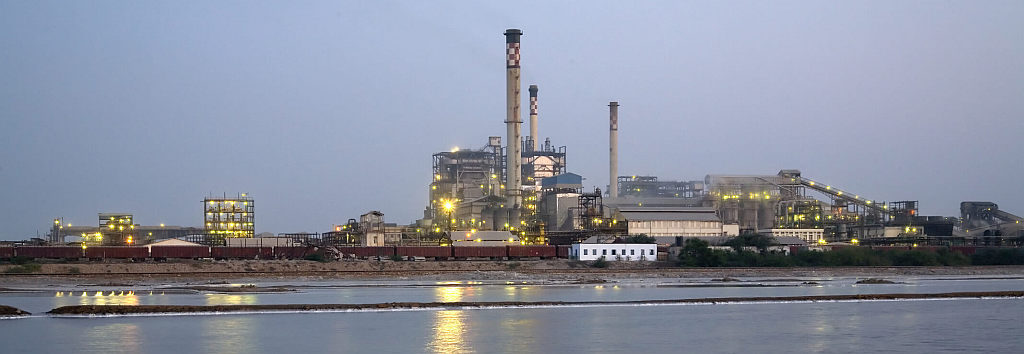
Tata plant at Mithapur.
Tata Chemicals plans to modernise the fishing industry in the nearby town of Dwarka. I can understand why. I was taken there to inspect the industry and to understand the need to change fishing methods and fish processing practices. The smell from the beach where the boats unload their product in the baking sun permeates the atmosphere. Not pleasant!
Dwarka is apparently where Lord Krishna lived and preached for some decades. I had the good fortune to visit the famous temple, the current version of which dates back to the 16th century AD but archaeological excavations of the original temple in front of the current structure date back to the 15th century Before Current Era.
The Tata Chemicals MD believes the foul smell from the fishing industry is disrespectful to the Krishna legacy. If the entire local government says that is so then it is so.
As I left the temple a monk handed me a piece of fruitcake. One step outside into the bright sunshine and in a flash the cake was snatched from my grasp.
I think the young beggar needed it more than me.
No begging, no ‘please’, no ‘thank you’, gone – off with the speed of a thousand gazelles.
Back in Mithapur I was guided down to the beach where Tata is developing an aquaculture business. Before inspecting the facilities I wandered over to a young man who, with an old bamboo fishing rod in hand, was casting his baited hook into the surf.
“Have you caught anything?”
Extraordinarily white teeth shine through a beaming smile. He reached into his shirt breast pocket and pulled out a single fish about five centimetres in length. Family dinner.
The aquaculture facility has many tanks holding just a single crayfish. I couldn’t conceal my excitement at seeing some progress in their aquaculture project. “Hopefully you have a successful breeder there. Crayfish are good eating.”
* * *
There are two grand buildings on a hill overlooking the township – the Tata guest house where my colleague and I are staying and the Managing Director’s mansion. We dined in the guesthouse and were joined by the ‘government’. Dinner is served and, to my everlasting embarrassment, it consists of crayfish and rice. I think we ate their entire breeding stock.
“The room you are staying in was Indira Gandhi’s room during her visit,” the Managing Director informed me. “Her Excellency was one of many honoured guests who have stayed here and slept in your bed.”
Unsure of how to react to that piece of information I replied, “It is indeed a privilege to have enjoyed the same hospitality as Her Excellency.”
The former Indian Prime Minister probably enjoyed a better form of transport to the town and possibly ate the breeder’s mate.
Gordon d’Venables has been, inter alia, a teacher, soldier, farmhand, lawyer and businessman. As a lawyer he travelled extensively for international clients. His letters from various times and places around the globe (PNG, England, Ireland, France, USA, Saudi Arabia, Serbia, Iran and others) refer to some of his experiences.
GORDON D’VENABLES: Letters.
GORDON D’VENABLES: Letter from USA, pre-Soviet Union Breakup.
GORDON D’VENABLES: Letter from Belgrade.
GORDON D’VENABLES: Letter from Iran.