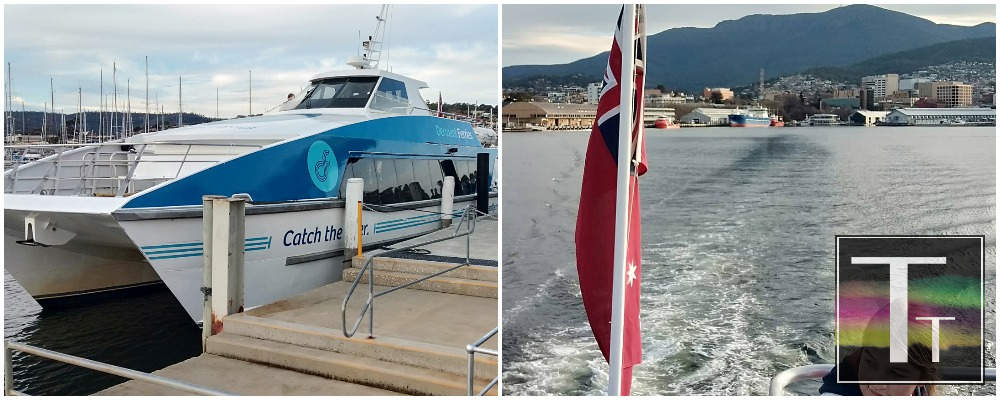
On Monday this week, a fast transport service began operating in Hobart the city’s free, perpetually ungridlocked superhighway.
Yes that’s right, the new city centre to Bellerive ferry began operating, with morning and afternoon departures in both directions.
Like (I suspect) many others, I went for a joyride. I took my bike over to the Other Side of the River, then rode back to the Good Side via the Tasman Bridge and safely home to Moonah. Herewith, a few thoughts.
Brooke Street Pier is not a great starting point. The ferry presence and entrance is not very well signed, and not that easy to find either if you mistakenly go up the steps and go into the main hall part of the building. Boutique whisky is nice, but it won’t get you across the ditch.
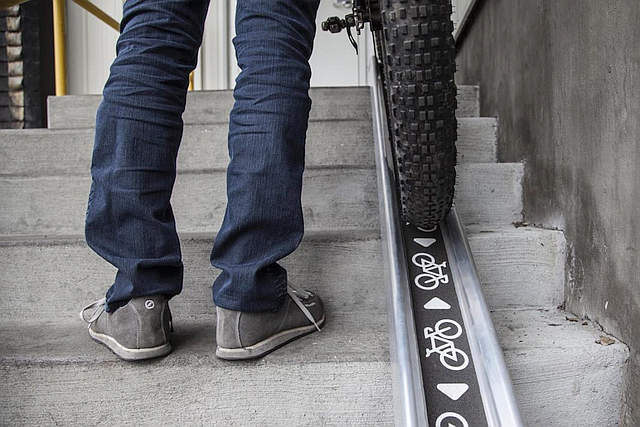 If you have a bicycle you then need to find the lifts, or haul your velocipede down two flights of stairs. The stairs are in fact wide enough to accommodate a roll ramp, but none is installed. These devices are in fact not very common in Tasmania but are inexpensive, easy to install and indeed easy to use (see image). For that matter there are no bike lockers at either terminal in case the ferry hits its capacity of 15 and you have to leave your bike behind.
Once you’re at the waterside level, a person checks you off – free travel for those with a bicycle, e-scooter or Metro Greencard – or charges you for a ticket. You then wait in a sash-rope zigzag queue until boarding starts. Some tight angles in this space also mean that it’s not that easy to navigate with a bicycle. An aluminium ramp takes you from the pier on to the boat.
The ferry itself is a neat vessel, probably accommodating more people than you might expect for its size. There’s an upper deck with some seating and standing room for those who prefer the wind in their hair, but also a comfortable interior cabin downstairs. This features a coffee and snack bar, seating, and some stand up tables.
There are racks for both bikes and e-scooters, and I saw about 10 of these in total on the trip I took. The staff were helpful, and as soon as the ramp was pulled up we chugged away.
Many of us have never been out in the middle of the River Derwent so it was quite a sight to take in the whole panorama: the city with its elegant waterfront, the mountain backdrop, the imposing Tasman Bridge, the eastern shore with its sculpted bays, and finally the satisfying long-view south along the estuary.
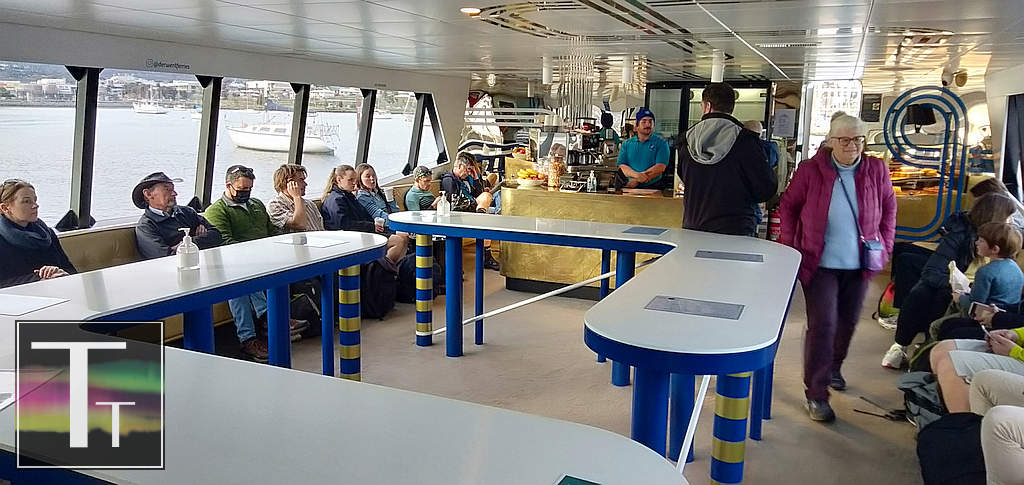
The interior cabin is light and offers good views.
This alone was priceless, but the trip was over almost as soon as it began. Disembarkation was smooth, right in the heart of Bellerive Quay. Some passengers headed for the cars of people who were waiting to pick them up, while most walked or rode away. Catch the river! is the new slogan of the ferry service and it felt like they had made it fun and easy.
My overwhelming thought as I stepped off was that this is the future. The trip was fast, quiet, exceedingly pleasant and somehow modern and stylish. Before you get uppity about ‘gentrification’ or some other accusation that the ferry is only for the indulgent, let me remind you that traditional working class hubs like Hong Kong for example have long had a ferry system.
Cities with the best transport systems offer lots of modes. They complement each other, and provide flexibility at capacity peaks and redundancy in the event of system disturbances. San Francisco has the Muni Metro streetcar system, BART heavy rail, buses, bicycle networks, cable trams, bay ferries and of course roads. Investing in transport infrastructure eventually enabled the tearing down of the Embarcadero Freeway and a veritable waterfront renaissance.
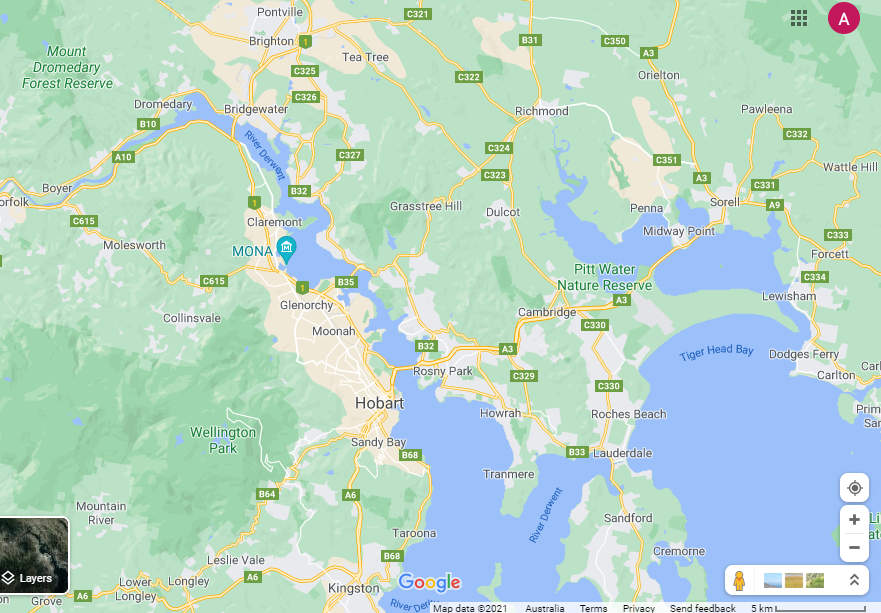
If you look at a map of Hobart, it’s clear that most of the densely populated areas are very close to the river. In most cases, residents live with an easy 10-minute walk/cycle/scoot/drive of the river. The Derwent – untrammelled by fishing nets, heavy boat traffic has the potential to take a lot of north-south traffic, and to improve the connectedness of the city.
Connectedness is still an issue with this trial, with no bus services really passing close at the city end, and services along Cambridge Rd at the other side not integrating very well timetable-wise. There are no (car) park and ride facilities due to lack of space, and perhaps inclination. No weekend services is probably a nod to lesser congestion issues on Saturdays and Sundays, but those are also days that arguably would be very good for introducing the concept of Hobart river ferry travel to the wider population.
The currently ferry trial is funded for a year. The weird thing will be as that comes to end there will doubtless be all kind of sage nodders pontificating about the cost. I say weird, because no-one every bellyaches about the cost of our existing roads. For example a few years ago the Howard Rd roundabout was removed and the Brooker Highway slightly widened for a few hundred metres towards Elwick Rd. What was effectively two sets of traffic lights cost around $30 million, and no-one breathed a word against.
A big chunk of that money went to interstate contractors and on huge amounts of materials like tar and cement that we import. What’s interesting about the ferry costs is that mostly the investment stays in Tasmania. The ‘road’ comes free and never needs resurfacing. The actual vessel was built here, and the operating company Derwent Ferries is local and employs Tasmanians. Employing Tasmanians to provide transport services to Tasmanians sounds like a solid ongoing investment to me from a lot of different angles.
But you don’t have to believe me. Try it out for yourself. The ferry runs Monday to Friday until about this time next year, at least, and you can find the timetable here.
Alan Whykes is Chief Editor of Tasmanian Times, and was a regular commuter by ferry in the Australian territory of the Cocos (Keeling) Islands.
View this post on Instagram