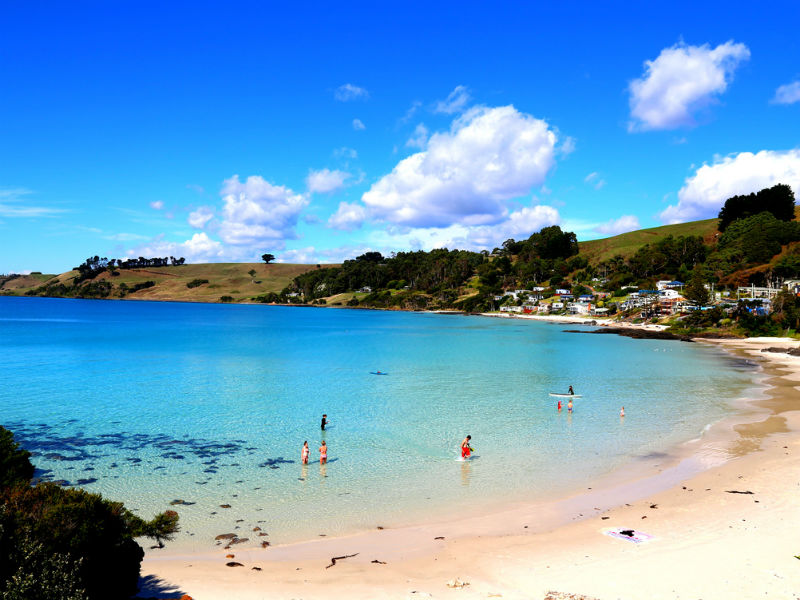
For some years now, there have been reports that the Tasmanian salmon industry is expanding. The Tasmanian Government is keen to promote the environmental and ‘good citizen’ status of the industry and there is talk of fish pens coming to the waters of the northwest.
This has caused a few ripples of concern, but not too many. A few of the local fishermen raised the alarm and gave warning of the potential harm to the marine environment, but still the people of the north-west didn’t stir. After all, the industry has a ‘clean green’ image does it not? There had been warnings: in Macquarie Harbour, a lot of fish died,
The Tasmanian Environment Protection Authority appeared to be acting in favour of the industry instead of the environment and was handing out ‘slap on the wrist’ fines. Then there was the controversy over the Marine Farming Planning Review Panel, where two of the members resigned in disgust and frustration over the lack of proper oversight of the industry. Nevertheless, that did not seem to worry the local north-west community. And let’s face it, there will be jobs in it. Always that carrot of jobs!
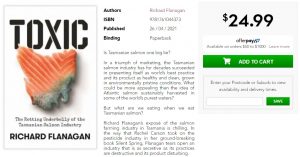 But when Richard Flanagan published Toxic – The Rotting Underbelly of the Tasmanian Salmon Industry, everything changed. Suddenly the salmon industry became exposed. The damage that had already been done to Tasmania and to Tasmanians was suddenly there for everyone to see.
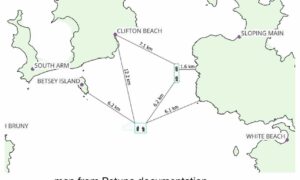
Ironically, a few months before the publication of the book, my wife and I had booked a cottage on Bruny Island and every morning I paddled out into the channel on my kayak into what I thought would be pristine waters. I would come back and tell her that there was a slime around the shore and in the shallow waters that seemed to be not quite natural. But we put it down to … well, we were not sure really.
But now we know what that green slime was and where it came from. It makes sense. The marine environment was being overloaded with fish sewage and nutrients from excess fish food. Suddenly we understood that this must not happen to our magnificent coast up here, and the shallow waters of Bass Strait. And it shouldn’t be allowed to go on in the waters off Bruny and Storm Bay and the rivers, estuaries, and bays down the south-east where the fish farms are already established.
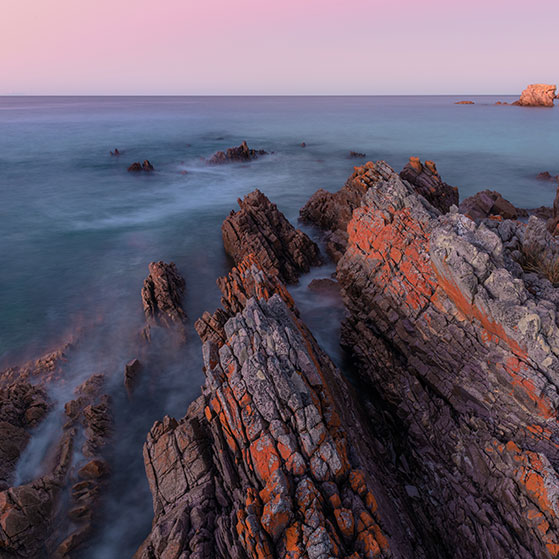
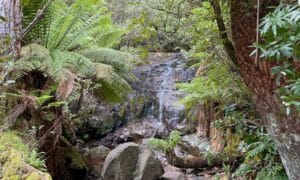
Rocky Cape National Park.
The islands between Cape Grim and King Island, the reefs and beaches around Stanley, the clear waters off Rocky Cape National Park and the stunning beaches of Boat Harbour and Burnie and Devonport belong to us all. They are our heritage, but they are at risk. The local fish stocks are only now recovering from the industrial onslaught of last century when industry was allowed to belch its filth into the waters of the strait and kill off the breeding grounds of native fish.
Now once again recreational fishing is thriving, and crayfish and abalone and oysters and scallop commercial fisheries are alive and well. So why would we want to risk that thriving marine environment with fish feedlots that will pour tonnes of nutrients and fish faeces into an ocean that is already under attack from everywhere – climate change, acidification, overfishing, plastic pollution, sewage, to name just a few – and when the ocean is the life blood of our planet?
That is where NWTAS for Clean Oceans has taken a stance. With assistance from our good friends at Environment Tasmania and the Tasmanian Alliance for Marine Protection, who are spearheading the fight down in south-east Tasmania, we are standing up to tell the government we do not want the fish feedlots in our ocean up here or in any ocean surrounding Tasmania. We do not want to risk our health and the health of Tasmania and the planet.
The lifestyle and culture that we enjoy and the tourist jobs that exist are worth much more than a handful of maintenance jobs on fish farms with profits going to multinational companies. We do not want to ruin our coastlines with slime, and we do not want to support an industry that uses more protein captured from the wild seas than it produces in fish that it sells, or alternatively uses the soy that is grown in the ravaged forests of the Amazon and, together with chicken bits, feeds that to the fish as a totally unnatural fish food. This so-called ‘environmentally sustainable’ industry uses gigalitres of fresh water to clean the fish regularly, as well as antibiotics, to prevent diseases sustained by fish that should be wild but are in overcrowded pens in water that is too warm for them.
Our first task is to inform and educate the community of the north-west. It needs to understand what the consequences are of allowing the Tasmanian salmon farming industry into our region.
We are not against jobs, but we are against jobs that threaten our marine environment and our health. We want a moratorium on further ocean based salmon farming.
We are calling for the government to create strict regulations based on independent scientific truth and to empower a body that can enforce those regulations without political interference. And, we are calling for a transition into land based fish farming.
Sure, it is more expensive and thus less profitable. Land-based fish farming has its problems too, but in many areas of the world huge investments are being made as it is seen as the only sustainable way forward – the only way to re-establish that social licence that the sea based fish farming industry so badly seeks but is rapidly losing.
To commence our campaign we are holding a double launch on the weekend of 21/22 August, at Burnie Town Hall on Saturday and Stanley Town Hall on Sunday. Check out our Facebook site at NWTAS for Clean Oceans for details of events and speakers.
One day we will all look back and say that this was the turning point. This was when we made the Tasmanian salmon industry sit up and take notice because we took away their social licence. This was when the politicians of Tasmania woke up to the realisation that their priority is to serve us, their constituents. And it all happened because of Richard Flanagan’s book.