Early life
Jessie Georgina Lloyd was born on 4 June 1843 at Longford farm near Launceston.
After leaving school, she taught a Sunday school class and played the organ at church services.
Marriage
Jessie married the son of George Alfred Lloyd on 6 September 1866. The couple then moved to New South Wales.
They had four children together and lived on a farm near Coonamble in the central-western plains district.
Writing career
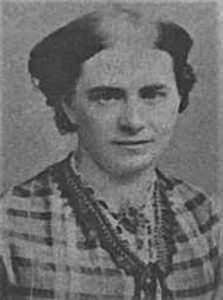
Jessie Lloyd.
In 1878, Lloyd started writing short stories, essays, and poems under the name ‘Silverleaf’.
Her work was published in a number of publications, including the Echo, the Illustrated Sydney News, and the Sydney Mail.
A contemporary described her as:
“a graphic and graceful writer, possessing the faculty of presenting her characters in a clear and unmistakeable light … The tone of her novels is always high and moral.”
In 1880, Lloyd wrote a novel titled The Wheel of Life: A Domestic Tale of Life in Australia. It received favourable reviews, though it was criticised for the number of errors that appeared in the text.
Her next novel, Retribution, was serialised in the Illustrated Sydney News between 1884 and 1885. At her death she left an unfinished story, On Turbulent Waters. Without being very original or revolutionary in her sentiments, ‘Silverleaf’ was popular as a pleasant and cheerful narrator of outback life.
Hobbies
Jessie Lloyd enjoyed gardening, sketching, and playing music.
She was also a good chess player and an entertaining conversationalist.
Death
Lloyd died on 30 July 1885 after a short illness. She was 42-years-old.
Her estate was worth £625 at the time of her death. This is equivalent to around $82,130 when adjusted for inflation.
Bibliography
- ‘Lloyd, Jessie Georgina (1843–1885)’ (Australian Dictionary of Biography).
- ‘Review’ (The Sydney Morning Herald, 13 January 1880).
- ‘Family Notices’ (The Sydney Mail and New South Wales Advertiser, 8 August 1885).
- ‘The late Mrs. G. A. Lloyd, Junior’ (Illustrated Sydney News, 2 August 1885).
Four o’clock Promenaders
by Silverleaf
Sydney streets, or the most fashionable portions of them, are crowded to excess between 4 and 5 o’clock each day. It requires some manoeuvring to get through them, and avoid collision.
The different modes of progression of the wayfarers is curious to see, there being almost as much difference as between swimming and flying.
There marches along the stately dame, of ample proportions, with a sonorous heavy tread, which carries weight with it; measured and slow, as if there were no such word as haste in her vocabulary.
She contrasts strongly with the nervous, fussy folk who are always in a hurry, never see anything around them, but always pressing on, urged by some impulse, some train or tram to catch, some appointment to keep; nothing hinders them, nothing stops them, and yet they are not the people who meet with accidents.
The class who get run over by trams, or knocked down by ‘buses, are the saunterers, who, with lazy slouch, loiter along, gazing with vacant eyes at all that is before and around them. They always go to the left when they should go to the right, and vice versa, stand in doorways and block the passers out, button-hole a busy friend at the street corners, ask for the time, or the name of a street, when they could obtain their information by looking up.
The strut is affected by self-conscious, conceited people, who throw the head back, and walk with a stiffness of gait which is painfully suggestive of starch.
On comes the waddler, rolling about like a ship in a gale, or a duck on land; when the waddler is of the feminine gender, with all the latest improvements of dress and fashions, the awkward walk is more than ever objectionable.
People are as much known by their walk as their faces, and nothing mars the effect of a handsome costume, or well dressed, stylish figure, more than an ugly or awkward carriage.
The remark is often made that some person dresses well, but nothing shows to advantage, the reason, in nine cases of of ten will be found in an ungainly walk.
Mashers (detestable word) and flirts, coquettes and dandies, pass and repass doing the block, in the most self-satisfied and complacent manner, and exhibiting every variety of walk, swagger, strut, and waddle.
– published in The Daily Telegraph (Sydney), 1 Feb 1884.