
Everyone in the town of Ross is excited about the bicentenary birthday coming up in June this year.
At present the Northern Midlands Council is promoting 2 June 2021 as the bicentenary of the founding of the town, with the Ross Bicentenary Committee planning events to celebrate the town’s birthday ….. see page 16 of the Council minutes for 27 January 2021 …..
https://www.northernmidlands.
When driving along the Midland Highway two roads are passed that go into Ross, and both have stone statements that declare the town was founded in 1821.
This year originates in the journal of Governor Macquarie, where on June 2nd 1821 he named Ross, “in honour of H. M. Buchanan Esqr. that being the name of his seat in Loch-Lomond in Scotland.”
But upon reading Macquarie’s journal entry for the previous day, it can be seen that there was an existing settlement in the newly named town, where he describes ….. “Set out from Campbell-Town at 1/4 past 12 o’clock and arrived at the Govt. Stock-Yard in Argyle Plains at 1/2 past 1 p.m. disce. 7 miles only.”
It is 7 miles between Campbell Town and Ross.
The Tasmanian Wool Centre, who are the custodians of much of the history of Ross, state on their website, “In 1812 a garrison of soldiers was stationed at the ford of the Macquarie River.”
http://www.visitross.com.au/
Once a military post had been established, the settlement to be called Ross began to grow around it and serve as the support base for farms in the district, so what could the first name of Ross have been?
Support facilities included a tavern, now long gone, for travellers, troops and settlers. I have not seen a name for the settlement, but it could have been called Argyle Plains, or Argyle, for where it was located.
An earlier name for Argyle Plains was Cock-Pitt-Plains, which Governor Macquarie had renamed in 1811 on his first tour of Van Diemen’s Land.
An industry at Ross that could have predated even Governor Macquarie’s visit in 1811, could have been the mining of salt from the salt pans south of Ross.
This historic detail is indicated in Macquarie’s journal, where he writes on 5 December 1811:
“At 1/2 past 3 p.m. pursued our journey over Salt Pans Plains, which are about ten miles in extent, hardly a tree on them, and a very poor barren soil.
Passed several of the Salt Pans, one of which, about seven miles from Antill’s Ponds, is a very large one, and now almost half covered over with fine salt, which I examined and tasted.
About half a mile further on and to the right of our track, is a very beautiful and singular round hill, with a top perfectly flat, hitherto called Donn’s Battery, but which I have now named Mount Henrietta, in honour of Mrs. M.”
After a party led by Lt Thomas Laycock were the first Brits to travel overland from Patersonia, now called Launceston, to Hobart in 1807, unsuccessfully seeking assistance, the surveyor Charles Grimes followed Laycock’s route later that year, exploring the area around Ross and naming places, including Grimes Sugarloaf and Grimes Lagoon, and would have reported on the salt pans in the area.
The rejection of assistance by the south to the north could well be the root cause of long-standing antagonism between the north and the south in Tasmania.
Colonial Settlement
That an incident happened near Ross sometime between 1807 and 1811, leading to a hill being called Donn’s Battery, shows that settlers were in the area, and they could have been seeking salt from the pans.
Macquarie’s renaming of Donn’s Battery did not stick, as the event there had become part of local history, described by R. K. von Stieglitz in 1960 ….. “the old name had been given in honour of Donn, a young stock-keeper there-about who had bravely held the summit against a tribe of blacks with only sticks and stones to defend himself. He had fought in this way through a long summer evening until his enemies had crept away with the dread of night.” [1]
On current maps this hill is called Dunns Battery. I hope someone will investigate the story of Donn’s or Dunns Battery, as it would be a good focus on early history in Van Diemen’s Land, and the earliest colonial activity around Ross.
Understanding stories like that of Donn’s Battery can also be a window into understanding the Tasmanian Aborigines, who had occupied and farmed the land with fire for tens of thousands of years, where truth is the basis of understanding.
When the first colonial settlers moved to Ross, the land was cleared like a garden through regular burns, with lands available for immediate agricultural use.
An early painting by Joseph Lycett made at the ford across the Macquarie River before the first bridge was built at Ross, shows a landscape that is largely clear of trees.
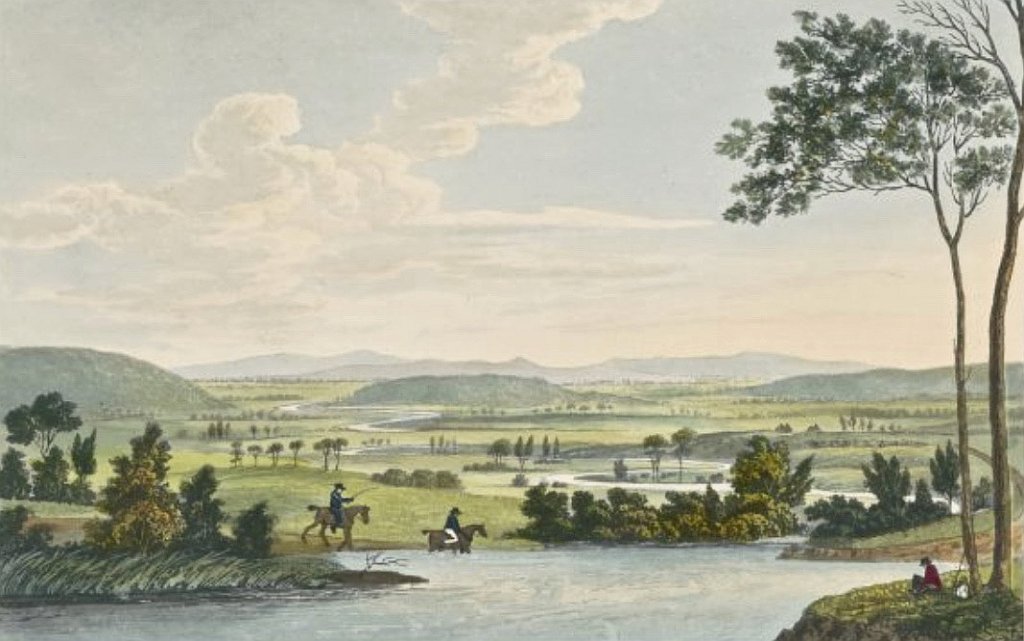
‘View on the Macquarie River, Van Diemen’s Land, near the ford at Argyle Plains’, Joseph Lycett, 1775-1828.
The first Brits to travel between north and south in Van Diemen’s Land would have been going through cleared land, and quite likely following the ancient Aboriginal track.
Should Dunns Battery be returned to the original spelling by the Tasmanian Nomenclature Board?
And should the dates on the entrance statements on the Midland Highway for Ross be changed from 1821 to 1812?
In an outrageous act of skulduggery, the Northern Midlands Council is robbing Ross of 9 years of its history as a settlement and town.
The council have access to heritage consultants, so how can they get the history of one of its towns so wrong, and why is the Tasmanian government so blind to these details, when every Tasmanian politician must see those stone statements when they drive past Ross along the Midland Highway, and the Heritage Minister at least should be alert to historic facts, not to mention accompanying advisers?
Then again, until recently the Northern Midlands Council had no idea that they were responsible for the bridge at Tunbridge, where their southern boundary falls on the Blackman River.
The town of Tunbridge, on the southern side of the Blackman River, is in the Southern Midlands Municipality,
Didn’t the Tasmanian Government ever inform the old Ross Council, and now the Northern Midlands Council, that they were responsible for a significant part of Tasmania’s history and heritage with the bridge in Tunbridge?
Is the naming of a town more significant than its founding?
For example, British settlement began in Tasmania in 1803, when the island was called Van Diemen’s Land, with the name being changed to Tasmania in 1856.
We don’t ignore the first 53 years of colonial settlement on this island, and we don’t refer to Tasmania as being founded as a British settlement in 1856.
Similarly with Ross, its founding year is more important than a new name, as names of places and towns are changed from time to time, but the founding year remains the same.
The actual date that Ross was founded as a military outpost along the road between Hobart and George Town, would be the day and year to celebrate.
Bicentenary dates
Sometimes historic dates are changed in Tasmania, to fit in with political ideas, such as when Tasmania held events to acknowledge the bicentenary of British colonial settlement on the island in 2004.
The year 1804 was when a British colonial settlement in Van Diemen’s Land was founded at Sullivans Cove, called Hobart, though old maps often show Hobarton.
Anyone with a nose for history knows the bicentenary events should have begun in 2003, for when the first settlement was established in Risdon Cove in 1803 along the River Derwent.
Acknowledging 1803 was avoided, because there had been a tragic event at Risdon Cove, when an Aboriginal hunting party was mistaken for a raid on the settlement.
I did hold an event in 2003, in the hall in Lauderdale, with a focus on the Danish Adventurer Jorgen Jorgenson, who was first mate on the Lady Nelson in 1803 and assisted in establishing the settlement at Risdon Cove.
Jorgenson was also present at the founding of the settlement at Sullivans Cove, when the Lady Nelson was part of the small fleet that moved Collins’ settlement in Port Phillip on the mainland to Van Diemen’s Land.
The motivation of the British at the time, was to pre-empt any French attempt to establish colonial settlements in the southeast of a land then known as New Holland, or on the island of Van Diemen’s Land.
In 2004 I held an official Tasmanian bicentenary event in Ross, again with a focus on Jorgen Jorgenson, as it is strongly believed that the carving of the king on the Ross Bridge is a portrait of Jorgenson, who served as a constable in Ross in 1833, sent to stop the black market in convict supplied building materials to the free settlers around Ross, instead of building the bridge.
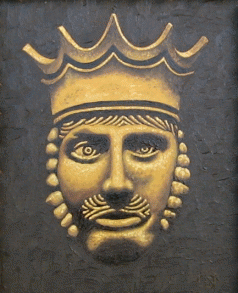 While Jorgenson was in Ross, there was no black market to be found, but after he returned to Hobart later in 1833, the black market trade continued.
The Ross Bridge was not completed until 1836.
Jorgenson gained mention in the 1921 booklet on Ross ….. “Also the settling for a time between Ashby and Bloomfield of Jorgen Jorgenson, the famous Dane who was once King of Iceland, and who was captured and sent out to the Colony by the English Government, whose naval officer he once was.” [2]
This is not an accurate account of Jorgenson, though based on what was understood at the time.
As myth can loom larger than history, so it was with Jorgenson, who had become a myth while he was still alive.
In those days, Jorgenson was popularly known as the ex-king of Iceland, because he had ruled that island for two months in 1809, where he never claimed to be a king, returned willingly to England and spent many years there, until being transported to Van Diemen’s Land as a convict in 1825, to cut a very long and detailed story quite short.
Later in 1804 a settlement was established at Port Dalrymple, at the mouth of the Tamar River on Bass Strait under Colonel William Paterson, called York Town, which was abandoned in 1806 and moved to the location of Launceston, which Paterson called Patersonia.
Governor Macquarie moved the settlement back to Port Dalrymple to found George Town, but then in 1824 the settlement was moved again, back to the site of Launceston, changing the earlier name to Launceston. [3]
North and South
In the early days there were two colonial territories in Van Diemen’s Land, with the County of Cornwall in the north, and the County of Buckingham in the south.
The dividing line through the island was drawn along the 42nd parallel, which passes just north of Ross, and is marked by a large metal structure featuring ’42’, which can be seen to the east from the Midlands Highway. [4]
There is also an interpretation installation for the 42 parallel and its role in Tasmanian history next to the Town Hall in Ross.
As the division of the island was in place until 1813, the military outpost in Ross would probably have been administered from the south during the first year.
Ross appears to have been subject to some tug o’ war between north and south, as since 1993 it has been drawn north into the Northern Midlands Council.
Will Ross go south again, or find a new identity in the Central Midlands, neither north, nor south?
The founding of the settlement on the site of Launceston, which was once called Patersonia, shows how the name of a place can change, but the founding date of a settlement remain the same. Some settlement must have continued at Patersonia, where farms had been established, while the government colonial administration was moved to George Town.
The moving of the settlement to George Town may have been to meet British Government expectations of a defensive position against the French in Bass Strait.
The belief that Ross was founded in 1821 runs back at least 100 years, as the old Ross Municipal Council held a centenial event in 1921, and produced a booklet:
https://visionross.discussion.
They may simply have not been aware that Ross was first settled in 1812, after Governor Macquarie had been through the area in December 1811, and ordered four military posts be established along the road between the north and the south, which were then located at Brighton, Oatlands, Ross and Perth, all of which he then visited and named in 1821.
Campbell Town
Is Campbell Town safe to celebrate 2021 as the town’s bicentenary birthday?
In Governor Macquarie’s journal for 31 May 1821 we can read ….. “Having determined on establishing a township on the north bank of the Elizabeth River, I have named it Campbell-Town in honour of Mrs Macquarie’s maiden name. This town is most admirably well situated in every respect, surrounded by a fine rich country and well watered.”
So yes, the founding year for Campbell Town and bicentenary birthday, is 1821.
But, the founding year for Ross would be 1812, and the day and month would be when the military outpost was established.
There lies another historic research project, to find the day in 1812 when Ross was founded.
The entrance statements for Ross need to be changed to reflect this grizzly fact of history, so vital for the identity of a heritage town and visitor destination.
If the correct year were made known for the founding of Ross, and presented to the world, would more people visit Ross? There is a much larger story to be told about this town.
Only 91 years to go now until the next centenary birthday for Ross in 2112.
Plenty of time to prepare.
REFERENCES
[1] A History of Oatlands and Jericho, R. K. von Stieglitz, 1960, page 9
[2] Ross Centenary – Glimpses of its History, R.C.K., 1921, page 15
https://visionross.discussion.
[3] The Companion to the History of Tasmania …..
https://www.utas.edu.au/
Launceston was a settlement hindered by indecision. Governor King of New South Wales, concerned with the presence of French explorers around Van Diemen’s Land, urged the Colonial Office to allow a settlement to be established in Bass Strait, and Lt-Colonel William Paterson arrived in Port Dalrymple in November 1804. He established a settlement named York Town, but it suffered from lack of water and poor land. Paterson’s exploration of the valley highlighted his concern for suitable land. This he found at Riching’s Park at the confluence of the Tamar, North and South Esk Rivers. The settlement moved in 1806. During 1807, it disintegrated into anarchy. Many settlers, facing starvation, abandoned farms and hunted in the bush. Ten convicts escaped with arms and dogs, and Lt Laycock’s intrepid expedition to Hobart was met with an inability to render assistance. Governor Macquarie’s administration from New South Wales hampered Launceston. Despite settlers’ preference, he relocated the settlement to George Town due to unreliable water supplies and low-lying land at Launceston. After a succession of poor administrators he transferred administration of the settlement to the lieutenant-governor in Hobart. Commissioner Bigge’s report conclusively recommended the Launceston site, and the settlement was reinstated in 1824.
[4] Tasmania was once (figuratively) split in two, could it happen again? Monte Bovill, 11 June 2019, ABC News Online
https://www.abc.net.au/news/
Kim Peart is a long-time resident of Ross, a writer, a keen afficionado of Second Life, and the founder of Space Pioneers.