Getting fleets to adopt electric vehicles is key to the transformation of the sector, according to the Electric Vehicle Association’s (EVA) Tasmanian branch. And with charging infrastructure being rolled out, they think the state is ready to go electric.
National Vice-President (and Tasmanian Treasurer) Clive Attwater said that with the branch recently celebrating their fifth anniversary, a lot had changed in that period.
“There were no charge stations in Tasmania that you could go to, public ones,” he said. “Now there are over a hundred places where you can plug in and there’s a network of fast chargers developing.”
Meanwhile the number of electric vehicles in the state has risen from ‘a handful’ in Attwater’s words to the hundreds. State Growth confirmed to Tasmanian Times that as at 1 September there are 302 cars and wagons classified as either fully electric or plug-in hybrid vehicles, with another 86 motorcycles and scooters.
“Fleets are the source of used vehicles and the vast majority of people don’t buy new cars, they buy used cars: about 70% of people do,” pointed out Attwater. “And the fleets are a major source of used cars for conventional vehicles. So they similarly expect to be the same for electric vehicles…clearly, there’s a desire to get fleets moving now.”
He explained that fleets tend to look at the whole life cost of a vehicle. Currently electric vehicles are more expensive to buy, but much cheaper to run due to lower fuel and maintenance costs. “Fleets are more likely to see the economics of electric vehicles before the private buyer who tends to look at the sticker price, often because they don’t have the capital to pay more even if it is cheaper in the long run.”
According to Attwater, pre-COVID there had been some work underway to try to set targets regarding adoption of electric vehicles by state government. That stalled due to higher priorities during the COVID crisis, which he sees as ‘entirely understandable’.
“Fleets are important…it does need to be kept on the agenda and kept cooking,” he said.
Australia Post, the owner of the largest vehicle fleet in the country, is rolling out of a fleet of electric bikes and trikes (electronic delivery vehicles or eDVs) in a bid to improve safety for their employees at the same time as reducing environmental impacts. The eDVs will soon entirely replace the outdated petrol-powered motorcycles with better stability, less noise and no local emissions.
Charge!
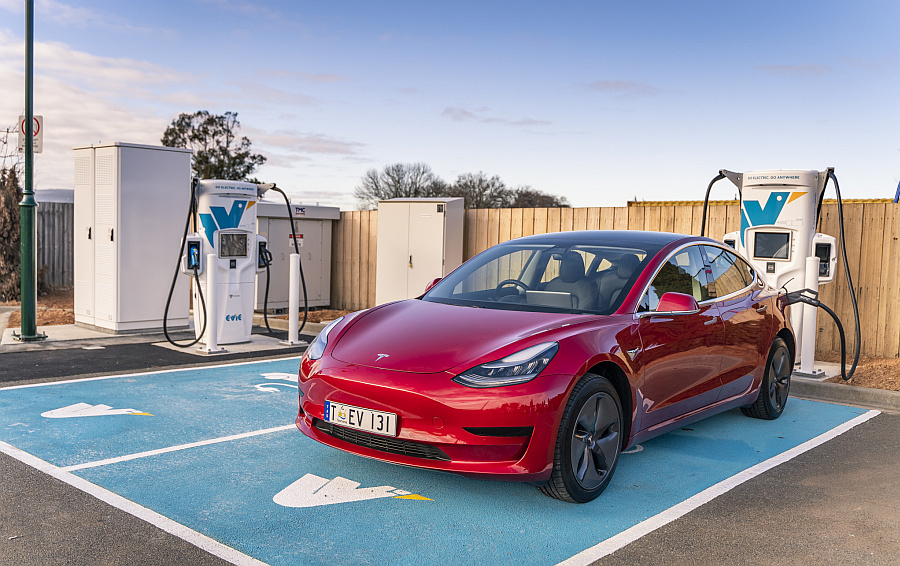
The EVA’s anniversary celebration was held in Campbell Town, partly to coincide with the launch of a new fast-charging station. The facility was built by Evie Networks, who claim to be Australia’s largest network of fast-charging points for electric vehicles.
It’s found in Commonwealth Lane, just by the central park that is probably Tasmania’s most popular rest stop. The station’s establishment was supported by the Tasmanian government’s Electric Vehicle ChargeSmart Grants Program in partnership with Northern Midlands Council.
Evie Networks Chief Executive Officer Chris Mills said the site will unlock the open road for EV drivers in Tasmania by connecting northern Tasmania with the south.
“Campbell Town and its surrounds have been a meeting place and rest stop for travellers from the first Australians to bullock drivers, stagecoaches, motor vehicles and now EV drivers,” he said.
“While EV drivers can recharge in 15 minutes with our centrally located 350kW chargers, the tranquil Elizabeth River and heritage listed city centre will likely see drivers enjoying a leisurely break before hitting the road again.”
In the last 12 months, Evie Networks has opened six ultra-fast charging sites across Queensland, News South Wales, Victoria and now Tasmania, with plans to continue launching one to two sites every month or so. Another two Tasmanian sites in their network are planned.
“While the electric vehicle market is still in its infancy in Australia, uptake has been positive, even despite the decrease in long-distance road travel due to COVID-19,” said Mills.
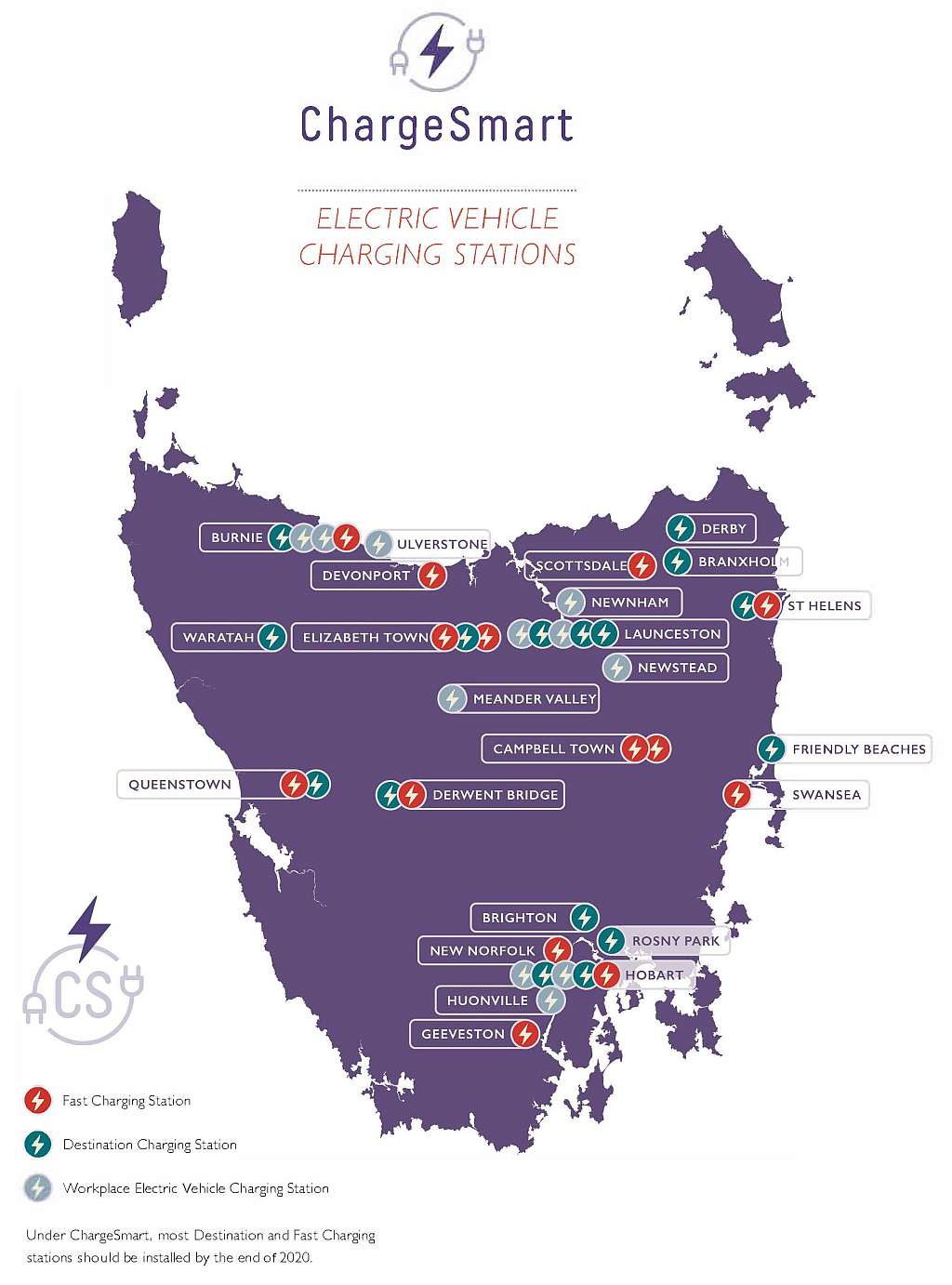
Other charging stations locations supported by the $526,000 ChargeSmart program and under development include New Norfolk, Huonville, Hobart, Elizabeth Town, Swansea, St Helens, Scottsdale, Burnie, Devonport, Queenstown and Derwent Bridge. Most fast charging stations should be completed by the end of 2020, although installation of some has been delayed.
national picture
According to a recently-released Electric Vehicle Council report, Tasmania is ranked third in Australia for the uptake of electric vehicles. That said, the report gives Tasmania a D on its policy scorecard along with South Australia. The best-ranked jurisdiction is ACT with a B, while Victoria, NSW, and Queensland score a C. Western Australia, Northern Territory and the federal government lag well behind with a F rating for policy.
The report notes that electric vehicle sales surged 2000% in 2019, as petrol and diesel vehicle sales fell by 7.8%. There are now 28 different models of electric vehicles available for sale in Australia.
Fonzarelli X1.
Despite the closure of ‘last car maker’ Holden this year, electric vehicles may lead a renaissance in automotive manufacturing. Several different partnerships are looking to manufacture electric cars, buses, trucks, utility vehicles and motorcycles in Australia.
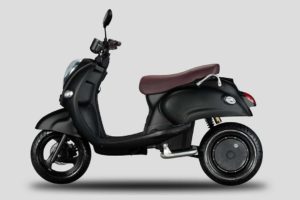
Sydney-based Fonzarelli are already manufacturing electric scooters. The X1, pictured, offers an 80km range with speeds of up to 90 km/h. The best part for some will be that it only consumes about a dollar’s worth of electricity for each 100 kilometres travelled.
In June Ebusco, a Dutch pioneer in fully electric city and regional buses, launched a regional partnership with the Australian Bus Corporation – comprising Precision Buses and Bustech – to build and maintain ‘the next generation of electric buses’ in Australia and New Zealand.
The primary focus of the new joint venture is to launch the Ebusco 3.0, a carbon fibre-based bus with a 90-passenger capacity, low flat floor, optional panoramic roof, and a range in excess of 500 kilometres on a single charge. Ebusco bills itself as “a pioneer and a forerunner in the development of electric buses and charging systems and is now able to offer an electric bus that is cheaper than a diesel bus.”
Rentals and Tourism
Commuters however are not going to be the only beneficiaries of electrification, with tourism also coming into play. The charging network, says Attwater, will support people getting out and about across the island not just making short trips in cities.
“You can practically buy an electric car, jump in it and go anywhere in Tasmania by the end of this year,” he said. “There’d be perhaps a couple of spots where I might have to just add a few ifs and buts but, but pretty much you can go anywhere in the state. Charge quickly when you need to and continue your journey and get around.”
Further support to tourism could be through accommodation providers offering charge services to overnight guests, so that they can plug in when they get there and in the morning leave with a full battery.
“At the moment there are about 25 or 30-ish places around the state where you can do that overnight and have your car charged by the morning. We want to see that up to a couple of hundred.” He said the EVA is working in conjunction with State Growth, Tourism Tasmania, the Climate Change Office and others to promote this to tourism operators. “We think we could probably hit 200 places available offering electric vehicle charging overnight, by the end of next year.”
He said at that point, it would make a lot of sense for car rental companies to offer electric vehicles.
“We know that the car rental companies are already looking at this, so we don’t have to convince them. They’re convinced. It just doesn’t make sense just yet…but that will change in the next two years, and we expect to see electric vehicle rental.”
Attwater pointed to electric car rental being ‘very big’ in New Zealand because they had had a fast charge network for several years now.
“In fact if you go in some countries, if you go to Norway you can’t rent a car that is not electric. They don’t have them.”
The economic pot of gold is that while Tasmania currently imports around $1 billion worth of liquid fuel each, it has the potential to largely replace that with electricity produced at home. An additional point, more about security than money, is that while fuel supply lines could easily be disrupted by world events, Tasmania’s electricity system is much more self-contained.
“It would be a big selling point that as we 100% renewable energy near enough in Tasmania, we are offering with electric vehicles, essentially a carbon neutral tourism; generally the carbon footprint of tourism is quite high,” said Attwater. “So if we can get people to come here from the mainland with their electric vehicles and tour around, or come here and then rent and drive around in an electric vehicle, recharged from renewable energy, that’s that’s a pretty positive sell.”
The relative size of other states and territories, apart from the ACT, meant it was going to be difficult for them to provide a comprehensive network. “It’ll be a big point of difference for Tasmania. It probably that has a strong appeal to particular market segments, but it certainly points away to a sustainable future for tourism.”