
Media conference featuring Cassy O’Connor, Tasmanian Greens; Jenny Weber, Bob Brown Foundation (5:35); Tom Allen, The Wilderness Society(7:29); and Eric Woehler, Birdlife Tasmania (10:45), responding to the recently released Forest Stewardship Council Audit report on Sustainable Timber Tasmania.
Transcript
Cassy O’Connor: Late on Friday under the cover of a budget briefing Sustainable Timber Tasmania, so called, finally released the FSC audit report, which they received six months ago in early February. We sought by right to information request early last week to obtain that audit report because it had been so long since the government or STT had said anything about it. No wonder the government’s forestry GBE was trying so hard to keep this audit report under wraps. It is absolutely damning of Sustainable Timber Tasmania, so called, and its approach to logging threatened species habitat. What we know from the auditors is that there is no way Sustainable Timber Tasmania will ever get FSC so long as it keeps logging old growth forests which provide critical habitat, not just for swift parrot but for masked owl, giant freshwater crayfish and all their other wonderful endemic fauna. So this is on forests minister Guy Barnett who has overseen the government’s forestry GBE’s absolute incapacity to get Forest Stewardship Certification, the acceleration of logging during the COVID months, and the continual driving of Tasmania’s marvellous, marvellous native species towards extinction. This week in Parliament, we’ll be moving again for an end to native forest logging in Tasmania. That is the only way in a climate and biodiversity emergency to manage our forests is to protect them, to protect them for their own sake, and for the critical habitat that they provide for our native fauna.
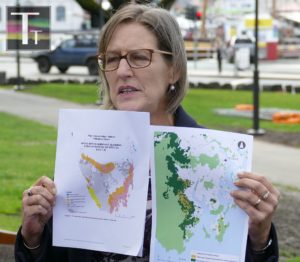
Greens leader Cassy O’Connor.
Journalist: Were the findings of the Audit report a surprise to the Greens?
Cassy O’Connor: Absolutely not. We knew that the government’s forestry GBE under the Liberals was accelerating native forest logging. The evidence is there for any Tasmanian who goes out into our production forests to see. Sustainable Timber Tasmania clear fells and burns threatened species habitat. And, late last week it tried to greenwash its behaviour by saying it’s setting aside 10,000 hectares for swift parrots. What we know from these very maps, which were provided in Sustainable Timber Tasmania’s conservation values report is that the orange and pink areas, swift parrot habitat, and the little yellow pieces here, in and around the southern forests are where Sustainable Timbers Tasmania is suggesting it might not log in order to protect swift parents. The auditors were really clear that that is inadequate. And we know absolutely it’s an attempt to greenwash this government’s continuing, unsustainable logging of native forests that is driving species to extinction.
Journalist: The Audit report did say some positive things about STT and made the observation that the staff did seem committed to sustainable forestry. So where does the buck stop with this overall fail, in your view?
Cassy O’Connor: The buck absolutely stops with the Liberals and Minister Guy Barnett. They have ramped up native forest logging since they came to office. We’re hearing from people all over Tasmania, that log trucks with large trees on the back of them increasing in their frequency. This is on the Liberals. Once upon a time, not that many years ago, Sustainable Timber Tasmania which was Forestry Tasmania then was committed to securing FSC certification. We’re not saying it’s the panacea by any measure, but it is something, but the failure of the government’s forestry business to secure this certification rests with the Liberals and Minister Barnett
Journalist: Are you comfortable with the mechanisms of scrutiny for decisions being made now to do with the coronavirus response?
Cassy O’Connor: Well, we’d like to see more scrutiny and we’d like to see more public accessibility to those scrutiny mechanisms. We’ve just been through the winter recess of Parliament. But there are some really serious questions to be answered by government about essential worker and essential traveller exemptions as part of Tasmania’s broad COVID response. And I think all Tasmanians expect parliament to be doing its work and scrutinising government around those decisions.
Journalist: We seem to be witnessing a trend for a massive concentration of power in the hands of the executive. It’s not just the state of emergency stuff, but it’s things like major projects and the like. Is the government taking power out of the hands of the Parliament and vesting it in themselves without sufficient oversight?
Cassy O’Connor: Well, the Liberals have never really been big on transparency and scrutiny. It is in their DNA to be secretive and to try to avoid answering questions. That’s why question time under the Liberals has turned into something of a farce where we have at least 20 minutes of every one hour question time devoted to the government congratulating itself. It’s not good enough. And we think Tasmanians deserve better.
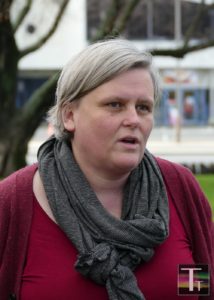
Jenny Weber, Bob Brown Foundation.
Jenny Weber: Tasmania’s logging has received an enormous failure. This Audit has shown that endangered species and Tasmania’s forests are not safe under the Tasmanian government agency. And we knew that, we’ve known that for decades, we’ve known that since the Wielangta case, the swift parrot has needed immediate protection and it has not been given that, its habitat has continued to get logged. We know that old growth forests are still being logged. Ancient ecosystems are being logged out there in the Wentworth Hills, the Upper Florentine, north of Mount Field National Park and in the Tarkine, rainforest in the Tarkine. We welcome the fact that Forestry Tasmania now called an appalling name Sustainable Timber Tasmania has failed, they have failed in a big way. They’ve had a number of major non-conformances and we thank the auditors for telling Sustainable Timber Tasmania that they need to get better. However, the only way that the Bob Brown Foundation is going to accept a future for Sustainable Timber Tasmania is in plantations, we have enough plantations in Tasmania to meet all our wood needs. We don’t need any more plantations. And it’s time that these forests were taken off Sustainable Timber Tasmania and off the logging schedule.
Journalist: What happens if Sustainable Timber Tasmania doesn’t stop logging native forests?
Jenny Weber: So we hope that this audit here says that they are doomed to failure for FSC. We really do hope that, however we can’t be sure that FSA won’t be screwed into supporting the logging of native forests in Tasmania, so we will remain vigilant. We are concerned that native forest logging is continuing under the Gutwein government as it’s done for decades. And the critically endangered species the swift parrot is running out of time. So too is the masked owl, so too is the Tasmanian devil. These native forests need urgent protection ,and the ancient old growth forests. The endangered species habitats are not safe with Sustainable Timber Tasmania anymore.
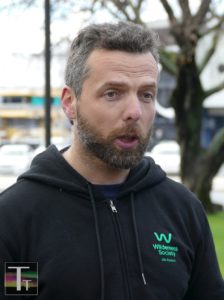
Tom Allen, TWS.
Tom Allen: So the future of forestry in Tasmania is plantations for forestry, forests for people and nature. The reasons that Sustainable Timber Tasmania Forestry Tasmania has failed its second Forest Stewardship Certification Audit are really quite straightforward. It continues to log and destroy high conservation value old growth forests and threatened species habitat. The public is right to oppose this continued forest destruction. No one wants it. STT is also trashing brand Tasmania. The Wilderness Society today calls on Premier Peter Gutwein to do two things. First, to immediately halt the logging of old growth forests in Tasmania. Number two, to permanently protect the future potential production forests across the state formally called future reserve land because of its proven high conservation values.
Journalist: This Liberal government were elected in 2014 promising to tear up the Tasmanian Forest Agreement. Do you think in six years they should have come up with an alternative plan for a sustainable forestry industry?
Tom Allen: Yes. (laughter)
Yeah, I mean, you know, I respond to that, look, the Liberals have no solution in terms of the future of Tasmanian forestry and we’re absolutely clear: the future for forestry in Tasmania is plantations for forestry, forests for people and nature. Everyone knows that’s the future. And you know, to pretend otherwise, it’s just in no one’s interest really. It’s extremely concerning that national parks, reserves and World Heritage wilderness is covered by the Major Projects Bill. The only reason one can draw for including national parks, reserves and World Heritage wilderness in the Major Projects Bill is because the government wants to develop them. That’s an absolute no-no. One reform we would ask for is that the reserves, national parks, World Heritage wilderness is excluded from the Major Projects Bill.
Journalist: The federal government’s looking at a bilateral agreement to do an end run around the EPBC Act. Are you concerned about that as well?
Tom Allen: We definitely are concerned about the bilateral agreements. On the one hand, we’re having environmental laws devolved to the states, and the EPA in Tasmania, otherwise known as the Everything Passes Anyway agency is incapable of high standard environmental assessment. Plus, you’ve then got state and federal governments putting through, putting up legislation that would provide additional workaround to that. You know, it’s a real real concern at the very time, everywhere in the world, we need better environmental regulation, not not less. And the idea that, you know, less environmental regulation is better is an absolute joke really.
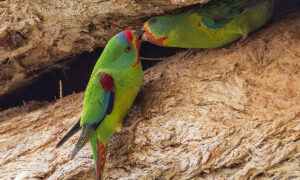
Eric Wohler: About three years ago, the best science in Australia predicted the extinction of the swift parrot in 16 years based on the existing threats, the loss of habitat. And we’re now three years down the road, nothing’s changed. I don’t want to see the swift parrot go extinct in my lifetime. We need to stop this logging, we need to protect the habitat of these critically endangered species.
Journalist: How are you looking at this new plan for Sustainable Timber Tasmania? What does this mean for the swift parrot?
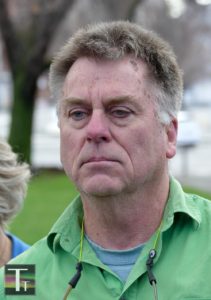
Eric Wohler, Birdlife Tasmania.
Eric Wohler: It means the ongoing loss of critical habitat for nesting, for feeding. This is a species that migrates to the mainland. It’s reliant on these forests in Tasmania to breed and maintain the population; we get rid of the habitat, they won’t be able to breed successfully, they won’t be able to feed, they won’t be able to do anything. The species is going to go extinct, as was predicted three, four years ago.
Journalist: How frustrating is this for you? You’ve been saying this for a long time?
Eric Wohler: (laughter)Yeah, it’s like a broken record. Look. We’ve known for many, many years that the swift parrot and many other species are in trouble. You know, the study that was done at the ANU a couple of years ago, clearly was the best science in Australia. They made these predictions. They did all the modelling, and they showed a 95% reduction in the population in a 16 year period. We know better that what’s going on at the moment is indefensible. There’s no way that we can pretend the science doesn’t exist and that we don’t know what’s going on, and that we can’t make the predictions about what’s going to happen in the future. All the information is available to us, it’s a lack of willpower to protect species for future generations of Tasmanians.