Forster was born in 1796 and received his education at the Royal Military College.
Career as a soldier
In December 1811, Forster, aged 15, was commissioned as an ensign in the 46th Regiment. He was promoted to the rank of lieutenant on 12 December 1812.
In 1813, he transferred to the 85th Regiment the following and participated in the Peninsular Campaign. He then served in Ireland for fifteen years.
He was promoted to captain in 1822 and acted as a deputy judge advocate for a time.
Chief Police Magistrate
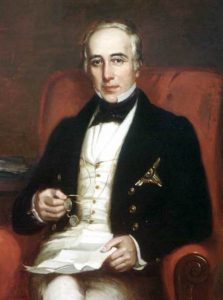
Sir George Arthur
In 1830, Forster decided to leave the army and subsequently sold his commission. He then sailed for Van Diemen’s Land in the hopes of getting a job in the public service. His wife and daughter accompanied him on the voyage. They arrived in Hobart Town on 23rd August 1831.
Lieutenant-Governor Sir George Arthur immediately asked Forster to join the committee inquiring into the treatment of the Aboriginals, and he accepted. A few months later, Arthur appointed him to the position of Chief Police Magistrate.
Forster immediately made himself familiar with all aspects of the Police Department. He was always insistent on efficiency from his subordinates, and he carried out his own duties impartially and capably. Despite this, the Secretary of State twice refused to increase his salary.
While Colonial Secretary John Montagu was on a leave of absence between 1839 and 1841, Forster acted in his place.
The Director of the Probation System
When the assignment system was abolished by the British government, Sir John Franklin (who had replaced Arthur as Lieutenant-Governor in 1837) appointed Forster as Director of the (new) Probation System.
As Director of the Probation System, Forster assigned some of the convict work gangs on works intended to develop the colony, but he found it difficult to control them due to the lack of suitable superintendents and overseers.
Eventually Van Diemen’s Land was increasingly saturated with unemployed convicts, and having failed to report clearly on the crisis, Forster was accorded some of the blame for the mismanagement of the whole convict establishment after 1841.
The Comptroller-General of Convicts
In 1842, Forster appointed to the new position of Comptroller-General of Convicts. The Controller-General was the head of the convict establishment in Van Diemen’s Land, and the position’s status was equal to that of the Colonial Secretary.
While Comptroller-General, Forster was constantly ordered to economise. He was also forbidden to employ convicts on useful works unless the colony paid for them, which it couldn’t afford to do. On top of this, there was a great increase in convict numbers between 1842 and 1844, and there was an insufficient number of superintendents to watch over them.
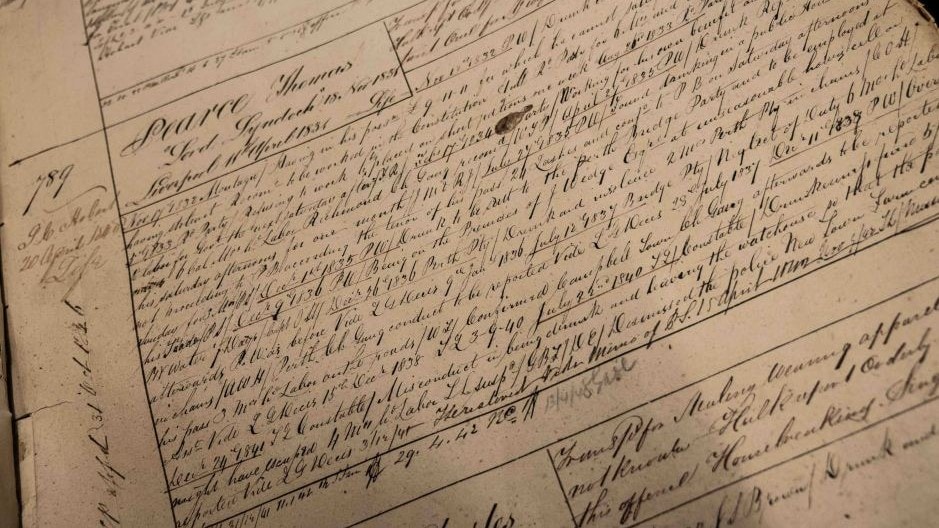
A convict record
Death and Legacy
Forster eventually started suffering from financial issues, and by April 1845, his health had deteriorated to the point where he asked for two years’ leave. But he passed away before this request could be accepted.
A.G.L Shaw summarises Forster’s career thus:
“A blunt, hard-swearing soldier, under Arthur’s strong rule he had shown himself a capable subordinate; given greater responsibility, under laxer supervision, his inability to regard the convict system as more than a job became more obvious and, whatever the defects of the probation system, he made little effort to correct them or even to make them known to his superiors.”
A monument to Forster’s memory stands in the churchyard of St John’s in New Town.