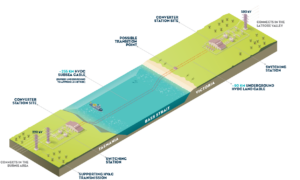

Marinus Link was confirmed today by the Australian Energy Market Operator (AEMO as a key part of Australia’s future energy needs.
AEMO released their Integrated System Plan (ISP) which outlines how Australia’s energy needs over the next 20 years will be provided. Marinus Link was confirmed in the ISP as proceeding to delivery – with timing as early as 2028-29 for the first of the two 750MW undersea Bass Strait Marinus Link interconnectors.
“Marinus Link will also unlock a pipeline of investment in renewable energy and long-duration energy storage with an estimated value of up to $5.7 billion and 2,350 jobs,” said Minister for Energy Guy Barnett.
“This means that resolution of a fair costing allocation for Tasmanians is an essential step in implementing this project.” He said government’s position was that Tasmania should only pay a fair share for what is “strategic national infrastructure benefiting the nation.”
Today’s report follows the Prime Minister’s announcement last month, that the Commonwealth would be providing additional resources to deliver the infrastructure sooner.
Early works for Marinus Link are expected to be completed by 2023-24, including land and marine surveys; technical design and engineering; detailed modelling and analysis; and significant community engagement in both Tasmania and Victoria.
Shadow Energy Minister David O’Byrne said until who will pay for the project is resolved, the cable is no closer to becoming a reality.
“The Marinus Link project is a unique opportunity for Tasmania to contribute to the nation’s future power needs and create much-needed jobs for Tasmanians,” O’Byrne said. “But before it can proceed the state government needs to answer some significant questions, chief of which is who will pay for the $3.5 billion Bass Strait cable.
“It is not enough for the government to say it will only pay its fair share – without understanding who pays what, it’s the equivalent of a blank cheque, with Tasmanian taxpayers footing the bill.”
He said that Labor supports more renewable energy jobs “but Tasmanians need to know that they will not be paying more for their power.” Until these questions are answered, in his view, the project is ‘going nowhere’.
Clark independent Madeleine Ogilvie MHA also welcomed the news, saying that Tasmania was ‘an expert in renewable energy’.
“It is critical that in moving forward on Marinus Link, that Tasmanians can have confidence that we both own and operate this important strategic asset,” she said. “What we need to see now is steps towards ownership without burdening Tasmanians with the majority of the cost.”
Hydro Tasmania Chief Executive Officer, Steve Davy, said the development was positive news.
“Alongside the Tasmanian government and TasNetworks, we’ve long been advocating for progressing the solutions the electricity market will need to support its transition to a very different future energy mix,” Davy said. “Together, Battery of the Nation and Marinus Link can play a critical role in that transition.”
Davy considers that the timeframes outlined in the 2020 ISP provide greater certainty for Hydro to continue progressing the Battery of the Nation project.
“The first 750 MW cable of Marinus Link will unlock the latent capacity of our hydropower system,” he said. “This represents hundreds of megawatts of existing, available capacity that can be delivered as soon as that cable lands, to support the market transition.”
“The second 750MW cable creates the opportunity for us to develop our first Tasmanian pumped hydro project so we can provide more of the cost competitive deep storage the future market will need.”
Battery of the Nation and Marinus Link are recognised in the Draft Tasmanian Renewable Energy Action Plan as engines for the state’s future economic prosperity and the path to Tasmania supplying even more clean, green energy to the nation, according to Hydro.
Community group Supporting Our Loongana Valley Environment (SOLVE) said it was a positive that the ISP contained the means to finally lay the foundations of coordinated planning of climate and energy policies at a state and federal level.
“The Step Change options within AEMO’s ISP make it clear that global heating and climate change are the drivers of change, and the need for speed of that change, but it is troubling that both state and federal governments have, so far, chosen to ignore this critical aspect,” said Chair Ben Marshall. “TasHydro’s support of the Marinus link is solely due to its commercial imperatives, and has little or nothing to do with the needs of Tasmanians.”
SOLVE continue to reject the proposed UPC-TasNetworks high voltage overhead transmission line through the Loongana Valley as “inappropriate infrastructure and unwarranted destruction to our environment and communities.”
“While corporate and political spin prevail, there is as yet no independent cost-benefit analysis that backs the market-led changes to our grid, or the claims of any long-term jobs beyond the building of infrastructure,” said Marshall. “The only plan we’ve found is the commercial building of that infrastructure, without linking it to community needs.”
Marshall said there was also a need to address TasNetworks’ conflict of interest in both designing the grid and profiting from building overhead transmission lines.
“Finally, even if there were merit to the current activity, railroading communities, and broadscale destruction of critical environments, including here in Loongana, is completely unjustified.”
SOLVE: 10 Questions for Marinus.
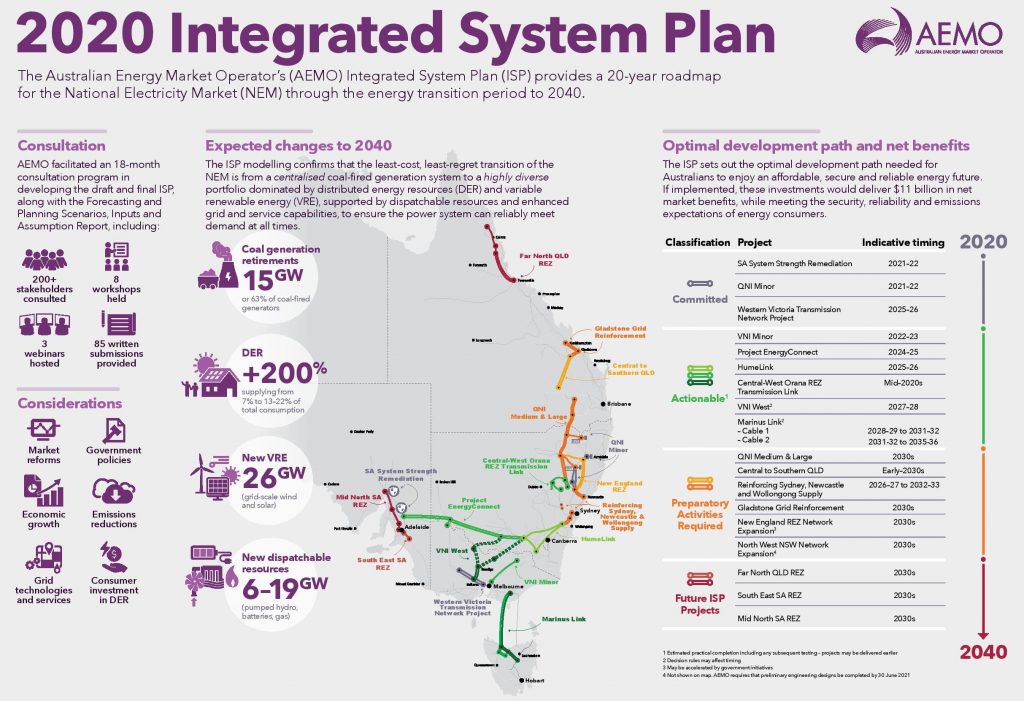
The Australian Energy Market Operator (AEMO) published its 2020 Integrated System Plan (ISP) here. The 2020 ISP identifies the optimal development path for the National Electricity Market (NEM) that will both maximise consumer benefits and deliver $11 billion in net market benefits to 2040.
AEMO’s Managing Director and CEO, Audrey Zibelman, said that the ISP undertakes a comprehensive review of the changes that are occurring in the electricity system and identifies the series of supply and network investments that can best meet consumer expectations of affordable and reliable electricity.
“The ISP analysis confirms that as our coal plants retire, the least-cost transition of the NEM will be to a highly diverse portfolio consisting of distributed energy resources (DER) and variable renewable energy (VRE), supported by multiple dispatchable resources,” Zibelman said.
“To enable the expected rise in renewable energy, the ISP identifies strategic investments in transmission infrastructure and renewable energy zones (REZs), which when coupled with low-cost firming resources, will be the most cost-effective way to add generation capacity and balance variable resources across the NEM.
“In progressing these projects, it is critical that the cost of building transmission lines is tightly managed to ensure consumers derive these benefits,” she said.
The work of producing the Final 2020 ISP has also highlighted essential market and regulatory reform needed to ensure consumers reap the benefit of the future power system.
“When implemented alongside market and regulatory reforms, the targeted transmission investments identified in the ISP will bring the right resources into the system in a timely fashion. This will create a modern, efficient and resilient energy system that delivers $11 billion in net market benefits weighted across the different ISP scenarios over the next two decades,” Zibelman said.
“The work of the Energy Security Board and market bodies on essential reforms to attract investment and optimise markets for emerging energy resources remains critical to ensure the consumer benefits of the ISP are fully realised,” she added.
Through extensive consultation, which included the publication and review of the Draft 2020 ISP in December 2019, AEMO considered many possible operating environments, transition scenarios and sensitivities to rigorously test and identify significant change in the investments needed for the NEM to 2040. These are broadly classified as:
- DER: expected to double or triple, providing 13 to 22 per cent of total underlying annual energy consumption.
- VRE: more than 26 gigawatts (GW) of new VRE is needed to replace coal-fired generation, with 63 per cent of coal-fired generation set to retire.
- Dispatchable resources: 6-19 GW of new dispatchable resources are needed to back up renewables, in the form of utility-scale pumped hydro, fast responding gas-fired generation, battery storage, demand response and aggregated DER participating as virtual power plants.
- Power system services: the growing need to actively manage power system services (voltage control, system strength, frequency control, inertia, ramping and dispatchability.
- The transmission grid: strategically placed interconnectors and REZs, coupled with firming resources, to add capacity and balance variable resources across the NEM.
Over an 18-month period, AEMO consulted on and developed the ISP that includes the least-cost investments to optimise net market benefits and deliver low-cost, secure and reliable energy through a comprehensive range of plausible energy futures for the NEM.
“AEMO thanks the hundreds of stakeholders that have contributed to this ISP and looks forward to working hand-in-hand with consumers, governments and the industry in helping ensure our energy system is affordable, secure, reliable and sustainable,” she said.
The 2020 ISP identified four categories of transmission projects ‒ committed, actionable, actionable (with decision rules) and future ISP projects ‒ permitted to be developed by the transmission network service provider through the Renewable Investment Test – Transmission (RIT-T) process.
Previously committed ISP projects include South Australian system strength remediation, the Western Victorian Transmission Network Project, and QNI Minor, which is the addition of 150 MW of capacity on the NSW-Qld interconnector.
2020 actionable ISP projects include:
- VNI Minor: a minor upgrade to the existing Victoria ‒ NSW Interconnector (VNI), which is close to completing its regulatory approval process, with project completion expected in 2022-23;
- Project EnergyConnect: a new 330 kV double-circuit interconnector between South Australia and New South Wales, which is close to completing its regulatory approval process. The project completion is expected by 2024-25;
- HumeLink: a 500 kV transmission upgrade to reinforce the NSW southern shared network and increase transfer capacity between the Snowy Mountains hydroelectric scheme and the region’s demand centres. This project commenced its regulatory approval process earlier this year, with project completion due by 2025-26; and
- Central-West Orana REZ Transmission Link: network augmentations to support the development of the Central-West Orana REZ. The project completion is due in 2024-25.
Two further projects are deemed actionable with additional decision rules:
- VNI West: a new high voltage alternating current (HVAC) interconnector between Victoria and NSW; and
- Marinus Link: two new HVDC cables connecting Victoria and Tasmania, each with 750 MW of transfer capacity and associated alternating current transmission.
Future ISP projects include major upgrades to the NSW-Qld interconnector, and grid augmentations in QLD, NSW and Victoria, which are all included in the optimal development path for the NEM.