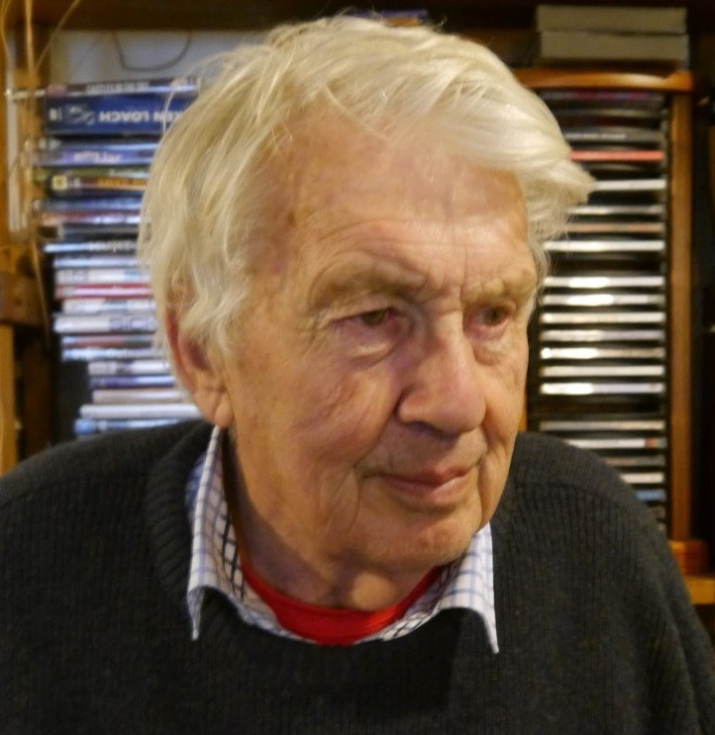
*New Zealand environmentalist Bill Benfield has tackled the country’s growing water crisis in his latest book Author Bill Benfield – “the matter is urgent”
New Zealand’s drive for more growth and more growth was akin to a “progress trap” with growth industries like large scale dairying killing New Zealand’s rivers says a New Zealand environmental author.
In his latest book “Water, Quality and Ownership,” W F (Bill) Benfield says an agricultural revolution has profoundly affected the country’s once free flowing and crystal clear rivers.
But he does not blame just agriculture.
“Although agriculture may be at the forefront of the water issue, urban areas are also contributing to the deteriorating environment.”
Bill Benfield cites the case of his region’s Ruamahunga River in the North Island’s Wairarapa where the deterioration had been for some time a combination of take for irrigation and town sewerage.
Further north near the city of Palmerston North the Manawatu River was tagged by a scientific institute as the dirtiest river in the Western world and it was that which galvanised Bill Benfield to research the topic. The deeper he delved and unearthed the magnitude of the erosion and its multi-causes, he eventually resolved to write a book on the topic.
He likened the government-backed pursuit of more and more corporate style dairying to “not just unsustainable agriculture but strip mining.” The current worsening state of New Zealand’s rivers was not an over-night happening but had been building up over recent decades.
Bill Benfield began to examine the rivers, turning over underwater stones to see the health of the larval insect life, known to trout fishers as ‘nymphs’ – a sure indicator of a river’s health. Not always was dairying near a stream devoid of aquatic life. He pondered that there was another cause and identified the likelihood that agriculture sprays were also a lethal factor.
“Selective herbicides to remove pasture weeds and potent organo-phosphates insecticides like diazinon used to control brown beetle are very probably adverse factors too,” he said. “Diazinon is listed as lethal to aquatic life.”
But he conceded that a lack of both research and water testing were inhibiting exactly identifying the causes.
“We just don’t know really what is going on,” he added.
Bill Benfield says Fish and Game NZ’s had blamed “dirty dairying” but that failed to acknowledge all factors.
“The trouble is that there are a lot more issues than dirty dairying.”
Bill Benfield says politicians have contributed by their championing of the mantra of growth and consequently falling into the “progress trap”. He targeted New Zealand’s Minister for the Environment Nick Smith as lowering river water standard classifications.
“The quick fix was just to wave the deteriorating water quality away,” he said.
Minister Smith changed water quality standards from “swimmable” to “wadeable and boatable.” But added Bill Benfield the water standards failed to take into account other water contaminants such as heavy metals like copper, lead and mercury.
In some cases demand from dairying and horticulture had drained under ground aquifers and caused rivers to run dry. The Selwyn near Christchurch once a revered dry fly trout fishing river was now often dry in summer.
“To be swimmable rivers, you need water,” dryly remarked Bill Benfield.
His book lets no culprits escape a blast. He charges commercial forestry with clear felling practices causing ‘silting and sedimentation” of rivers, a foreign owned salmon farmer King Salmon and foreign exploiters wanting to bottle water for export.
The best policy for New Zealand would be to stop land and asset sales (e.g. water) to foreigners and have a population policy that controlled growth to a level the environment can sustain.
“It’s a problem New Zealand has to urgently address and there’s not much time left to tackle it,” he concluded.
Footnote …
1. “Water Quality and Ownership” is available through Tross Publishing, Wellington, $20.
*Tony Orman (MNZIS) is a former town planner, life-long conservationist (‘wise use of resources’), journalist and author of over 20 books.