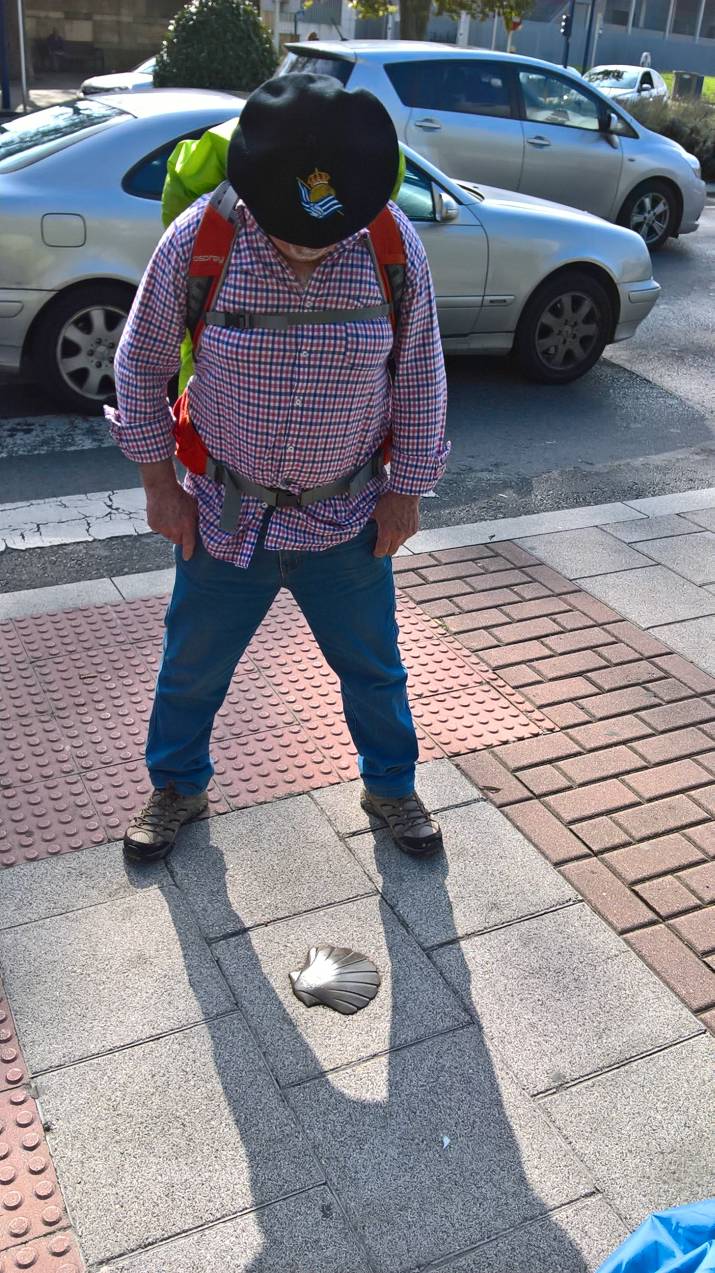
*Pic: The Field Marshall asks what is this? … The conche is used in cities to mark the way

Camino markers can be found up high

Camino markers can be found down low

Camino marks can be confusing

Camino markers can be repeated but they are always there

You can travel by bus or bike

You can walk or take a donkey

The Camino taken today

The Camino can take you through an old Roman mine

The only thing you cannot do on the Camino is fly

We walked through the hills to this beach, la Arena

And down this path on the Camino
The way is clearly marked and easy to find. The oldest person we have met was 80 years and thundering along with a six kilo backpack. We have turned Gonzo our Basque shopping trolley into a donkey and on the flat sections he now carries our fifteen kilos, strapped to his back. I whip him along at a furious pace of 3 kmh. The little fascist has saved our knees, feet and legs. He knows better than to complain or we won’t talk to him politely.
I have included photos of the many different markers, sometimes we have to search for clues like in a Dan Brown novel, but it is impossible to get lost and enter perdition, yet it is probable we already are lost.
Our youngest Camino Santiago friend is 7 year old German traveling with his Dad, a little inquisitive fellow, amazed that I could count to ten in English, just like he could.
We have been told that the northern way, which is along the northern coast and the one we are travelling, El Norte is the quietest Camino to travel and that the main way is a zoo, roughly about 100 km from entering Santiago de Compostela. Hundreds of Mericans and some Aussies going through a sixty year olds, middle class rite of passage. We haven’t met any other Australians. The Field Marshall is on that path and has lost a notch on his belt. Now wearing a Real Sociedad FC beret and a smile bigger than a headland, all his fears have left him and he is relaxing. I am buggered, carrying him and Gonzo from hillside to beach.
The cost of the Auberges or hostels can vary from a donation to 20 euros. Some are private and they cost, some by the various churches are donation and others run by the municipality are cheap. We eat in the tabernas, the food is cheap and the good vino blanco about 7 euros ($10) a bottle. The daily cost is about $40 per day to eat, drink and sleep.
I am not a purist, with aluminium walking poles, the best boots, freeze dry hiking clothes and medical kits, after hitch hiking from Sydney to San Jose, Costa Rica in my 20s, I can still see myself sleeping under a bridge or on a church veranda. The Field Marshall prefers a five star monastery, the Mercure.
Today we left Bilbao and walked until 7pm, now eating and drinking with Franscisco, who is walking all the way. A kid from Oregon, smart, perplexed and pleasant company.
Pliny describes in 77 AD travelling the same path, past the iron ore mines on our way today, its that old. We take the public transport through the cities, interesting, but one cities industrial zone blends into another industrial zone, just like the other. The Spanish eat after 8pm at the tabernas and when in Spain …
To be continued …
*Greg James is a malcontent capitalist. He has employed (and fired) a lot of people and spawned many business opportunities for himself and others. Some have been wild successes and some abject failures. Greg refuses to accept that Tasmania is second rate, it is only the people who occupy it who are second rate. Greg is a self and state educated owner-operator. He has been Chairman and President of State and Federal organizations, has owned a gay bar, built a suburb and wasted his life hoping that others around him would see the light as he see it. His brain is addled, his motives suspect and age has caught up with a life well lived. He writes about himself in the third person.