As a perpetual contributor to Hobart City Councils coffers via the ruthless parking fine regime, I consider myself as a small shareholder of Myer’s new Hobart store.
In my defence it’s generally not the case that parking meters went unfunded by the shrapnel in my back pocket that persistently threatens to subject me to an uncomfortable future as a sufferer of sciatica. More accurately, in an uncertain world, whereby many variables are outside one’s control, returning to one’s personal parked contribution to a warmer Tasmania in a timeframe that is not typically five minutes outside my statutory allotted timeframe is, more often than not, a bridge too far!
Now regulars to Hobarts increasingly vibrant CBD don’t need me to tell them that five minutes is more than enough time for every available council parking officer to descend upon said dinosaur of the Anthropocene (I’ve always preferred motorcycles anyway) and each leave a subscription for more Myer shares under my windscreen wiper.
So it is with great delight that one of the doyens of Hobart’s local dwindling industry (apparently if its not tourism related then its inconsequential to our collective futures), Bob Clifford of the annoyingly persistent boat building sector, has floated the not so new idea of a citywide ferry service.
And here I use the term citywide deliberately as any cursory glance at google earth will demonstrate that Hobart suburbia is little wider than her central artery – the Derwent River or Harbour as I prefer to call it beyond the Hawke government gift that is the Bowen Bridge. Indeed the width of the Derwent Harbour between Taroona and Lauderdale would be greater than the distant for most residents from their little patch of suburbia to the Derwent’s foreshore.
In the mighty Derwent (ok that might be hyperbole) we have a ready-made gift from glacial forces for our progressively annoying traffic snarls – surely a term coined from the expression on the faces of most drivers.
And it is here that I must declare my own self-interest, other than not wanting anymore Myer shares. A couple of rotations of the earth around the sun ago, back when I annoyed policy makers as an employee of a prominent ENGO, I researched, advocated and promoted this issue. That is prior to the scant funds, that permitted me a wage that was frankly below the poverty line, ran dry.
It was a fortuitous time to focus on public transport, not least because at the time the Tasmanian Legislative Council was in the throws of an 18 month long investigation into the Integrated Sustainable Public Transport System in Southern Tasmania.
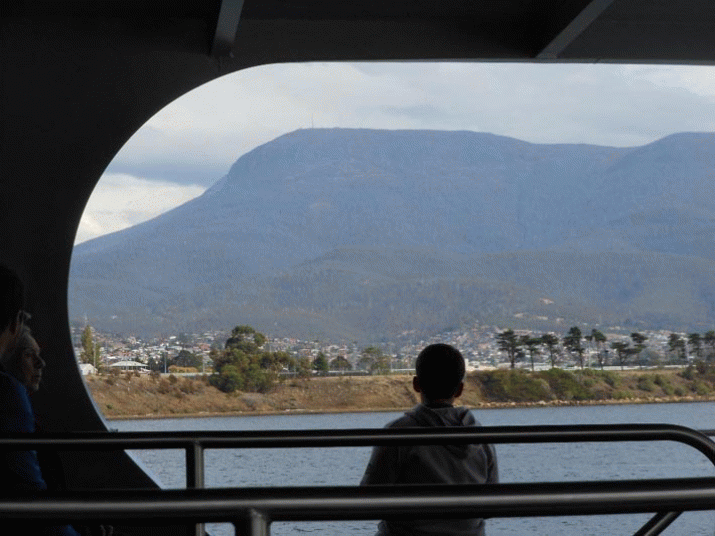
As part of the campaign to highlight the potential viability of a sustainable and integrated ferry service for greater Hobart, I organised with the very kind support of the operators of Mona’s successful ferry an invitation for interested Legislative Councillors and relevant Council Mayors and Alder[people] to a sea trial of MR1 to Kingston Beach and back to demonstrate the capacity of a modern ferry to navigate this passage in a very timely manner that would challenge the time frames of driving a vehicle even at a relatively clear time of the day. The journey from just off Kingston Beach to the Brooke St Pier took 16 minutes at about 60% of full power.
Now while not all invited attended, I suspect being very suspicious of working with an ENGO, to the credit of those who did, some remain prominent advocates for a ferry service a number of years later across the political divide at both local and state government .
And why wouldn’t they? Our research (based partly on previous government research) at the time had identified that the wharf infrastructure required for a widespread network North, South and East of the CBD would cost between $20 and $30 million. As a point of reference the then newly completed Kingston Bypass (two kilometres of two lanes of road) cost $42 million.
The reason I mention this above pleasant journey on the Derwent harbour back in 2013 is to highlight a couple of critical issues that were discussed amongst those who attended. Those issues being that if a ferry service is to remain sustainable for greater Hobart then the following issues amongst others need to be considered and addressed;
1. Instilling a culture of public transport in greater Hobartians who are currently welded to their cars (traffic jams will help this greatly);
2. Limiting innercity carparking to its current generous capacity;
3. Ticket pricing that is commensurate with bus transport;
4. Integrating bus transport with ferry hubs, i.e. a resident of Snug catches a bus to a wharf at Blackmans Bay to ferry into the CBD;
5. Integrating ticketing and timetabling between the above two modes of public transport;
6. Providing sufficient integrated bike storage and promotion of these dual modes of transport;
7. Ferries that are relatively efficient, fast and time competitive;
8. Creating a private/public investment strategy (also proposed by Bob Clifford) whereby public funds build the relatively modest wharf infrastructure and the private sector provides vessels and the operation of the service; and
9. Appropriate scheduling of services that saw a concentration of services at the peak times of the day and a rationing of services during quieter periods, whereupon some buses could revert to full service to the CBD. This would first and foremost be a commuter service.
At the time the above Legislative Council Committee was investigating sustainable public transport options for Hobart they visited our windblown cousins in Wellington, New Zealand to examine their small but successful east-west ferry service in a similar if not smaller size city. Yet again our Trans-Tasman cousins lead the way in the progressive stakes.
There will be no end of naysayers who say it can’t be done, my favourite being the ones who claim the Derwent to be the most treacherous body of water on the planet that will render ferries inoperable for a large portion of the year.
It may surprise these people that Sydney harbour experiences larger swell pushing through its heads than the Derwent and this has proven no barrier to a ferry service. Of course there are issues around the threshold of patronage and population that would make such a service financially viable but I think many would agree that point is approaching rapidly.
Lastly, a ferry service should not be seen as a political opponent to a northern suburbs light rail. Both are possible into the future, but at the end of the day a northern suburbs light rail is just that, while a ferry service accesses the full gamut of transport corridors accessing Hobart.
Seriously, an integrated and comprehensive ferry service is a no brainer for our little patch of North America and my increasingly problematic parking fines and associated shares in Myer along with those other little issues around traffic congestion, energy consumption, atmospheric pollution, and public amenity.
Amongst other things Shane Humphreys is a freelance journalist who lives more than a walk away from Hobart.