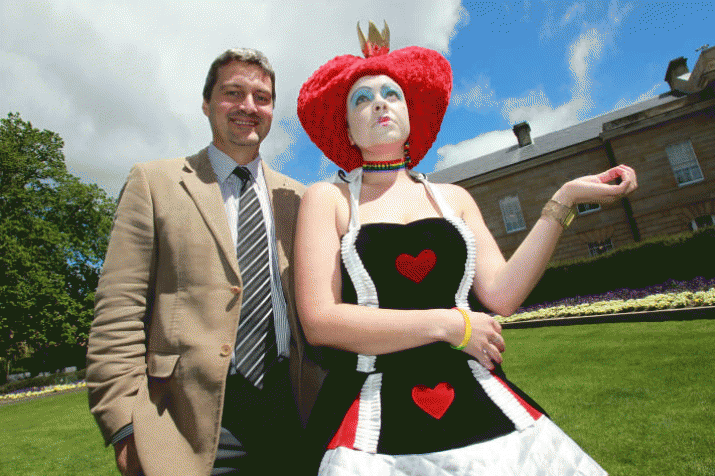
Rodney Croome with the Red Queen from the launch of the TasPride Festival at Parliament House yesterday.
After narrowly voting down the Tasmanian Same-Sex Marriage Bill last year, eight votes to six, the state Upper House has voted, by the same margin, against an attempt to bring it back for further debate in the light of developments since that time.
The developments include the passage of legislation in the ACT, New Zealand and the UK, the election of a federal government unfriendly to the issue and new information from legal experts about the constitutional issues raised by the Bill.
One of these experts was Bret Walker SC, the nation’s most senior constitutional barrister and someone Legislative Councillors hold in high esteem. His view was definitive and unequivocal; the Tasmanian Bill is constitutionally valid.
This last point is important because the constitutionality of the Bill was one of the key reasons many MLCs voted against it last year.
But some MLCs seem to have conveniently forgotten that this was one of their main concerns.
Now they have put a raft of other concerns front and centre, including the need for “nationally consistent” marriage laws, a perceived lack of community support for reform, the High Court case against the ACT’s marriage law, the perception that a state law isn’t true equality and the astounding idea that state law allowing same-sex couples to marry will actually worsen discrimination against these couples.
I’m not saying these weren’t mentioned last time, just that they paled next to the then-all-important and now-almost-forgotten constitutional question.
As one my colleagues quipped, the Legislative Council is made up of Red Queens who capriciously change the rules of the game whenever an end is in sight, leaving marriage equality advocates running as hard as we can just to stay in the same spot.
I can see how that image may reassure those upon whom the defeat weighs heavily, but it’s not one that gets us very far in understanding Upper House members’ motives, or moving marriage equality forward.
Many Tasmanians will assume prejudice is the real unstated motive of some Upper House members.
I’m not so sure. They voted overwhelmingly earlier this year to allow same-sex couples to adopt, arguably a more contentious reform in their eyes because it directly involves children.
The difference between the two issues was that the Liberals had a conscience vote on adoption but not marriage.
A Liberal conscience vote was also what got the decriminalisation of homosexuality over the line in the Upper House in 1997.
It seems the Liberals are the key to this reform, making it crucial to secure a marriage equality conscience vote from them in the lead up to the March state election.
This looming election probably also figured in the Upper House decision.
I assume some of them figured voting down the Bill was the easiest path forward because a Liberal majority government after March will rid them of the issue for years to come.
If that’s the case, it’s a delusion.
A minority government supported by a mix of cross-benchers is just as likely as a majority government.
Given rapid developments on this issue locally, nationally and internationally, it is inevitable the Bill will return to be debated in one or both houses soon after the election.
Until then, the job is to muster as much community support as possible to show Upper House members who oppose the Bill they are out of step.
Polls show majority support in Tasmania. It’s time for that majority to be more visible. It’s time for a broad-based community coalition for marriage equality.
• MLCs who voted against further debate on the Same-Sex Marriage Bill: Rosemary Armitage, Ivan Dean, Adriana Taylor, Vanessa Goodwin, Leonie Hiscutt, Paul Harriss, Greg Hall and Tania Rattray.
• MLCs who voted for further debate: Ruth Forrest, Mike Gaffney, Kerry Finch, Rob Valentine, Craig Farrell and Tony Mulder.
As president, Jim Wilkinson didn’t vote.
• Rodney Croome: O’Farrell has ‘moral responsibility’ to act on same-sex marriage