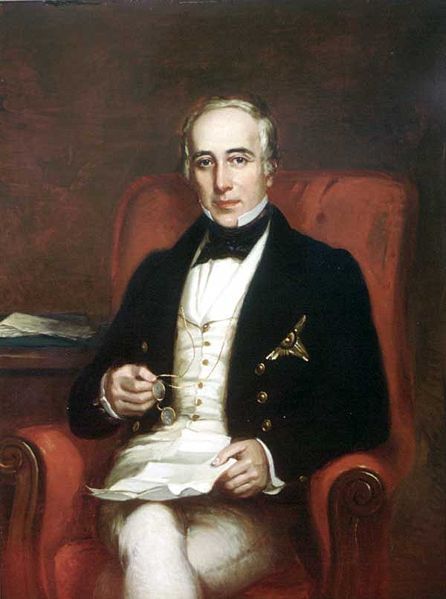
Lieutenant-Governor George Arthur ‘was delighted with someone who could deliver such a thunderous declamation about the evils of alcohol …’
Launch speech, John Biggs, Tasmania Over Five Generations: Return to Van Diemen’s Land? (Forty Degrees South Publishing, Hobart 2011)
Compared to the Thornes, the Biggses are Johnny-come-latelys, but what’s a generation or two compared to the millennia of sustainable habitation of this island which the arrival of such families interrupted such a relatively short time ago? Abraham Biggs and Samuel Thorne both arrived here with the intention of exerting some influence for what they perceived as the good of the settlement, one of the most isolated and godforsaken of Britain’s imperial outposts.
In the case of Abraham, the patriarch of the family whose chronicle this book is, it was the desire to spread the message of the Wesleyan faith and lifestyle. Marine Corps sergeant Thorne’s job was to help impose a more secular kind of authority, but that’s another story. Whatever one might think of the whole colonisation project, one has to admire the audacity of anyone who would sail halfway round the world into an entirely unfamiliar environment with only the sketchiest idea of what awaited.
This book is much more than a family history. What underpins it is the continuing interplay between each generation of the family and the political and social context in which those family members operated. We all inherit certain values and ways of looking at the world from our parents, but our own attitudes develop through a more complex and subtle combination of circumstances and experiences. The Biggs family demonstrates this.
Abraham Biggs in the 1830s had the autocratic and corrupt administration of Governor Arthur to contend with. Young John Biggs in the 1940s had the institutionalised bullying and petty tyrannies of a private school. Both survived and went on to succeed despite these adverse climates. In between, the various Biggses dealt with the deeply embedded faults of the Tasmanian system of governance in their own ways, from Alfred’s vehement denunciation of the injustices he met at the hands of an incompetent and self-serving bureaucracy to Walter’s unreflecting Anglophilia and conservatism and Oscar’s retreat into music and alcohol.
When it comes to the current generation, the political issues understandably receive closer attention. Corrupt and authoritarian politics were perhaps to be expected in an out-of-the-way colony in the 19th Century, but the strong message of this book is that Tasmania has never emerged from the secrecy, the favouritism, the graft and the injustices that characterised Van Diemens Land. As John points out, Governor Arthur would fit perfectly well into a 21st century Tasmanian Cabinet or Shadow Cabinet. Equality before the law was a concept that Arthur had no time for, a concept that didn’t seem to inform the deliberations of the Board of Education concerning Alfred Biggs forty years later, nor those of the University Council concerning Professor Sidney Orr during John’s undergraduate days. It is a concept that has been well and truly trashed in the infamous Clause11 of the Pulp Mill Assessment Act of 2007.
John devotes roughly the last quarter of the book to the last decade or so. It makes for grim reading. Mainly through the conduits of the forestry industry and Federal Hotels’ poker machine monopoly, successive state governments have been crucial actors in the process of delivering their citizens’ wealth to the corporate sector. Successive elections have shown that the majority of Tasmanians have no problem with this, presumably because they are happy with the occasional crumbs that fall from the table at which their superiors dine. Nor have most contemporary Tasmanians viewed the endemic violence that permeates our culture with any less equanimity than their ancestors did a couple of centuries ago.
We are, after all, as the book makes clear, albeit indirectly, in large part descended from those who themselves were swept away from Britain as surplus to requirements, the human detritus of the social and industrial upheavals of the late 18th and early 19th centuries. There were not too many convicts involved in what John refers to (from Governor Arthur’s point of view) as “bleating…about free speech” in Van Diemens Land in 1836. We knew our place then, and, apart from those who chose bushranging (basically a romanticised form of bullying), were grateful for it. The alternatives, after all, were worse misery or death.
We know our place now, and know that the best we can hope for in our democracy is the chance every few years to change the names and faces of those who, with almost identical policies, continue to give our money away to their masters, to those who make the real decisions that affect our lives. The alternatives today are neither the gallows nor the torture chambers of Port Arthur, but the massive unemployment, gutted public services and declining public health that would accompany a major economic depression.
John Biggs is one of the few who dare to hope for more than this. In this book, as well as in his writings elsewhere, he exposes the mendacities, the injustices and the sheer incompetence of some 180 of the 209 years of whitefella power on this island. But he does not stop there. He points out (and I quote from page 258) “Ecological sustainability is today the pivot on which the world’s future swings.” On page 332 he has a wish-list of policies for a government to adopt and put into practice. Whereas Abraham Biggs demonstrated his audacity by setting out into the geographical unknown, his great-great-grandson demonstrates his by daring to propose a more compassionate, transparent and sustainable future in the face of vested interests which are in many ways even stronger and more ruthless than those which informed the British Empire at its height.
Abraham, the non-conformist lay preacher, fulminated against the situation of a people being so alienated that they rarely rose out of the slough of alcoholic torpor. I fear that John’s hopes for those whose torpor is more variedly induced, including as it does the effects of various other drugs, mindless television, addictive gambling machines and as many more opiates as our society can produce, may be as vain as his ancestors’ proved to be. Of course I hope not, but hope on its own is just another opiate.
Perhaps the realisation that an economy based on the prospect of unlimited growth, and the political superstructure that such an economy both needs and creates, is a fantasy, a dangerous and destructive fantasy, might take hold in time to avert a completely catastrophic future. Perhaps. John refers to Antonio Gramsci’s concept of “cultural hegemony” and describes how it operates in Tasmania to work against good sense in public policy. It is worth remembering that in Abraham Biggs’s time there was a greater variety of news and information media than for most of the period since. The fact that that particular pendulum is now swinging back the other way, with the availability of a myriad of views and a cornucopia of information thanks to contemporary technology, might be a saving grace.
That is the most positive note on which I can conclude: that and the thought that from time to time in various places people have been inspired by history and by rational analysis of their circumstances to effect massive changes. The more people who read this book and the history and analyses it contains, the greater the chance of such vitally necessary change taking place here. I can think of no better reason to buy, read and discuss Tasmania Over Five Generations, and so I am pleased to launch it and commend it to you.
Tim Thorne
Launceston
3 February 2012
• The book was also launched in Hobart on Saturday by Andrew Wilkie