I have recently been in Turkey on business visiting Miletus and Ephesus, both cities famous for their Greek and Roman ruins.
This prompted me to consider the reasons behind their ruination.
Miletus (like Launceston on the Tamar River) is on the Meander River and was once one of the most important cities in the ancient Greek world.
Its decline was due to the silting up of its harbour caused by the logging of the headwaters of the Meander River which gave it its access to the sea.
St. Paul’s letter was written at Ephesus, another superb Greek and Roman city, then also in the process of losing its access to the sea due to the silting up of the river from exactly the same cause.
I suggest that the fact that two of the great Greek and Roman cities in world history lost their access to the sea and thence their relevance and financial security due to the logging of their head waters some 2000 years ago, should provide a lesson for the God/Gay/Gunns/Forestry Tasmania-worshipping citizens of Launceston.
The only problem to attracting tourists some 2000 years from now to Launceston is that we are slightly lacking in Greek and Roman ruins, but if its any consolation to Emperor Justinian/Julian Amos, we will still have a silted up and meandering river.
Picture, Above: Bay of Lions Monument: From HERE:
Miletus was located on a small peninsula that jutted from the south into the bay of the Meander River. The ancient bay made an obstacle for direct land travel from Miletus to Ephesus. Today, Miletus is 5-6 miles (9-10 km) away from the Aegean Coast because silt has filled the bay. Direct travel between Miletus and Ephesus is now possible on dry land. The southeastern extremity of the ancient bay is now a lake (Bafa Golu).
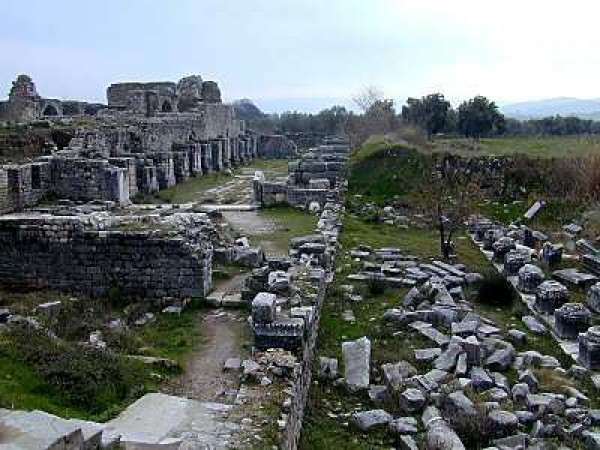
Roman Bathhouse: Archaeological work has been done mostly by German teams. In 1899, excavations began by the Berlin Museum. Professor Wiener of the German Institute of Archaeology is supervising the most recent excavation and restoration work. Like all Roman bathhouses, this bathhouse had an apodyterium (dressing room), a frigidarium (cold room), a tepidarium (warm room), and a caldarium (hot/steam room). Here there was also a broiler room and exercise area; statues of Greek gods were located in the halls.
And, Launceston …

Meanwhile, Clive Stott, http://www.cleanairtas.com , on another impact of logging, for him a particular, deadly horror: smoke …
Whilst Tasmania has the highest rate of asthma in Australia, the forest industries continue to burn their waste and the Asthma Foundation (Tasmania) refuse to lobby on behalf of its members to stop the smoke at the source. http://www.cleanairtas.com/asthma.htm
Instead, AFT prefer to see asthmatics affected by the smoke put on medications to control their symptoms so forestry can keep on burning.
This practice can bring additional life-threatening risks to asthma suffers according to the following information:
The U.S. Food and Drug Administration (FDA) recently issued new restrictions for four popular long-acting asthma drugs. Novartis AG’s Foradil, GlaxoSmithKline’s Serevent and Advair, and AstraZeneca’s Symbicort, all contain an ingredient that relaxes airway muscles in the lungs which can cause asthma-related death. If not accompanied by other asthma drugs to offset this life-threatening side effect, the consequences could be fatal.
It defies logic to try to figure out how asthma drugs that can kill people by causing severe asthma attacks are considered to be useful and effective medicine
It is unclear from the agency’s press release exactly how it intends to strengthen the drugs’ current death warning.
Since 2002, the FDA had continually rejected all of the overwhelming evidence presented to it that LABAs are inherently dangerous. Only in 2008 did the FDA first admit that the drugs were dangerous, particularly for children and some adults. Prior to that, the agency seemed to be in agreement with a series of industry spin pieces concocted by the drug industry to defend the alleged safety of the drugs; this alone exhibits the FDA’s lunacy in asking the industry to conduct more of its own safety studies.
While warning that the drugs should only be used “as necessary” seems like a step in the right direction, the FDA should be taking a leap to pull these drugs off the market. Many experts agree that these drugs are wholly dangerous, and that the industry has been aware of these dangers for nearly a decade. Once again, the FDA is giving lip service to the public it is supposed to be defending while protecting drug industry interests instead.
The full article can be found: HERE